

ROGER CRAWFORD
When Britain’s economic landscape is surveyed today, the sense of déjà vu is overwhelming. It feels eerily like the 1970s, when socialist governments piled tax upon tax, inflation eroded wages, industries were strangled by regulation, and Britain staggered into the arms of the International Monetary Fund, forced to beg for loans just to keep the lights on. Back then, the rhetoric was the same: higher spending would fix the services, more intervention would solve industrial malaise, and ordinary families had to accept higher burdens “for the common good.” We know how that ended. It ended with humiliation abroad and stagnation at home, until Margaret Thatcher swept to power and cut through the rot with policies that trusted the people, rewarded enterprise, and restored pride in the nation.
And yet here we are again, half a century later, watching another Labour government make the same mistakes and worse. For this is not simply economic mismanagement. The decisions being made are so counterproductive, so destructive of growth, so hostile to the very idea of self-reliance, that they cannot be understood in isolation. Either we are governed by incompetents of historic calibre, or there is a hidden purpose: to weaken Britain until it begs to be taken back under the wing of Brussels.
The evidence is plain. Labour’s tax policies hit at every level. Income tax thresholds are frozen so that inflation drags millions into higher bands. Capital gains and inheritance tax are altered to strip wealth from the prudent. Business rates rise, crushing the high street. This is not targeted redistribution from the very rich; it is a broad-based assault on middle-class aspiration. A young couple saving to buy their first home are squeezed by higher rents, higher mortgage costs, and higher taxes. A retired teacher who hoped to leave her modest semi-detached house to her children finds the Treasury ready to take a large cut. A self-employed builder, already struggling with material costs, discovers his tax bill rising even as his real income falls. These are not oligarchs. These are the people who keep the country running.
Meanwhile, Labour presides over the managed decline of British industry. Look at Port Talbot. For generations, the blast furnaces of South Wales poured out the steel that built ships, railways, bridges, and the very skeleton of modern Britain. Now those furnaces face closure, replaced with electric arc alternatives that require far fewer workers and depend on scrap imports. Tata Steel says this is about decarbonisation, but everyone knows the truth: energy prices in Britain are so inflated by green levies that producing virgin steel here is uneconomic. The government prefers to boast about carbon targets than to defend an industry essential to sovereignty. Without primary steelmaking, how will Britain arm itself in time of war? Will we order tanks and warships from abroad? What self-respecting nation chooses that fate?
Or consider Britishvolt, once hailed as the flagship of a “green industrial revolution.” This company was supposed to deliver a domestic battery industry for electric vehicles. Instead, it collapsed into administration in 2023, a casualty of confused government policy, unreliable subsidies, and the impossibility of competing with state-backed giants in Asia. Carmakers such as Ford and BMW openly warned that Britain’s erratic approach to the EV transition made long-term planning impossible. Deadlines for banning petrol and diesel cars were set, then moved, then set again, as ministers lurched between ideology and reality. Meanwhile, ordinary motorists are left in limbo, unsure if the family saloon will soon be outlawed, and facing costs they cannot afford. Charging infrastructure remains patchy, the national grid groans under strain, and the very metals required for batteries are controlled by regimes hostile to Britain’s interests. Yet the government presses on, blind to common sense.
Farming is treated with the same contempt. British farmers are told to tear out hedgerows, rewild fertile fields, and chase environmental subsidies instead of feeding the nation. Imports of lamb from New Zealand and fruit from Spain undercut domestic producers who struggle with labour shortages, energy bills, and ever more onerous inspections. Farmers’ protests have erupted, tractors blocking roads in anger at being forced to go broke in their own land. Is this the independence voters chose in 2016, to import our food while British fields lie fallow? What happens when global supply chains falter, as they did during the pandemic? Will Britain discover too late that sovereignty without food security is a sham?
Small businesses fare no better. Across the land, pubs are closing at record rates. The public house, more than just a business, a community centre and cultural treasure, is being strangled by soaring energy bills and punitive taxes. A landlord in Yorkshire saw his annual electricity bill rise from £20,000 to £65,000 in two years, a figure that no amount of pints could cover. Breweries collapse, high streets hollow out, and yet Labour piles on further regulations in the name of Net Zero. Shops, cafes, workshops, all report the same: costs rise, margins vanish, and government indifference reigns.
And what of energy itself? Britain sits on vast reserves of North Sea oil and gas, yet Labour is determined to shut them down. Instead of supporting domestic extraction, it imports liquefied natural gas from America, at a far higher cost. It bans new coal, yet buys steel produced abroad with dirtier processes. It boasts of closing mines while importing materials from countries with lower standards and weaker protections for workers. This is not environmentalism; it is economic self-harm dressed up as virtue.
The costs of Net Zero are staggering. The Office for Budget Responsibility estimates – almost certainly conservatively – that the transition will cost over £800 billion by 2050. That is more than the entire NHS budget for a decade. And yet even this sum does not include the hidden costs borne by households and businesses in higher bills, lost jobs, and reduced competitiveness. The government waves away these numbers, insisting that green industries will create new wealth. But the flagship projects keep collapsing, from Britishvolt to carbon capture schemes that vanish into thin air. What is left is an energy system more expensive, less reliable, and increasingly dependent on foreign suppliers.
Some argue that this is simply incompetence. But the economic illiteracy is surely too great even for the immature champagne socialists running the country. It must, surely, be deliberate. For a Britain reduced to weakness, dependent on imports, shorn of industry, and taxed into submission, is a Britain that can be persuaded it made a mistake in leaving the EU. Labour leaders insist they will not rejoin, but they constantly speak of alignment, of smoothing relations, of being “good Europeans.” They deny the end while pursuing every step towards it. If independence can be made unbearable, then re-entry—or something close to it—can be sold as relief. And don’t think they wouldn’t reduce you to poverty to further their ideological goals.
And let us not absolve the Conservatives. Their record is scarcely better. They too raised the tax burden to levels unseen since the war. They too embraced Net Zero without a plan for industry. They too presided over collapsing productivity, endless bureaucracy, and a betrayal of Brexit’s promise to cut red tape. They boasted of deregulation, yet exporters found themselves smothered in paperwork. They spoke of “Global Britain” while failing to defend domestic producers. They opened the door, and Labour now pushes it wide.
The historical parallels are stark. In the 1970s, Britain was told that higher taxes and greater state control would revive the economy. Instead, inflation raged, strikes paralysed the nation, and the IMF had to be called in to bail us out. Sovereignty itself was compromised. It took Thatcher’s courage to reverse course, to slash taxes, curb union power, privatise failing industries, and trust the people to build prosperity. Today, we face the same choice. Either we continue down the path of high taxes, collapsing industries, and creeping foreign dependence, or we take the Thatcherite road once more—trusting enterprise, rewarding effort, and defending sovereignty.
Brexit was supposed to be the modern equivalent of that turning point, a chance to break free from the bureaucratic straitjacket of Brussels and chart our own course. Instead, successive governments have squandered the opportunity, unwilling to diverge and afraid to unleash the power of independence. Now Labour threatens to undo even what has been gained, not with a dramatic re-entry but with a slow erosion of independence, hidden beneath the fog of economic decline.
Patriots must not allow this. The people voted in 2016 to leave the European Union. They were promised control over laws, borders, and money. That promise must be honoured, not whittled away. Sovereignty means the right to shape our own tax system, to produce our own energy, to defend our own industries, to feed our own people. It means rejecting policies that make us dependent on imports, on subsidies, on foreign diktats. It means standing up to those who would use economic misery as a lever to drag us back into Brussels’ orbit.
The remedies are clear. Taxes must be cut, not raised. Income thresholds must be unfrozen, inheritance tax abolished, business rates reduced. Energy policy must prioritise affordability and security, with new nuclear and continued oil and gas extraction. Farming must be backed to feed the nation first, not sacrificed for fashionable but absurd environmentalism. Industry must be shielded during transition, not left to collapse.
Britain has faced decline before and risen from it. In the late 1970s, few believed the country could be turned around. Yet within a decade, thanks to bold leadership and faith in the people, Britain became the most dynamic economy in Europe. We can do it again. But only if we reject the path of sabotage disguised as policy, only if we resist the drift back to Brussels, and only if we remember that sovereignty is worth sacrifice.
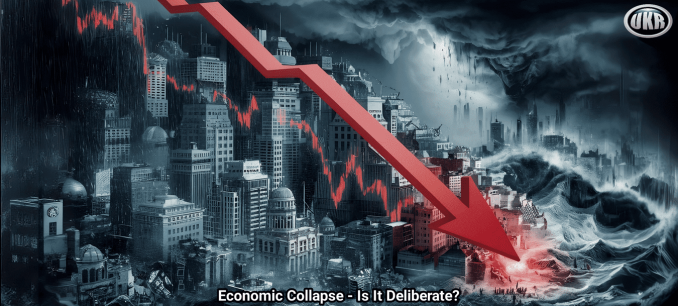
This article (Economic Collapse – Is It Deliberate?) was created and published by Free Speech Backlash and is republished here under “Fair Use” with attribution to the author Roger Crawford

••••
The Liberty Beacon Project is now expanding at a near exponential rate, and for this we are grateful and excited! But we must also be practical. For 7 years we have not asked for any donations, and have built this project with our own funds as we grew. We are now experiencing ever increasing growing pains due to the large number of websites and projects we represent. So we have just installed donation buttons on our websites and ask that you consider this when you visit them. Nothing is too small. We thank you for all your support and your considerations … (TLB)
••••
Comment Policy: As a privately owned web site, we reserve the right to remove comments that contain spam, advertising, vulgarity, threats of violence, racism, or personal/abusive attacks on other users. This also applies to trolling, the use of more than one alias, or just intentional mischief. Enforcement of this policy is at the discretion of this websites administrators. Repeat offenders may be blocked or permanently banned without prior warning.
••••
Disclaimer: TLB websites contain copyrighted material the use of which has not always been specifically authorized by the copyright owner. We are making such material available to our readers under the provisions of “fair use” in an effort to advance a better understanding of political, health, economic and social issues. The material on this site is distributed without profit to those who have expressed a prior interest in receiving it for research and educational purposes. If you wish to use copyrighted material for purposes other than “fair use” you must request permission from the copyright owner.
••••
Disclaimer: The information and opinions shared are for informational purposes only including, but not limited to, text, graphics, images and other material are not intended as medical advice or instruction. Nothing mentioned is intended to be a substitute for professional medical advice, diagnosis or treatment.
Disclaimer: The views and opinions expressed in this article are those of the author and do not necessarily reflect the official policy or position of The Liberty Beacon Project.


Leave a Reply