

TOM ARMSTRONG
For most of human history, political power was a matter of geography. The Crown or Parliament in Westminster was, to all intents and purposes, remote to the majority of the people. Decisions handed down from London might take weeks to arrive in Yorkshire, Cornwall, or the Highlands, and still longer to make their effects felt. Government was not simply remote in spirit, but remote in fact.
So is it not strange that in an age when a message can travel the globe in less than a second, we still cling to a centuries-old model of centralised power? Why, in an era of instant communication, decentralised finance, instant communication and artificial intelligence, do we persist in allowing a handful of ministers – career politicians – and an army of arrogant mandarins in Whitehall to run the lives of seventy million people, often in ways the vast majority of those millions disapprove of?
So here I ask a question hardly never asked: Do we still need “government” as we know it? Is the centralised State, with democracy heavily qualified by the inaccurate word ‘representative’, its archaic practices, bloated bureaucracy and self-perpetuating ‘elite’ anything more than an anachronism, a hangover from horse-and-carriage times? And could we, the people, using modern technology, do a better job without it?
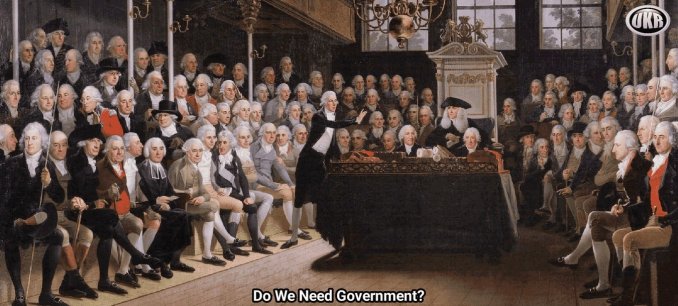
It is worth reminding ourselves why government assumed its present form. Before the railways, before the telegraph, before cheap print, a central authority was logistically necessary. The Crown required a network of sheriffs, clerks, and magistrates because the physical act of conveying orders and collecting taxes was slow, difficult, and local. Even representative democracy, which we are told is the pinnacle of civilisation, was a product of communication constraints. Constituents needed to choose one man to travel to Westminster because the rest of them physically could not. Parliamentary sittings were not some noble experiment in shared sovereignty; they were the only way a dispersed people, or some of them, could have any voice at all.
But today we can consult millions of voices simultaneously over the internet, witness the petitions calling for an election and opposing Digital ID. We can take part in referenda online, with secure cryptographic voting. We can crowdsource solutions to problems that would have baffled the mandarins of old, which the modern mob sweep under the carpet or make worse. Yet we persist in electing a single “representative” for half a million citizens and pretend it is democracy. It is nothing of the sort. It never was.
We are not merely talking about quaint traditions. The continued existence of centralised government carries immense costs. The civil service consumes billions annually, issuing regulations, forms, and diktats that most citizens neither asked for nor understand. Government has become a career in itself, with MPs today less statesmen than professional party men, beholden to donors, lobbyists, and whips rather than the people. Every sector, from farming to fintech, groans under the dead hand of regulation, most of it written by people with no direct experience in the fields they regulate, or in much else other than manipulating the machinery of government.
The modern state extracts enormous sums through taxation, often with minimal accountability as to how it is spent, and the incompetence that results is by design rather than by accident. A distant bureaucracy will always know less than the dispersed individuals actually living their lives. The mismanagement of transport, health, housing, and energy is inevitable in a system built to centralise decision-making. If a business were run with the same inefficiency, it would collapse. Only government, with its monopoly on force and taxation, can afford to fail endlessly and still expand.
We are told that we “are the government,” because we elect representatives. But in practice, voting once every few years for one of two nearly identical parties hardly amounts to meaningful sovereignty. Modern citizens are no longer illiterate peasants. They are highly connected, educated, and capable of engaging in real-time debate. The fiction that they must outsource their will to a single Member of Parliament is increasingly insulting. In an era where a teenager can build an app with global reach, why should a sixty-year-old career politician, who may never have run a business or created a product, dictate the legal and economic framework of society?
If central government is obsolete, what might take its place? The libertarian right is often caricatured as anarchic, as though we simply want no rules. That is false. Libertarianism is not chaos, but order rooted in freedom, and new technology provides the tools for freedom as much as it does for tyranny. Imagine a political system where those who contribute most, through work, knowledge, innovation, or service, enjoy a proportionally greater voice. Not a crude plutocracy of wealth, but a weighted democracy of merit. Just as shareholders have influence in a company, citizens could have influence in a polity based on measurable participation. Such a system would discourage the free-rider problem inherent in welfare statism. A citizen who invents, builds, educates, or defends would rightly carry more authority than one who never lifts a finger. Responsibility and rights would be tied once again.
Blockchain technology already enables secure, transparent, tamper-proof records. Why not apply it to governance? Every vote, every debate, every decision could be recorded and verified. The days of opaque parliamentary deals and “lost” ballot boxes would vanish. Decisions could be made at a local, regional, or national level in real time, without waiting for a distant, usually malevolent government to convene. Beyond this, perhaps the most radical yet necessary proposal is to entrust the constitutional guardrails not to fickle, human politicians, but to a neutral AI trained on the principles of Magna Carta, the 1688 Bill of Rights, and the tradition of English common law. Such an AI would not “rule” but prevent any mob or majority from trampling on fundamental liberties. It would act as a digital Magna Carta, a constant safeguard against tyranny, reminding and informing citizens that rights are inherent. With digital coordination, decisions could be pushed down to the most local level. Communities could organise their own schools, healthcare, policing, and commerce, with federated cooperation where necessary. The principle is simple: power must flow upwards from the people, not downwards from an elite.
Critics will scoff: you cannot abolish government, people need to be told what to do. But this is itself a statist assumption, that without a master, individuals cannot organise. History says otherwise. English common law itself arose not from government fiat, but from centuries of custom, private resolution of disputes, and shared precedent. The market economy was not invented by Parliament, but by countless free exchanges. Others will say technology cannot be trusted. Yet we already trust technology to manage our finances, our communication, even our health. Surely it is less risky to trust decentralised, transparent systems than to trust the opaque intrigues of political parties with vested interests. Some will cry that this is elitism, that it would disenfranchise the poor. But is our current system not already elitist, in the worst sense? The poor are already ignored, bribed with crumbs, while policy serves the powerful. A contribution-based democracy would, at least, reward initiative and agency wherever it arises and, with the burden of the State out of the way, the economy would blossom and the poor diminish.
The twenty-first century has made the old system not just outdated but dangerous. Central governments, addicted to spending, have shackled future generations with unpayable debts. Their regulatory excess stifles innovation at the very moment when AI, biotech, and energy breakthroughs could deliver abundance. Their obsession with control has produced an intrusive, near totalitarian surveillance state. The same technology that governments exploit to track and tax us can liberate us if we seize it for ourselves. The question is not whether government will change, but whether it will evolve into an even more suffocating Leviathan, or whether we will have the courage to scrap it altogether.
Picture a society where law is rooted in centuries-old principles of liberty, safeguarded by a constitutional AI incapable of political bias. Picture decision-making that is continuous, transparent, and accessible to all citizens through secure digital platforms. Picture influence tied to contribution, to work, building, teaching, protecting, and innovating, rather than to empty rhetoric and shuffling government files. Picture communities free to govern their own affairs yet federated in matters of common defence and infrastructure. Picture government as a parasitic class withered away, replaced by a living, breathing citizen-government of all who care enough to take part. This is no utopia. It is practical, achievable, and infinitely preferable to the moribund spectacle of modern Westminster politics.
So, do we still need government? Not in the form we inherited from the days when a journey from London to York consumed a week. Not in the form that treats free citizens as subjects, and a handful of politicians as monarchs in all but name. We need rules, yes. We need order, yes. But we do not need rulers. We do not need a permanent, parasitic class of officials to run our lives. The tools of liberty are already in our hands: digital platforms, decentralised systems, AI safeguards. The only missing ingredient is courage. Courage to say: the age of government is over. The age of citizen rule has begun.
This article (Do We Need Government?) was created and published by Free Speech Backlash and is republished here under “Fair Use” with attribution to the author Tom Armstrong

••••
The Liberty Beacon Project is now expanding at a near exponential rate, and for this we are grateful and excited! But we must also be practical. For 7 years we have not asked for any donations, and have built this project with our own funds as we grew. We are now experiencing ever increasing growing pains due to the large number of websites and projects we represent. So we have just installed donation buttons on our websites and ask that you consider this when you visit them. Nothing is too small. We thank you for all your support and your considerations … (TLB)
••••
Comment Policy: As a privately owned web site, we reserve the right to remove comments that contain spam, advertising, vulgarity, threats of violence, racism, or personal/abusive attacks on other users. This also applies to trolling, the use of more than one alias, or just intentional mischief. Enforcement of this policy is at the discretion of this websites administrators. Repeat offenders may be blocked or permanently banned without prior warning.
••••
Disclaimer: TLB websites contain copyrighted material the use of which has not always been specifically authorized by the copyright owner. We are making such material available to our readers under the provisions of “fair use” in an effort to advance a better understanding of political, health, economic and social issues. The material on this site is distributed without profit to those who have expressed a prior interest in receiving it for research and educational purposes. If you wish to use copyrighted material for purposes other than “fair use” you must request permission from the copyright owner.
••••
Disclaimer: The information and opinions shared are for informational purposes only including, but not limited to, text, graphics, images and other material are not intended as medical advice or instruction. Nothing mentioned is intended to be a substitute for professional medical advice, diagnosis or treatment.
Disclaimer: The views and opinions expressed in this article are those of the author and do not necessarily reflect the official policy or position of The Liberty Beacon Project.


Leave a Reply