

The White British majority is in sharp decline. Politics is dividing between those who care and those who don’t. But can national solidarity survive if ethnic majorities don’t?
DAVID GOODHART
There are many explanations for the cloud of pessimism and anxiety that has hung over Britain and most other Western countries since the financial crash. Sluggish economic growth in most places: the rise of China and the splintering of the West; the shift in political focus from economic issues to harder to compromise on value divides (see Brexit); the rise of the knowledge economy and the loss of status for people of average and below average academic ability; less stable family life; fears about the impact of climate change, AI and social media echo chambers; the pandemic and its aftershocks. Everyone will have their own sources of disquiet and disruption to add to the list.
Since history speeded up in the 18th/19th century after the industrial revolution and the emergence of modern nation states there have been few periods of relative calm. Consider the first half of the 20th century. But maybe the second half of the 20th century will, in retrospect, be regarded as one such period of calm. It was reflected in our politics by a stable two-party system that for all the sharp economic divides reflected widespread agreement on basic values and Britain’s place in the world. That system is now breaking up in response to some of those forces listed above.
But there are also deeper trends beneath the surface that are eroding centuries and even millennia-long certainties and contributing to a sense of disorientation for many. The loss of religion is one. It is only in the past couple of generations that mass secularisation has taken hold in most Western countries. Notwithstanding the strong traces of Christian belief that still animate public and private life this has removed a handrail of daily ritual and moral guidance. The changing relationship between the sexes is another. Women’s financial autonomy and mass entry into work (outside the home) and public life represents the biggest increase in human freedom since 1945, at least in the West. But, as Helen Andrews has pointed out, female domination of institutions such as education and the law is historically unprecedented and meanwhile many men have lost their role as main family provider and found nothing satisfactory in its place.
There is a third deeper shift. Within the life-time of today’s young adults the ethnic majority in many democratic nation states in Europe and North America will fall below half of the population. For most of human history people did not live in nation states but generally lived in relatively homogenous groupings, often within bigger imperial structures. Over the past 150 years, and much longer in the case of older nations like England/Britain and France, most European nations have crystallised, sometimes bloodily, around ethnic cores. (There are exceptions and caveats such as the dual or multiple ethnicity Belgians and Swiss, and immigrant lands such as the US, where the WASP core lost its majority more than a century ago but expanded its self-conception to include others of European descent.)
These ethnic cores are now diluting fast. Whether from colonial obligation, appetite for workers or generosity to refugees, the second half of the 20th century saw most big European states become multi-ethnic, not without some friction, but with visible (ie not white) ethnic minorities generally accounting for just single figure percentages of the population by the end of the century. Yet in Britain today nearly 20% of the population is foreign born and the White British core has shrunk from almost 90% in 2000 to around 70% today (lower in England alone). Just 53% of births in 2025 were to White British mothers. Britain is on track to become majority-minority some time in the 2060s, though that depends on levels of immigration and also on how quickly the mixed-race population, now around 3%, grows (the grandchildren of mixed-race couples usually identify as White British).
London, Birmingham, Manchester, Leicester and Luton are already majority-minority, not always happily, and many other cities and larger towns are getting close. In the capital only around one third of the population remains White British and just 20% of school children. Around one fifth of the total White British population are probably already living in majority-minority towns or cities.
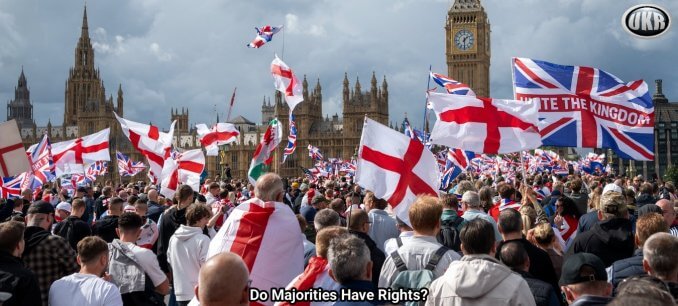
In many places this transition will have happened without overt friction and in some places without people even noticing, especially younger people in sprawling metropolitan centres. In other places, especially less affluent places with other stresses and strains, it has become associated with decline, neglect and low level disorder, especially by a white working class that carried most of the initial burden of adjustment to new arrivals. It is surely a big factor behind the ‘raising the colours’ movement and the recent noise around British ethno-nationalism, for and against.

It is hard to ascertain just how much the ethnic shift is impacting the consciousness of the average member of the White British majority, partly because it remains a semi-taboo subject. Yet the rise of Trump in America and populist parties in Europe is usually assumed to be driven in part by those who are discomforted by the transition, fear the loss of a common life and blame elites for minority favouritism.
In public, the preference for lower levels of immigration is generally framed in the language of pressures on infrastructure and public services rather than the more intangible desire to continue living in places dominated by people who look like you or at least broadly share your way of life. But significant numbers also complain in polls of feeling a stranger in their own land and if one observes patterns of settlement and segregation it is clear that members of the majority (of all political persuasions) tend to move to areas where their group is dominant just as minorities tend to cluster together.
So what? Was the famous response of former Tory cabinet minister Sajid Javid to the advance of majority-minority Britain. Most politicians and commentators have little sympathy for expressions of anxiety about the transition. Those like Nigel Farage and Robert Jenrick, who have drawn attention to it, are damned as divisive.
But it is surely a very big social fact that must be possible to discuss in a rational manner without either promoting bigotry or assuming that those who do admit to anxiety about the big changes to their town or neighbourhood are themselves bigots. It is a failure of imagination and empathy on the part of liberal Britain to struggle to accept that a White British person can feel no personal prejudice against minorities, indeed can have workmates, friends and even spouses from other races and ethnicities, yet also have a strong preference to preserve the majority way of life where they live and in the country as a whole.
Is it possible to retain a strong sense of common interest and mutual regard in a society not grounded in an ethnic majority?
A word about language. Ethnicity just means shared ancestry, and often shared myths/symbols of that ancestry, it is not the same as race. The English, Spanish and Bulgarians are the same race but different ethnicities. The official ONS label of White British may not be an entity that many people feel they belong to but there is nothing sinister, let alone ‘ethno-nationalist’, about it, and it is already a multi-ethnic category including the English, Scottish, Welsh and some Northern Irish. In my view Englishness should also be regarded as an ‘open’ ethnicity (in other words civic, like Britishness, as well as strictly ethnic), and one that includes people of different racial and ethnic backgrounds, such as the India-descent Rishi Sunak or the Persian-Indian-descent Freddie Mercury.
Of course, most of us, especially if we live in a high-churn metropolitan centre, are largely oblivious to ethnicity in our daily lives, and only a small minority from the White British ethnic majority continue to feel racial antipathy or fear. Such obliviousness is often seen as a marker of what it is to be a sophisticated, modern citizen.
In mass societies you cannot see at an individual level whether a stranger from a minority race or ethnicity (or indeed someone from the majority) feels comfortably part of mainstream British society. You cannot assume that fellow-citizen solidarity is at least as important to any given individual than more particular co-ethnic, religious, regional or other attachments. Indeed, it is clearly not as important for some religious minorities, particularly many Muslims and also, but in far fewer numbers, Orthodox Jews and Roma.
Yet when you move from the individual level to that of the town or neighbourhood patterns of settlement and attachment become visible. And in Britain today there are, broadly, three kinds of demographic zones: places that remain heavily White British, mixed areas with a shrinking majority, and minority dominated areas, in some places dominated by one minority, ie British Bangladeshis in Tower Hamlets.
From this demographic pattern two main models for the majority-minority future are now emerging, an integration model and a segregation one. Even many middle England towns that are still heavily dominated by the White British, for example Abingdon in Oxfordshire, will typically now have a significant ethnic minority population of around 15%, most of whom are second or third generation immigrants, tend to speak with local accents, are largely absorbed into the majority way of life, with some cultural and religious distinctions, and often inter-marry with the majority. There is no single minority dominating (the biggest in Abingdon are East Europeans and South Asians) and little neighbourhood segregation. In the next few decades the minority population there, and in similar relatively affluent places (say Warwick in the Midlands, Sale in the North), will grow to 30 or 35% but in a manner that is set to be comfortably accommodated by the majority.
At the other end of the spectrum is a place like Bradford which is 40% minority and has distinct minority zones, where most people dress differently, often speak a different language, consume different media and often follow politics more closely in countries of ancestry, partner only within their minority, go to largely mono-ethnic schools, and live by significantly different norms (religiosity, sex equality) to the White British majority, especially in the Pakistani areas. In the next few decades Bradford will become not just majority-minority but majority Pakistani, as the White British population dies or moves out.
The future will be a mix of Abingdons and Bradfords, with more affluent places leaning towards the former and less affluent, especially those with significant Muslim populations, towards the latter (some poorer regions like the North-East and Cornwall will remain overwhelmingly White British).
All the evidence we have from surveys and observation makes it clear that most people from the majority are happy to live in mixed places where their group continues to dominate numerically and minorities broadly fit in with majority ways of life. This can also happen in places far more diverse than Abingdon where the minority population is already more than one third—Reading, Watford, Milton Keynes and parts of Manchester might fit this description—places with large minorities and relatively comfortable levels of integration that could be the model for a future soft-landing.
What is meant by that phrase majority way of life—open to all comers—is hard to pin down but would include, as a minimum, common language (meaning fluent, idiomatic English), dress, and norms of public behaviour, some local attachments through sport/ media consumption, and easy mixing across lines of class and ethnicity in so-called third spaces (meaning neither home, nor work) such as pubs and cafes. At a national level it would include some sense of a shared history and Britain as a secular democracy but with a continuing attachment to Christian-influenced symbols and rituals, such as Remembrance Day or the 2023 Coronation, and some degree of emotional citizenship, with people feeling part of a common team and national story.
This majority way of life is something shaped by the White British but is fluid and evolving and open to people of all races and ethnicities who are also increasingly coming to mould it too.
Rapid ethnic change impacts the majority way of life and hence politics in many, often subterranean, ways as we move from an era of metropolitan openness to one of provincial insecurity. In Britain the US’s red state/blue state fault-line takes the shape of blue state big cities, ethnically diverse (often with single minority enclaves) and full of the highly educated and politically liberal, and red state towns and the countryside, that are older, less diverse and more conservative. (The Gorton and Denton by-election constituency in Manchester is an intriguing combination of the two.)
National identity remains important to most people, both majority and minority, but strong national allegiance has been in decline as has social solidarity, in 1989 61% of people thought spending on the poor should be higher even if it meant higher taxes, today the figure is 37%.
Other negative trends such as the decline in trust and volunteering—regular volunteering is down from 27% to 16% of the population in the past decade—and the closure of pubs and other third spaces have many causes, but population churn and demographic change is one of them. Civic pride is lowest in areas of high diversity and deprivation. (Muslims volunteer more than average but much of it is in-group.)
These declines are probably the inevitable consequences of a more diverse and individualistic society, which brings many benefits too, but they do not bode well for dealing with the big collective challenges we face.
Rights or Interests?
If politics is now increasingly impacted by ethnic majority decline, and attempts to slow it down, then it begs the question: should we think of shrinking majorities, as well as minorities, as having rights?
Constraints on majoritarianism is one of the basics of ‘essential liberalism’ and the rule of law. If majorities favour themselves, minorities will potentially suffer, hence the need for minority rights and anti-discrimination laws. But as majorities shrink in size and the common norms they have forged over time are no longer taken for granted, do majorities themselves need protection? This is the implicit promise of many populist parties.
Academics such as Ruud Koopmans, Liav Orgad and Eric Kaufmann argue that majorities are the absent centre in liberal democratic thinking. Political progress and much liberal political theorising for the past two centuries has focused on limiting and spreading power and thus, in part, on preventing majorities from abusing their dominance.
But two of the great progressive causes of the late 19th century were extending the franchise to all classes and to women—so creating the modern democratic majority—while also securing the equal rights of minorities: Catholics, Jews and non-conformists in Britain. So, historically speaking, majority and minority rights were not in conflict.
Yet, once the right of minorities to join the majority in full citizenship had been achieved, the focus shifted in the mid and later 20th century, in the shadow of war and genocide, to the right of minorities to be different from the majority. The universalist shift of the mid-20th century, codified in the United Nations Declaration of Human Rights (1948), proclaimed the moral equality of all human beings and, implicitly, the right of individuals to practice a religion or a distinct way of life wherever they might find themselves.
In the context of significant non-Western immigration into Western societies in the 1960s and 1970s, the message of liberal or laissez-faire multiculturalism was often “come here and remain yourself”. The mainly progressive-minded people who were managing immigration at local level believed that because all cultures are worthy of respect it was wrong to force newcomers to adopt the common norms and way of life of the majority society beyond obeying the law and paying your taxes.
This may have provided a psychological soft landing to minority groups, especially from traditional societies, arriving in increasingly pluralistic and liberal Western societies but it was also a recipe for ethnic Balkanisation—see the Bradford, Leicester or Luton segregation model—and majority resentment, underpinned, in Eric Kaufmann’s memorable phrase, by “asymmetrical multiculturalism”.
This means that minorities have a way of life and a culture—an ethno-nationalism even—that is usually important to them, indeed is part of their identity as human beings, and this needs legal protection and recognition in liberal democracies, but majorities do not need the same protection for their way of life.
Two reasons are usually given in defence of this asymmetry. First, majorities do not need special rights or protections in the way that minorities do because their culture and way of life is already pervasive: the language that is spoken everywhere, the national ceremonies and rituals, the culture and history that is transmitted through the school system, and so on.
Second, while ethnic majorities may share common ancestry in a rather fuzzy sense, there is no identifiable majority culture or single way of life any more, there is too much value and life-style diversity, too many different tribes in today’s Britain.
Christian Joppke, an academic on the other side of the argument to Kaufmann, rejects the idea that there is a dominant ethnicity in a country like France or Germany but then also argues that majorities do not in any case need protection. “Majorities by definition have the democratic process at their disposal, they do not need the legal process which is the domain of rights”.
It is true that the forces that make integrating minorities harder—live and let live individualism, multiculturalism, personalisation of media consumption, identity politics and so on—also increasingly fragment the majority. Think of the gulf between a Reform-voting 65-year-old grandfather living in a small town in the north of England and a Green-voting, lesbian, web designer living in Hoxton. But do we still recognize something in common behind our different accents and life-styles?
It seems that many of us do. We may no longer think ethnically, or at least use the language of ethnicity, and most of us would be horrified if Robert Jenrick started talking about promoting white British values (even though his critics claim that is just what he is dog-whistling). But large majorities continue to value the idea of national solidarity and want newcomers, and established minorities, to commit to this society beyond an instrumental relationship to the evident benefits on offer.
Moreover, the main defence of asymmetrical multiculturalism, that the culture and way of life of the majority is too pervasive to require protection, has been weakened by the demographic facts, some of which I pointed to above. In an increasing number of neighbourhoods, the majority way of life and its language and institutions—the shops, pubs, churches and so on—is no longer dominant. Moreover, there is a rising tide of complaint about two-tier justice and unfair privileging of some minorities in the name of social peace, especially Muslims (see the grooming gangs scandal and the latest Maccabi Tel Aviv row).
If there was no such thing as an ethnic majority way of life, however varied and hard to define, then nobody would care about its disappearance. Yet it is clear, as noted above, that a large minority or even a majority of citizens of the majority group do care about this erosion. And a smaller, radicalising number feel it as an existential threat, arguing that unlike many ethnic minorities with ancestral connections elsewhere they have nowhere else to go.
The claim that majorities are already protected is also weakened by the fact that majorities are not self-conscious agents in the democratic process. Apart from the new Muslim parties there are, thankfully, few religion or ethnicity-based political parties in the UK (though Sinn Fein, the SNP and Plaid Cymru all flirt with ethnicity, one reason they feel obliged to talk the language of universal progressivism so loudly). Majorities, especially the English, have a low political self-awareness, albeit one that is rising as their majority status is threatened in many places.
How should that rising self-awareness be channelled? Should liberal societies think harder about how to defend majority cultures or at least slow their decline? Can there be a right to remain a majority?
Legal rights for majorities are not practical or desirable. The state does not belong to the ethnic majority and the legal system, although granting group rights to minorities in some rather exceptional cases (for example, the Sikh motorcycle helmet exemption), should remain broadly indifferent to majority or minority status.
It is possible to imagine laws to protect the majority language from being over-shadowed in certain places and even to protect certain national rituals, but a more general right to lock in majority status would be divisive and impossible to enforce. It is more appropriate to think of concerns about majority decline as interests rather than legal rights, interests to which mainstream democratic politics should give voice to more than is usually the case at present.
What shape those interests should take will be worked out as part of national democratic conversations that depend on local circumstances. The right to remain the dominant, tone-setting group in any particular neighbourhood is not a right that any liberal society could easily grant as it would require restrictions on where people live, something that smacks of China or apartheid South Africa, though both Denmark and Singapore do try to enforce it.
Yet the idea of a stable and predictable life and a degree of control over one’s environment is precisely the promise that modern politics does hold out to citizens, of all backgrounds. And it is the promise that is most egregiously broken by indifference to high levels of immigration.
Stability need not mean ethnic homogeneity and stability is not only desired by majorities—consider the resentment among British Caribbeans at the way they are being driven out of their Brixton by affluent whites or Shabana Mahmood’s anger at queue-jumping illegal immigrants on behalf of her British Pakistani constituents.
Multi-ethnic, not Multi-cultural
So, what policies could reassure people that where they live will end up more like Abingdon than Bradford? Here are a few: much lower immigration for many years to ensure a degree of demographic stability; manage settlement to favour skilled/educated minorities more likely to mix easily with the majority; more emphasis from public authorities on integration of newcomers into common norms than on diversity and difference, and the phasing out of any affirmative action; insistence on English alone being the language of the state and public services; encouragement in the public sphere (including schools) to celebrate a non-chauvinistic version of the national story; prioritising the claims of citizens, and long-term residency, in social housing and welfare (and in the longer run returning to a more contributory welfare system); public subsidy of pubs and other traditional majority institutions that are disappearing; proper records of who is in the country and moving across its borders with rigorous inflow and outflow checks, and a household register or national identity scheme.
A bigger theme (too big for here), stressed by David Willetts and others, is that Brexit’s global turn in geo-politics and immigration was also the wrong direction demographically and should be reversed. We should be more open to Poles or Romanians than Somalis or Pakistanis.
Not all these things are easily subject to legislation, and some would be expensive, but there are other ways of promoting desirable things than through law. Well-designed “nudges” may be more effective than legislation in encouraging people to integrate around broad common norms and think of each other as sharing common interests as citizens, perhaps above all the common interest in a better life for one’s children.
Jonathan Haidt, talking about race in the US, puts it like this: “You can make people care less about race by drowning race differences in a sea of similarities, shared goals and mutual interdependencies.”
Many of the proposals above have been the stuff of debates and commissions on integration and social cohesion for many decades, yet hardly any have come to pass (will the current Together Coalition’s commission be any different?). That is partly because of legal obstacles and partly because of a liberal politics that takes as its starting point individual rights. Societies are not, however, just random collections of rights-bearing individuals but feature group attachments, including among the majority, that politicians struggle to articulate for fear of disadvantaging minorities.
Yet the desire to retain a majority way of life is usually a defensive not an assertive sentiment and is not in principle hostile to settled minority groups and minority rights. Indeed, majorities and most minorities usually want broadly the same thing on mixing, the big exception being more separatist Muslims.
The failure of mainstream politics to recognize majority feelings is a political mistake that has created a space for the extreme right to exploit. And would Donald Trump be US President today if not for the demographic anxiety of lower-status whites—non-Hispanic whites now make up just 55 percent of the US population—people who are irked to have to press one for English on automated phone systems?
On the other hand, maybe this whole argument is old hat and the concern for majority rights is a swan song for a dying idea of national identity in super-diverse, hyper-individualistic countries. Perhaps as people become more educated and mobile, they will draw their identities less from place and group and history and more from inside themselves, from their distinct personalities and temperaments, making them less concerned with maintaining stable communities. This is already true for some highly educated, mobile Anywheres. I doubt it will spread to majorities any time soon.
But if ethnic majorities are destined to lose their majority status and become just the largest minority among others, we are left with another question. Is it possible to retain a strong sense of common interest and mutual regard in a society not grounded in an ethnic majority? Will it be possible to demand high levels of tax and redistribution in welfare states—already faced with a squeeze on productive workers thanks to falling fertility—without the reflex of solidarity provided by the backdrop of an ethnic majority? Will there instead be more overt communalism, already evident in places like Tower Hamlets, and ethnic conflict over resources? Even a return to overt racism already increasingly evident on social media?
In parts of Britain today the secular, individualistic culture of the majority is being supplanted by tight-knit, high-solidarity, religious cultures. Biraderi-style clannishness is the unwelcome underbelly of multi-ethnic Britain. And our future challenge is how to reconcile a reviving majority identity, in some places with an ugly ethno-nationalist face, with an assertive Islamic conservatism.
No one knows how this well evolve, though we do know from history that declining majorities can lash out (see Russians, Serbs and Ulster Protestants in recent decades). So, it is best to move with caution and hope that a majority-friendly, but multi-ethnic, sense of national community can take root replicating some of the effects of a majority ethnicity even as it is leaving the stage.
For many people, especially on the left, the very idea of the national feels dowdy, old-fashioned and uninspiring, if not downright reactionary. On the contrary, an over-arching national story that can appeal to the widest possible range of British lives with vivid language and symbols, a story that respects and celebrates the historic ethnic core but is not limited to it, remains a permanent and ambitious, maybe even utopian, project, and one that has hitherto eluded our politicians (remember Gordon Brown on Britishness?) and other meaning-creators.
As the author Lorenzo Warby puts it, it should be a multi-ethnic story but not a multicultural one. His local cafe in Melbourne provides a template for what we need.
“The local cafe I go to most regularly is very Western Melbourne. It is an ordinary cafe in a local suburban mall. Its clientele represents the enormous ethnic diversity of the area. It is run by a Chinese-Australian family some of whom have very Australian accents. Its customers include East Africans, South Asians (Sikh, Hindu, Muslim), East Asians, Pacific Islanders, Central Europeans, Anglo-Celts.
“So, the cafe is very multi-ethnic. It is, however, not multi-cultural. Folk may come from several continents and island chains, but they all follow Anglo-Celtic norms. They queue, they interact, they show courtesies, according to Anglo-Celtic norms. Going about their business, they do not spit on the ground. They do not litter. The place and its surrounds feels very Australian.
“How so? Because of how Australian migration policy works. Migrants to Australia are, on average, better educated than native-born Australians. They are also split among lots of small groups. Anglo-Celts may not be a majority in the area, or even of the customers, but they are by far the biggest group. So, the varied groups of migrants gravitate towards the norms of the Anglo-Celts.”
That’s a template worth reaching for and it could unite both those who think it unbecoming to worry about the decline of the White British majority and those who think it peculiar not to. For this is Britain’s increasingly central, though largely unspoken, political divide.
This piece is adapted from an essay in the collection ‘Majorities, Minorities and the Future of Nationhood’ (CUP 2023), edited by Liav Orgad and Ruud Koopmans
This article (Do Majorities Have Rights?) was created and published by David Goodhart and is republished here under “Fair Use”


Leave a Reply