

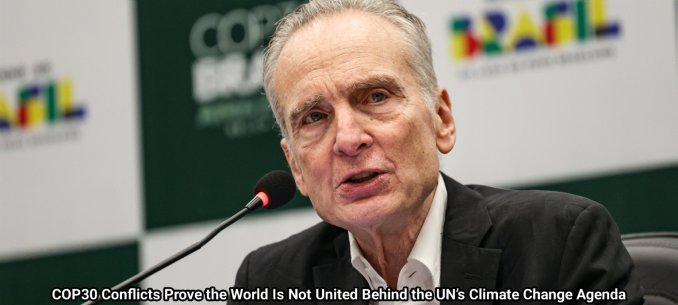
RHODA WILSON
The 30th United Nations (“UN”) Climate Change Conference (“COP30”) is entering its final stretch in Belém, Brazil, with a palpable sense of urgency as negotiations shift from technical details to high-level political decision-making.
“Social movements are pressing hard on climate finance, warning of potential ‘ecological debts’, and demanding a broader vision of just transition,” the UN claims.
Brazil’s COP30 President André Corrêa do Lago has released an early draft of a potential deal, known as the “mutirão decision,” which addresses the “big four” issues not included in the official agenda. Unsurprisingly, finance is one of the “big four” issues for the UN.
In today’s newsletter, Devex provides an update on how the UN’s climate conference is progressing.
The following is a section of a newsletter published by Devex. We should bear in mind that Devex is a Globalist outlet. It describes itself as delivering “insider reporting that drives the global development agenda.” As such, Devex will promote and advocate for what even Bill Gates has recently described as the climate change “doomsday outlook.” This narrative aims to frighten the world into accepting, and paying for, the United Nations’, the wannabe One World Government’s, Sustainable Development Goals – Agenda 2030.
Related: Henry Lamb: The UN’s 1995 ‘Global Neighbourhood’ plan for a One World Government
Ignoring Devex’s nod to Globalist propaganda, the newsletter is quite revealing as it appears the Globalist narrative is falling apart. We have only republished the first section of the newsletter relating to finance because, as we have noted before, the climate alarmist narrative is driven by global finance. However, it’s worth reading the newsletter in full. In the following, we have added links to related articles we have previously published in [square brackets].
Ministers Arrive, Money Stalls and Minerals Teeter At COP30
As ministers land in Belém, finance fights, fragile mineral language, and rising Indigenous pressure set the stage for a tense second week at COP30.
By Jesse Chase-Lubitz, as published by Devex on 18 November 2025
It’s Week 2 of the 30th UN Climate Change Conference. I hope you’re hydrated.
After a week of heat, toilet closures and the constant, unnerving scream of air conditioners throughout the COP30 venue, we’re back for more. This weekend featured an impressive show of force from Indigenous groups and local communities, who walked through the streets of Belém, Brazil, to call for more environmental protections. On the lighter side, there was a boat ride to the beach for some lucky attendees.
The Agenda’s Sticky Spots
While Week 1 was more technical, Week 2 is when the ministers arrive and the political side of COP begins.
The main disagreement we expect is on finance. Many lower-income countries still want to see a larger total amount going from developed to developing countries – this is a reference to the new collective quantified goal, or NCQG, which was the main topic of debate last year in Baku, Azerbaijan. But wealthier countries are saying “been there, done that” and don’t want to reopen the question of total developed-developing finance. This could be a serious stalemate in the final hours.
The adaptation finance debate could add fuel to that fire, as many countries are calling for a tripling of adaptation finance from the $40 billion target of Glasgow in 2021 to $120 billion per year. Developed countries are unlikely to agree to this. An official of a developed country told Devex that their country has no intention to commit to a specific number on adaptation finance; instead, they are focused on indicators, which are measurable benchmarks – such as climate-risk assessments, early warning coverage, resilience of infrastructure or adaptation finance – that track collective progress toward adaptation outcomes. The indicators and the finance goal fall under the Global Goal on Adaptation, an international framework aimed at helping countries adapt to climate impacts and reduce vulnerabilities.
“As countries are expected to agree on a set of indicators to track progress towards the Global Goal on Adaptation, or GGA, finance continues to be the elephant in the room,” Salomé Lehtman, climate advocacy adviser for Mercy Corps, told Devex. “For the GGA to be meaningful, it must be accompanied by a new and ambitious adaptation finance commitment. The GGA cannot be left hanging without sufficient and high-quality finance to implement it.”
The indicators are contentious for another reason. African countries are trying to avoid committing to anything too specific in the event that donors use technicalities to withhold funds. Others are pushing for a list of indicators somewhat smaller than 100. Though that’s a reduction from the original 9,000.
Beyond finance, we still don’t have all the nationally determined contributions, or NDCs – originally due in February, and then late September, and now whenever they arrive. This means it’s hard to tell what countries’ greenhouse gas emissions goals will look like moving forward.
[Related: The whole world is disillusioned with climate politics, except for the UK and IEA report admits commitment to climate change is melting away]
And there is also no agreement on trade. The European Union is holding steady on its carbon border adjustment mechanism, or CBAM, which takes effect next month and puts a carbon tax on certain products imported to the EU. CBAM is meant to prevent carbon “leakage,” which is when companies move production to countries with weaker climate rules to avoid taxes. With all of Europe creating an emissions wall, the hope is that it will encourage global emissions reductions. However, developing countries are pushing against the plan, arguing that it’s more of a trade barrier than a climate remedy.
[Related: EU “Carbon Tax” on Chinese and Indian Imports could spark a Global Economic “Cold War”]
On Sunday evening, the COP presidency issued a summary note addressing the four problem topics of last week: the gap between current greenhouse gas emissions versus the level needed to keep global warming to 1.5 degrees Celsius, climate finance, trade measures and the transparency of country reports. It plans to bring these together and address them in a mutirão decision, referring to the Brazilian word for collective action – or in COP terminology, a cover decision.
The umbrella term for the decision is the Belém political package, which also includes mainstream agenda items such as adaptation and the just transition. This is likely to be rather unwieldy, covering around 14 topics and with wording broad enough to include just about anything.
On Monday, the 11th letter from the presidency called for countries to “accelerate the pace.” By morning today, the presidency shared an update with delegates saying it was speeding up work on the Belém political package, and that delegates would receive draft texts today in order to work toward an agreement on Wednesday.
You can read Devex’s newsletter in full HERE.
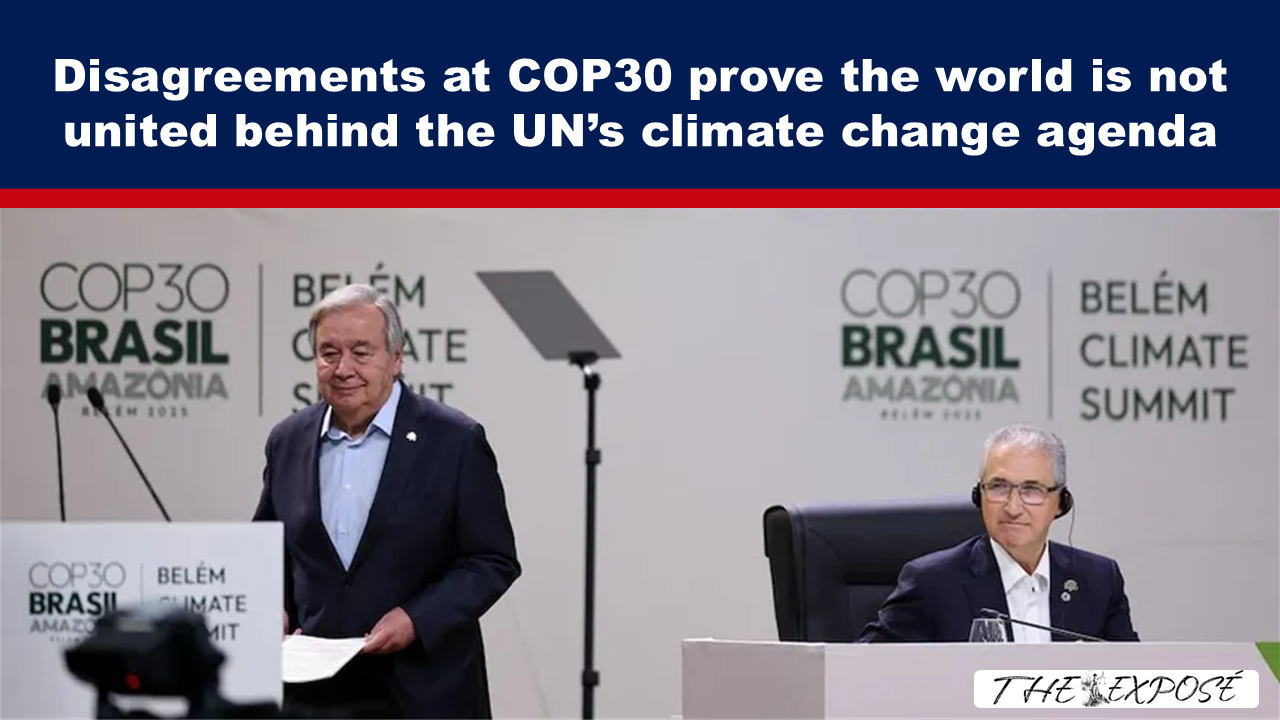
This article (Disagreements at COP30 prove the world is not united behind the UN’s climate change agenda) was created and published by The Expose and is republished here under “Fair Use” with attribution to the author Rhoda Wilson
See Related Article Below
I Thought It Was All About Saving the Planet! You’re Telling Me It’s Really All About the Money and One Big Trade Show?
DAVID WOJICK
Guest Post from David Wojick via CFact.
The vast majority of the tens of thousands of people attending COP30 are there to sell and buy stuff, including oil, natural gas, and even coal. Climate policy has little to do with it. This is by far the world’s biggest trade show, with almost every country represented. There is nothing else like it.
Pre-registration for COP30 is around 56,000, the second highest in COP history. Total attendance might be 70,000 or more. The press often talks as though all these people are somehow involved in the climate deliberations, but that is wildly false.

The number of actual in-the-building negotiators is likely fewer than a thousand. It is possibly a lot less, as that would be five per country, and some countries only send two or three people. Many countries have several negotiators as negotiations often proceed in multiple simultaneous work groups. So, let’s say it is a thousand.
There are also around a thousand journalists, several thousand activist observers, and likely several thousand conference support staff.
So, suppose there are ten thousand people directly involved in the negotiations as doers, helpers, and watchers. What do the other 60,000 or so people do? Well, for a start, many of them man the endless pavilions, booths, and presentations going on outside the negotiations building. Many others attend this carnival.
Many countries have pavilions. Some, like China’s, are whole buildings. There are also components of countries like states and cities. But then, there are big businesses and multi-national corporations that develop projects in and sell to countries and their components. There are even big financial institutions. The show is enormous.
CFACT’s team in Belém has reported on some of these heavy hitters. See, for example, Peter Murphy’s “COP30: Traversing the UN Green Zone. Corporations and government PR on full display for the Amazon” here.
They also talk to each other, and this is where I am sure many deals get done. Plus, there are lots of people who come just to deal with the people in the show.
On the funny side, a few COPs ago, the UN started asking registrants about their ties to oil and gas companies. There turned out to be well over a thousand per COP, which is as many, or more than, the number of negotiators. I am sure a lot of oil and gas deals get started here. In fact, at COP28, the COP president, himself an oil executive, got yelled at for talking about making such deals.
Countries do business in a lot of areas besides oil and gas, from airplanes to agriculture. It would be fun to assess all the shows for the range of businesses potentially involved.
There is no other get-together in the world even remotely like these COPs. Senior people from most countries and a lot of big businesses all talking to each other around the clock for well over a week. I envision 100,000 elevator pitches.
The number of people here to talk about climate change is probably relatively small, say just 15%. Most are here to see and be seen, to sell and to buy, or at least to start talking about that. This might actually make these otherwise stupid COPs valuable. Imagine that!
Dr. David Wojick is an independent policy analyst and senior advisor to CFACT. As a civil engineer with a Ph.D. in logic and analytic philosophy of science, he brings a unique perspective to complex policy issues. He specializes in science and technology-intensive issues, especially in energy and the environment.
This article (I Thought It Was All About Saving the Planet! You’re Telling Me It’s Really All About the Money and One Big Trade Show?) was created and published by Energy Security and Freedom and is republished here under “Fair Use” with attribution to the author David Wojick
Featured image: agenciabrasil.ebc.com.br


Leave a Reply