
G. CALDER
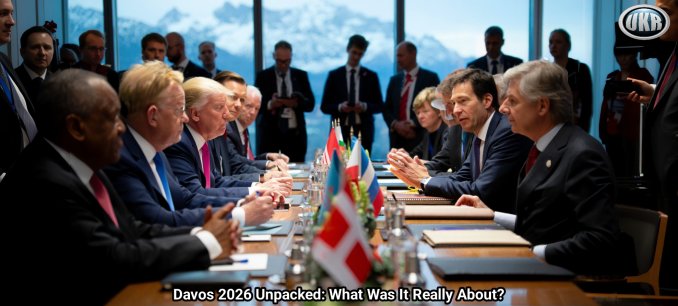
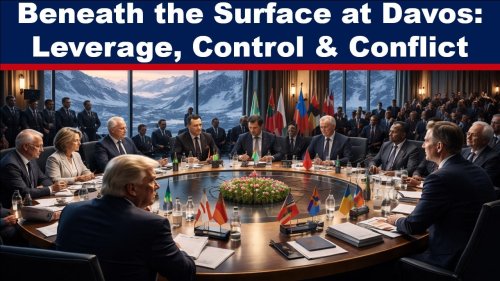
Davos presents itself as a forum for shared solutions to global problems. But this year was not about cooperation – it was about leverage. The public agenda focused on technology, climate, and “global risks”. Beneath that language, the real conversations revolved around territory, recognition, market access, and population control. Davos 2026 was less about consensus and more about who gets to set the terms as geopolitical competition intensifies.
Here’s our attempt to summarise what actually happened, and why it matters to us all.
Greenland and the Return of Negotiable Borders
Unsurprisingly, Greenland was centre stage. President Trump’s comments about the island were treated by many as theatrical provocation, but that misses the point. Raising Greenland at Davos was not about a single land purchase. Instead, it normalised the idea that territory – especially strategically critical territory – is once again negotiable.
As we outlined in our previous article, “Why Everyone Suddenly Cares About Greenland“, the island sits at the intersection of Arctic shipping routes, space surveillance, critical minerals, and missile defence. Treating Greenland as an asset to be discussed openly among elites signals a vital shift away from the post-Cold War assumption that borders are fixed and untouchable. That previous assumption depended on a world where security was stable and resources abundant – neither condition holds today.
What this really means is that sovereignty has been re-priced. Control of land isn’t just symbolic or historic anymore, but it’s become transactional again particularly where security and supply chains overlap. Importantly, Davos did not recoil from this idea. Instead, it was treated as a practical question of leverage. That alone tells us how much the rules have already changed.
The Board of Peace: A Rival to the UN?
One of the more consequential announcements at Davos was the launch of the Board of Peace. This body was presented as a new international mechanism designed to act where existing institutions – particularly the United Nations – are seen as slow, gridlocked, ineffective, and bureaucratic.
Its initial focus appears to be conflict zones where major powers want outcomes rather than prolonged negotiation. The proposal centres on a smaller organisation with the ability to offer security arrangements and political stabilisation without the procedural delays that define the UN Security Council.
A streamlined body such as the Board of Peace could move faster and impose clearer conditions, whereas the UN often produces statements, resolutions, and processes that rarely translate into action. But the risks here are clear: a structure built outside traditional treaty frameworks concentrates decision-making among those who fund and control it. Peace, reconstruction, and sovereignty risk becoming conditional on alignment with the few in control.
Again, the reception of this idea was mostly pragmatic, and the concept was treated as a realistic workaround to multilateral stagnation. That response signals how much confidence in existing global institutions has waned.
Somaliland Quietly Enters the Market for Recognition
Another telling development took place away from the main stages. Abdirahman Mohamed Abdullahi, President of Somaliland, met Eric Trump in a nearby hotel conference room while Donald Trump spoke. An aide said it was one of Eric’s main meetings. The Somaliland leader also met with Israeli President Isaac Herzog.
Somaliland – a de-facto state with long-standing autonomy since 1991 – lacks formal recognition from any major country. In an October article, “Will Somaliland Help Israel in Return for Independence?”, we investigated the potential of the US and Israel awarding recognition to the East African breakaway state. At Davos, the reality edged closer.
Somaliland controls a key port on the Gulf of Aden, near one of the world’s most important shipping lanes. Its geography alone gives it leverage. Davos, in this case, served as a marketplace for sovereignty – a space where such leverage can be monetised through access and relationships, even without formal legal status. But if such recognition can be advanced through quiet meetings, then is sovereignty becoming purely transactional?
See our earlier article for further reading on the topic of sovereignty: “Why Does Nobody Know How Many Countries There Are?”
Zelensky Lectures Europe on Vulnerability
Volodomyr Zelenskyy’s speech in Davos was openly critical of Europe. He did not appeal to unity or shared values. He lectured European leaders on vulnerability.
By pointing to symbolic troop deployments, fragmented defence commitments, and hesitation over security spending, Zelenskyy highlighted what many already understand. Europe totally lacks strategic coherence and relies heavily on American protection – all while resisting the implications of that dependence.
His message appeared transactional rather than emotional. A continent that cannot act decisively becomes a liability rather than a partner, and in a world defined by leverage, that weakness invites pressure.
The implication is that Europe’s inability to project power independently reduces its influence in broader global negotiations that hinge on security, resources, and enforcement – just like we’re seeing with Greenland.
The Climate Becomes a Mechanism for Market Control
Climate language dominated Davos, but the real focus was on enforcement via markets, not emissions or environmental outcomes.
Carbon border taxes, compliance frameworks, reporting standards, and disclosure requirements are all tools that translate “climate” policy into economic leverage. These mechanisms determine which goods can enter markets, who can buy them, which companies are penalised, and which countries must align or pay.
This is a crucial point. Climate policy increasingly functions as an instrument for regulating trade and industrial behaviour rather than protecting the environment. Davos discussions reflected this reality. The “climate” crisis was treated as a means of shaping supply chains and controlling access rather than a scientific debate.
This explains why climate rules are now inseparable from financial regulation and trade policy. They provide a moral justification for enforcement that would otherwise be politically difficult to impose.
AI and the Struggle for Control
AI discussions followed a similar pattern. The emphasis wasn’t innovation or technological development, but governance and control. Who manages the models, who owns the data, and who decides what systems are allowed to do?
Safety and sovereignty were the preferred terms. In practice, the conversation was about permissions and control. AI governance is becoming a way to regulate transactions, behaviour, and speech at scale.
Davos treated this as inevitable. Once rules are embedded, they will become difficult to challenge. The debate was not about whether the control should exist, but rather who should wield the power.
Conflict, not Cooperation, is on the Horizon
One of the most revealing short-term signals came from risk framing. The dominant concern for the next two years is not climate, pandemics, or inequality. Instead, it’s geopolitical conflict.
Trade wars, sanctions, bloc competition, and regional wars now define the short-term outlook. Davos is planning for a world of managed confrontation rather than global harmony. That reality seemed to shape every discussion, even when not mentioned explicitly.
Final Thought
Davos 2026 made one thing clear: the global system is being reorganised around leverage. Territory is being discussed as an asset. Sovereignty is negotiated through port access. Climate policy is being used to enforce market control. AI governance opens the door to behavioural control. And they’re not even hiding it anymore.
This article (Davos 2026 Unpacked: What Was It Really About?) was created and published by The Expose and is republished here under “Fair Use” with attribution to the author G. Calder

••••
The Liberty Beacon Project is now expanding at a near exponential rate, and for this we are grateful and excited! But we must also be practical. For 7 years we have not asked for any donations, and have built this project with our own funds as we grew. We are now experiencing ever increasing growing pains due to the large number of websites and projects we represent. So we have just installed donation buttons on our websites and ask that you consider this when you visit them. Nothing is too small. We thank you for all your support and your considerations … (TLB)
••••
Comment Policy: As a privately owned web site, we reserve the right to remove comments that contain spam, advertising, vulgarity, threats of violence, racism, or personal/abusive attacks on other users. This also applies to trolling, the use of more than one alias, or just intentional mischief. Enforcement of this policy is at the discretion of this websites administrators. Repeat offenders may be blocked or permanently banned without prior warning.
••••
Disclaimer: TLB websites contain copyrighted material the use of which has not always been specifically authorized by the copyright owner. We are making such material available to our readers under the provisions of “fair use” in an effort to advance a better understanding of political, health, economic and social issues. The material on this site is distributed without profit to those who have expressed a prior interest in receiving it for research and educational purposes. If you wish to use copyrighted material for purposes other than “fair use” you must request permission from the copyright owner.
••••
Disclaimer: The information and opinions shared are for informational purposes only including, but not limited to, text, graphics, images and other material are not intended as medical advice or instruction. Nothing mentioned is intended to be a substitute for professional medical advice, diagnosis or treatment.
Disclaimer: The views and opinions expressed in this article are those of the author and do not necessarily reflect the official policy or position of The Liberty Beacon Project.


Leave a Reply