

JON MOYNIHAN
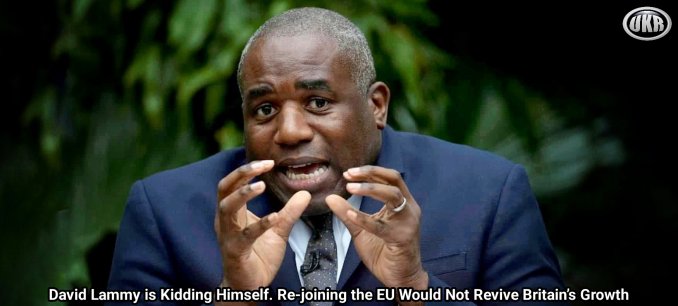
Today’s Telegraph reports remarks attributed to David Lammy suggesting that re-joining the European Union would accelerate Britain’s economic growth. We have heard these claims before: that Brexit has “hit GDP by 4%”; that we have missed out on a supposed European growth miracle; that our malaise can be cured simply by crawling back into Brussels’ embrace. These assertions are not only wrong — they are founded on economic models that have already been disproven by both logic and real-world data.
The Office for Budget Responsibility’s oft-repeated claim that Brexit will reduce GDP by 4% (I won’t bother to address the even more ludicrous recent paper that our GDP has lost 8% since we left) has become a kind of secular scripture in some political circles. Ministers recite it, the BBC broadcasts it, and commentators build entire arguments on it. Almost all claim that the reports prove that the 4% decline has already occurred; yet the OBR itself has repeatedly stated that this supposed effect is expected to happen over 15 years. Only five of those years have elapsed — yet we are told the entire (non-existent — as I will show below) impact has already landed. In fact, both the supposed impact and the supposed timing are myths.
Even if one had accepted the OBR’s modelling — which, see below, would be ill-advised to do — only around 1.3% of that forecast (the first 5 years’ worth of 4% alleged to be happening over 15 years) would have occurred to date. Yet the Government, media and Opposition all talk as if the full 4% blow has already been felt. How convenient for those who wish to attribute every difficulty our nation currently suffers to a single political decision made nine years ago.
The trouble is deeper than misinterpretation — the model itself is indefensible. When the OBR first produced its forecast, it did so by averaging a group of economists’ projections. Six of the ten were productivity-based models, forecasting an average impact of around 3%. The other four used versions of the so-called gravity model (a concept now largely discredited). Those gravity models produced a 6% average — including one preposterous 11% forecast from the World Bank. A simple arithmetic average of the 10 predictions became a supposedly precise measure of Brexit’s economic impact.
Meanwhile, the IMF — regularly cited by Chancellor as a gold standard authority on economic matters — estimated only a long-term 2% effect (so, in the first 5 out a presumed 15 years, just two thirds of one percent so far!).
Let’s look at the assumptions behind those models. Those who produced them (nine years ago, remember) assumed no trade deal would be secured with the EU; that Britain would trade under the terms of a “typical” agreement — rather than the uniquely deep Trade and Cooperation Agreement that was actually negotiated: zero tariffs, zero quotas. To judge Brexit using assumptions that have already been invalidated is not serious economic analysis. It is wishful thinking dressed as expertise.
When challenged, the OBR shifts ground. Half of its infamous 4% is derived not from trade effects at all but from the idea that pre-2016 Britain was outperforming the EU, and would have continued to do so — if only we had remained inside the European project. Got it? If we had stayed in the EU, following all its rules (including having to follow what my AI estimates as the 10-12,000 new legislative Acts that have been passed since we left in 2020), we would have grown much faster than the EU. As they say, riiiiight… The OBR attribute this putative outperformance to higher immigration, and they assumed immigration would fall after Brexit. Yet immigration has risen far above pre-Brexit levels. Even by the OBR’s own logic, therefore, that 2% half of the forecast collapses on contact with the facts.
The other half is pinned to a predicted deterioration in “trade intensity.” But since 2019, both France and Germany — still EU members — have also suffered declines in trade intensity. If lower trade intensity is proof that Brexit damages growth, then the EU must now be deemed harmful to France and Germany. Or perhaps — just perhaps — there are forces at play, mostly self-harming steps taken by successive UK governments, which have nothing whatever to do with Brexit. Take for example the following:
- the catastrophic impact of our Covid policies on schooling, employment, the national debt and inflation
- the madness of Net Zero which has given us the highest industrial electricity prices in the developed world
- policy-driven declines in manufacturing as we closed down the North Sea and eliminated our oil and gas, chemicals, ammonia and other related industries
- regulatory destruction of the City’s competitiveness
- an exodus of wealth and entrepreneurial talent
- ever-tightening bank regulation throttling investment
- sharply higher business taxes
- labour-market policies discouraging hiring and rewarding idleness
Are we seriously to believe that none of these have harmed growth — that only Brexit is to blame? The wonder is not that our growth has been slow, but that it has not been far worse given the anti-enterprise regime our own governments have created.
The six productivity models I referred to above are ‘doppelgänger’ models, which take countries whose economies apparently resemble the UK economy pre-Brexit and see how they have done in the intervening years, and then say how much Britain should have grown had it emulated them. Under the approach, 60% of their model performance is that of the United States. And since the United States has grown fast since 2020, therefore Britain should have also. Riiiight! Chance would be a fine thing that we could have the kind of open, free-market economies that the engines of US economic performance – Texas, Florida, Georgia – have. The truth is that Britain’s economy is still structured much as are the other large economies in the west of the EU – Germany, France, Italy – big state, high taxes, very high regulation (in large part EU-imposed, but with lots of self-inflicted calamities too). That is precisely why, since Brexit, our economic growth has been the same as in those three countries. To say that with the same economic structure as them, we should have outperformed them, is in my view intellectually dishonest.
The models do correctly point out that productivity growth has, in the UK as much as in those other big EU countries, been poor. Yet there is a twist to that. For most of the past two decades, productivity growth in the UK’s private sector has happened — around 30% cumulatively— while it is the public sector that has been flat-to-negative over that entire period. Flat productivity in a huge and expanding state will drag down national growth regardless of our relationship with Brussels. Yet the models assert that our low rate of productivity improvement is down to our having left the EU.
Will we see Mr Lammy arguing, with a straight face, that if only we had stayed inside the EU, civil servants would have abandoned their four-day weeks, their working-from-home privileges, and their ever-rising salaries, benefits and gold plated pensions? That bureaucratic productivity would suddenly have surged? That the state would have magically become leaner and more dynamic? Because we had stayed in or rejoined the EU? Such claims are not analysis. They are fantasy.
The Opposition’s prescription — return to Brussels’ orbit — is founded on an elementary economic error: the belief that growth comes from government spending and regulatory saturation. Yet the evidence, globally and across history, is unequivocal: the smaller and more agile the state, the stronger and more sustained the growth. The countries that cut taxes, slash red tape, unleash enterprise and embrace affordable energy are the countries that prosper. This is a future for the UK that can only be achieved outside, not inside, the EU.
The United States shows this clearly. If indeed Britain had matched America’s growth since 2016 — as the “doppelganger” models claimed, bizarrely, would have happened had we stayed in the EU actually — we would indeed be significantly richer today. But America did not achieve that growth through submission to supranational rule-making. It did so because, in the red states at least, it rejects the very high-tax, high-regulation, dirigiste approach that Brussels embodies — and which, unfathomably, too many in Westminster admire.
What we needed after Brexit was not a softer compromise with the status quo — not managerialism, not tinkering — but a deeper realignment toward freedom: a decisive shift to deregulation, competitive tax rates, abundant and inexpensive energy, and a state that lives within the bounds of what taxpayers can bear. What we did not need, above all, was for Boris Johnson, Dominic Cummings et al to fall for the glaringly obvious trap of the Northern Ireland Protocol, which has led to us being trapped into regulatory alignment, on so many growth-destroying matters, with the EU.
And then, successive governments have compounded the error with trillion-pound climate-driven energy policies, the highest tax burden in modern history, ever-increasing debt, worse inflation than our peer countries, swollen welfare rolls that make unemployment more lucrative than work, an obsession with regulation that has collapsed construction and rendered industry uncompetitive. And now we are told that the solution to the failures of this big-state experiment is a yet larger state — our economy handed over to a distant, ‘We Know Best’ bureaucracy over which we have no democratic control.
We cannot spend ourselves into prosperity. There is no money left. To restore growth, we must cut the state down to size. We must end the dogma of Net Zero that makes our energy the most expensive on Earth. We must ensure work always pays — which means cutting benefits. We must tear down the regulatory labyrinth suffocating enterprise. We must trust individuals and businesses, not bureaucracies and supranational institutions.
If we do not do this, then yes — Britain will decline. But to blame that decline on Brexit is economic illiteracy.
The choice before us is simple. We can either cling to the illusion that prosperity is granted by Brussels — or we can summon the courage to shape our own future.
Brexit was never the obstacle to growth. It remains our greatest opportunity to secure it — if only we take it.
Lord Moynihan of Chelsea is the author of Return to Growth, a two-volume treatise on how to get Britain’s economy growing again. James Alexander reviewed Volume One for us here and Volume Two here. You can buy them on Amazon here and here.
Stop Press: Watch Lord Moynihan delivering a speech on this subject at the House of Lords in Thursday’s budget debate.
Excellent speech from my colleague Lord Moynihan in the budget debate this afternoon in the House of Lords. https://t.co/l0lViM9nIH
— Toby Young (@toadmeister) December 4, 2025
This article (David Lammy is Kidding Himself. Re-joining the EU Would Not Revive Britain’s Growth — it Would Guarantee Our Decline) was created and published by The Daily Sceptic and is republished here under “Fair Use” with attribution to the author Jon Moynihan

••••
The Liberty Beacon Project is now expanding at a near exponential rate, and for this we are grateful and excited! But we must also be practical. For 7 years we have not asked for any donations, and have built this project with our own funds as we grew. We are now experiencing ever increasing growing pains due to the large number of websites and projects we represent. So we have just installed donation buttons on our websites and ask that you consider this when you visit them. Nothing is too small. We thank you for all your support and your considerations … (TLB)
••••
Comment Policy: As a privately owned web site, we reserve the right to remove comments that contain spam, advertising, vulgarity, threats of violence, racism, or personal/abusive attacks on other users. This also applies to trolling, the use of more than one alias, or just intentional mischief. Enforcement of this policy is at the discretion of this websites administrators. Repeat offenders may be blocked or permanently banned without prior warning.
••••
Disclaimer: TLB websites contain copyrighted material the use of which has not always been specifically authorized by the copyright owner. We are making such material available to our readers under the provisions of “fair use” in an effort to advance a better understanding of political, health, economic and social issues. The material on this site is distributed without profit to those who have expressed a prior interest in receiving it for research and educational purposes. If you wish to use copyrighted material for purposes other than “fair use” you must request permission from the copyright owner.
••••
Disclaimer: The information and opinions shared are for informational purposes only including, but not limited to, text, graphics, images and other material are not intended as medical advice or instruction. Nothing mentioned is intended to be a substitute for professional medical advice, diagnosis or treatment.
Disclaimer: The views and opinions expressed in this article are those of the author and do not necessarily reflect the official policy or position of The Liberty Beacon Project.


Leave a Reply