

RON CLUTZ
Paul Schwennesen explains the nefarious intent behind this latest government hostile takeover in his Daily Economy article. Excerpts in italics with my bolds and added images.
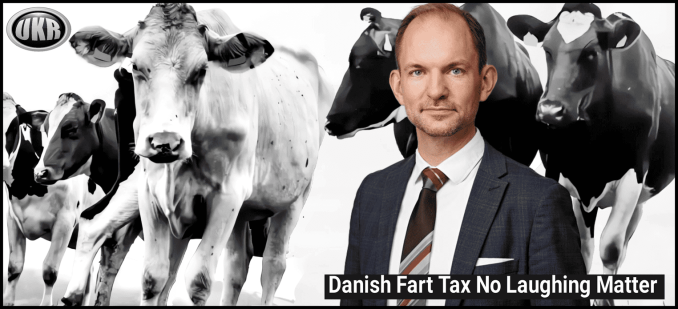
Cow farts are a distraction, and the joke’s on us. The Danish tax is a significant step toward state ownership of the means of production.
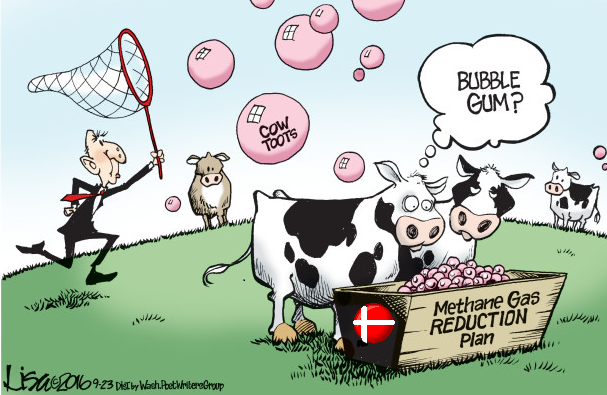
Denmark, according to The New York Times, is going ahead with its livestock “Burp Tax.” Though hotly contested, the Danish government has nevertheless finally settled on levying farmers 300 kroners (~$43) per ton for carbon dioxide emissions, ramping to $106 per ton by 2035. As is the case with many of these farm-targeted green interventions, the action is ludicrously ineffectual at addressing the trumped-up problem, while remarkably effective at further cementing state controls over economic production.
Part of the reason farms (and especially cows) are such fat targets for this kind of statist intervention is that, politically speaking, they are the perfect scapegoat. It all seems so harmless, after all — so silly even — that serious-minded folk risk looking ridiculous if they object. Is it really so very draconian, goes the argument, to ask farmers to reduce their cow flatulence? The ever-so-reasonable request (enforceable by law, to be sure) glides under the radar in a scree of giggle-inducing copy that distracts readers to what is really afoot.
The Times plays its part in this façade, relishing the chance to print “poop, farts, and burps” in the business section so that the regulation seems plucked from an impish children’s story rather than what it is: a deadly serious infringement on economic liberty.
Defenders of the scheme insist it is necessary to address the pressing issue of climate change. But even if we were to accept the lobby’s poorly understood climate science at face value, the claims would be dubious. Cows stand accused of emitting 5.6 metric tons in annual “CO2 equivalent” emissions. All this politically motivated tabulating and assessing completely ignores the other side of the ledger, the growing recognition that grazing livestock have a complex, largely offsetting (and quite probably net-positive) impact on overall carbon emissions. Nature, after all, doesn’t work in simple equations and we are woefully under-informed about the rich and inherently unmodelable world of stochastic ecology.
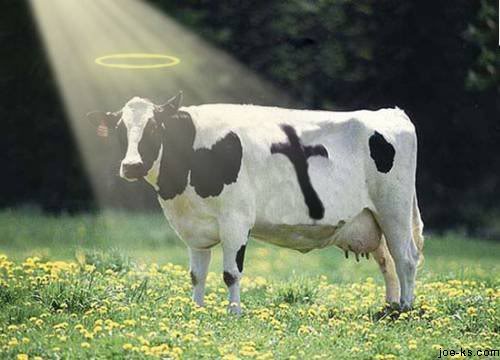 Give Daisy a Break.
The New York Times, by way of perspective, accounts for 16,979 metric tons of its own, meaning that it, as a single company, has the footprint of ten Danish dairies. What would readers of “All the News That’s Fit to Print” have to say about an annual tax of $730,000 a year, ramping to $1.8 million, being added to the newspaper stand price? Advocates of a free press might well ask why the government was using state power to make the newspaper of record less competitive.
But in any case, climate science and cow farts aren’t really the issue here.
The issue is essentially about control, and who gets to occupy the commanding heights of a centrally managed economy.
“A tax on pollution has the aim to change behavior,” says Jeppe Bruss, the Danish “green transition” minister in an unguardedly candid moment. Government programs to change behavior are much easier to introduce slowly, and against somewhat laughable minority sectors like farming than against, say, the population at large. They do not seem eager, for instance, to levy additional burdens on average people’s heating and transport emissions, which combined dwarf the agricultural sector’s. The Times says that livestock emissions are “becoming” the largest share of Denmark’s share of climate pollution which is another way of saying that it isn’t the largest share.

If beef and milk production indeed posed such an existential climate risk, then why not simply tax the consumers of beef and milk who, after all, are the real source of the production signal? The answer, of course, is obvious: no politician wants to be pegged as the one who raised the price of butter for average Danish grandmothers. Politically, it is far easier to go after the farmers, knowing full well that any cost burdens on farm production will be passed along to consumers anyway — only then it will be the farmers’ fault, not the government’s.
It’s an old trick, a kind of regulatory-impact laundering scheme.
The success of the Danish strategy remains to be seen. If examples from the Netherlands and New Zealand are any indication, the plan may well backfire, with frustrated farmers taking to the street and even grabbing back the reins of power. It is a useful warning:
allowing government the power to surgically tax and thereby “change behavior” of producers is the same as granting them economic planning privileges.
The Danish “Burp Tax” is a significant step toward the state ownership of the means of production, and as the history of centrally managed economies shows, it’s not likely to end well.

This article (Danish Fart Tax No Laughing Matter) was created and published by Science Matters and is republished here under “Fair Use” with attribution to the author Ron Clutz

••••
The Liberty Beacon Project is now expanding at a near exponential rate, and for this we are grateful and excited! But we must also be practical. For 7 years we have not asked for any donations, and have built this project with our own funds as we grew. We are now experiencing ever increasing growing pains due to the large number of websites and projects we represent. So we have just installed donation buttons on our websites and ask that you consider this when you visit them. Nothing is too small. We thank you for all your support and your considerations … (TLB)
••••
Comment Policy: As a privately owned web site, we reserve the right to remove comments that contain spam, advertising, vulgarity, threats of violence, racism, or personal/abusive attacks on other users. This also applies to trolling, the use of more than one alias, or just intentional mischief. Enforcement of this policy is at the discretion of this websites administrators. Repeat offenders may be blocked or permanently banned without prior warning.
••••
Disclaimer: TLB websites contain copyrighted material the use of which has not always been specifically authorized by the copyright owner. We are making such material available to our readers under the provisions of “fair use” in an effort to advance a better understanding of political, health, economic and social issues. The material on this site is distributed without profit to those who have expressed a prior interest in receiving it for research and educational purposes. If you wish to use copyrighted material for purposes other than “fair use” you must request permission from the copyright owner.
••••
Disclaimer: The information and opinions shared are for informational purposes only including, but not limited to, text, graphics, images and other material are not intended as medical advice or instruction. Nothing mentioned is intended to be a substitute for professional medical advice, diagnosis or treatment.
Disclaimer: The views and opinions expressed in this article are those of the author and do not necessarily reflect the official policy or position of The Liberty Beacon Project.


Leave a Reply