

JAMES PRICE
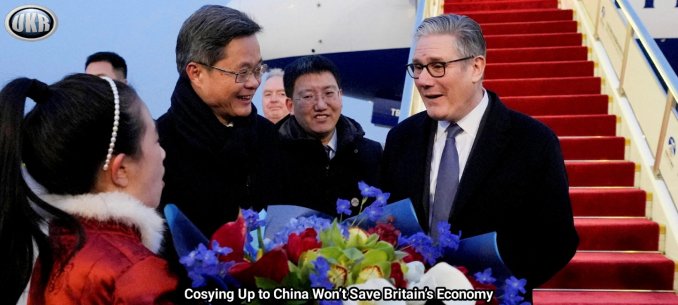
So, never-here-Keir is on, by my counting, his 38th overseas trip since entering Downing Street. This time, it is to Communist China, in what must feel like something of a homecoming for Starmer. The Prime Minister has declared that this trip will make Britain richer, which is a surprising goal given he is doing seemingly all he can in order to prevent this with domestic policy.
Cosying up to the CCP will make us not just richer, but also safer, apparently. As safe as Jimmy Lai, the British citizen held as a political prisoner in the Peoples’ Republic? As safe as the Uyghurs subjected to the mass sterilisation and cleansing programmes? We shall have to wait and see.
We all know that China has an enormous economy that has grown at stupendous rates in the 21st century. In fact, its economy outgrew Britain’s almost exactly 20 years ago. And we know, too, that many China watchers prize nuance above all else in the analysis of the Middle Kingdom, from academics and civil servants to City businessmen with greedy eyes on China’s domestic market. The more nuanced you acknowledge the situation to be, the better a China watcher you are.
But on the economics, the story isn’t actually that nuanced. The prospects for Britain to benefit from deeper economic ties are vastly more limited than its cheerleaders make out. For example, China accounts for just 0.2% of Foreign Direct Investment (FDI) into the UK. Compare this to the USA, which contributes nearly £1 in every £3 of FDI.
Since the last PM to visit China, Theresa May, travelled there in 2018, our trade deficit has doubled. (Most of the deals signed failed to materialise into anything, according to the FT). And even our biggest success stories, as Sam Goodman at the China Strategic Risks Institute reminded me, are failing: ‘AstraZeneca’s executives in China languish in jail and Lotus (owned by Geely) has cut its workforce in the UK by 42%.’
Surely these risible numbers are a REASON to try to engage more, rather than less, some will cry. No. The only areas that the CCP are interested in investing in are related to our critical national infrastructure. Don’t take my word for it; here’s the great leader Xi Jinping himself in 2020:
China must tighten international production chains’ dependence on China, forming powerful countermeasures and deterrent capabilities against foreigners artificially cutting off supplies.
The strategy is clear; make the world dependent on China by destroying our domestic capacity, compromising our energy and other sectors and forcing us into obeisance in the event of a future conflict.
Previous rounds of Chinese investment have likely cost more than they have saved anyway – let’s not forget that the taxpayer has had to foot the bill for over a quarter of a billion pounds so far on a partial renationalisation of British Steel thanks to Chinese firm Jingye. Not to mention the £2 billion we’re spending removing Huawei from our 5G, and whatever the cost was of buying China Nuclear General out of Hinckley.
In a nod to these concerns, the Labour Government says that money for heavy energy infrastructure, from nuclear to wind turbines, is not to be discussed, but that lowering whisky tariffs, improvements to market access for services firms and banking licences will be. On the surface these are all perfectly sensible. But what will this cost in return? The super-embassy, complete with its secret basements and ability to fill London with more agents of China’s security services, perhaps?
Given that Starmer need only turn to the pages of CapX or the swamps of Tufton Street to find ways to transform our economy without recourse to Beijing, we should ignore his comments on economic growth.
His baffling spinelessness – visible not just on this trip, but in the China Embassy and Chagos deals – is a grim case study of Robert Conquest’s rule that ‘every organisation behaves as if it is run by secret agents of its opponents’. If Starmer wants to convince the public that he is capable of making hard choices – not simply giving Xi Jinping everything he wants – he will need to do better than this.
All of this will be redundant if the Taiwan issue goes hot. And we will all wish we had de-risked our economy completely, rather than trying to be nuanced about it.
Click here to subscribe to our daily briefing – the best pieces from CapX and across the web.
This article (Cosying up to China won’t save Britain’s economy) was created and published by CapX and is republished here under “Fair Use” with attribution to the author James Price


Leave a Reply