

An operating system for climate action with a digital identification layer at its center.
JACOB NORDANGÅRD
As usual around this time of the year, it is time for the United Nations Climate Summit. About 50 000 conference attendees have flown to Belém in Brazil from all over the world to discuss how “to accelerate and expand climate action” at COP 30.
Despite the huge spikes in emissions that the transportation and accommodation of all participants will produce, the event is planned to be “carbon-neutral” by “offsetting the greenhouse gas emissions”, probably to the delight of the carbon credit scam industry.1
It seems like a never ending story. As usual, media has started to whip up scares about imminent climate doom, failed commitments to limit emissions, and the absence of prominent world leaders. The climate meetings are almost always described as failures. “Too little, too late.” It’s a worn-out formula repeated every year.

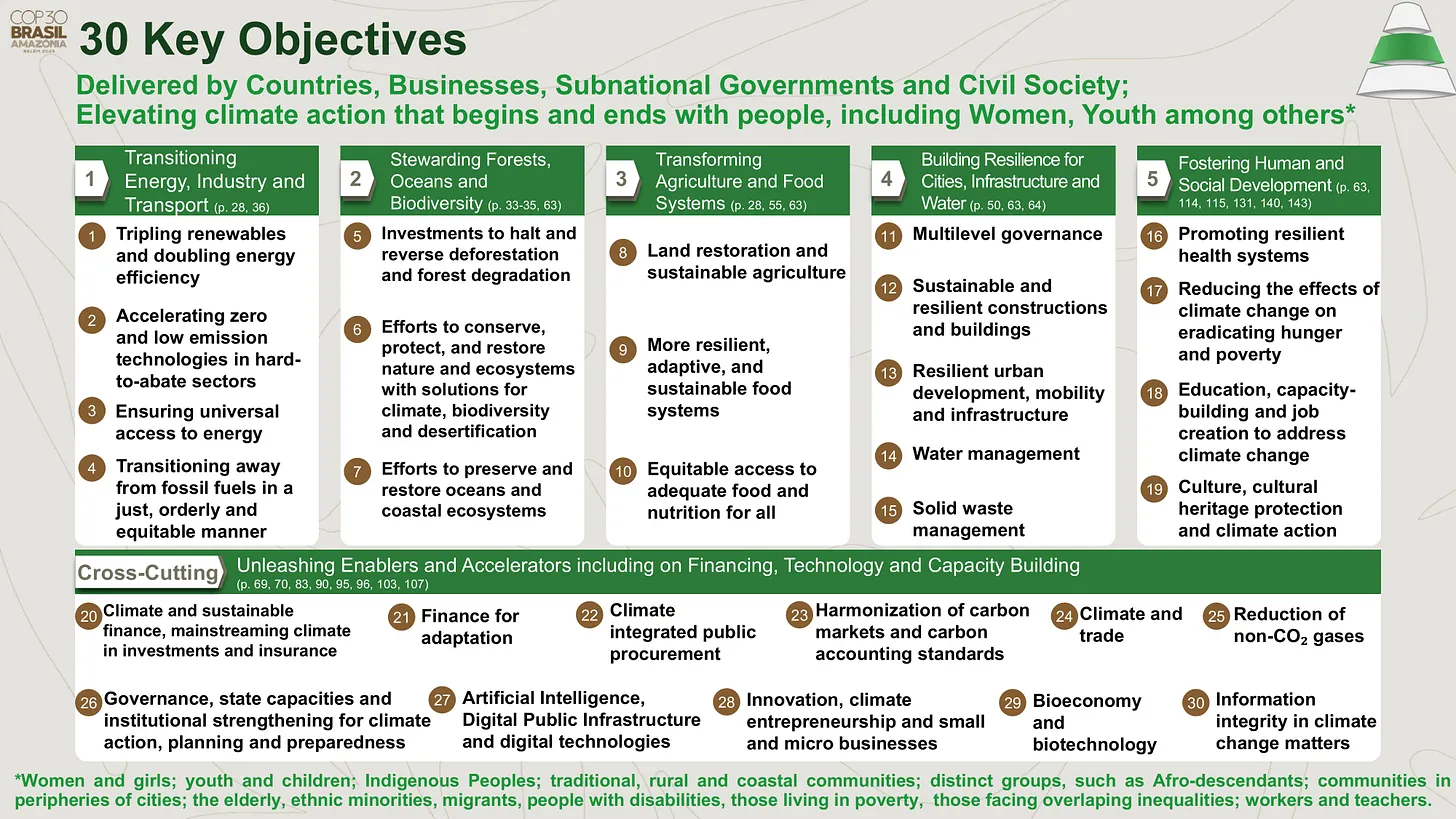
So, what is on the agenda? Well, the whole climate charade is intended to give birth to a highly efficient carbon management system that will support the Sustainable Development Goals (SDGs) with humans in the crosshairs. Climate Change is Systems Change. An important tool to achieve this is the application of Artificial Intelligence, Digital Public Infrastructure (DPI) and digital technologies (Key Objective #27).
Bill Gates is still highly involved in delivering these digital tools for “climate transformation”, despite the recent reporting about his retreat from climate change alarmism.2
A couple of days before the summit started, the Brazilian presidency presented a “groundbreaking proposal” for “transparent, interoperable and rapid coordination” of climate action called Global Public Digital Infrastructure for Climate (Climate DPI).
The proposal is an answer to the DPI for People and Planet Innovation Challenge which was launched in June this year by Japan International Cooperation Agency (JICA), Co-Develop, the Gates Foundation, the Centre for Digital Public Infrastructure (CDPI), and Boston Consulting Group (BCG) in partnership with the COP30 presidency.
The mission is to “to design, prototype, and present transformative solutions that leverage DPI to address pressing planetary environmental challenges” and “spark a global wave of experimentation, nurture a new generation of climate-tech builders, and surface solutions that are ready to scale – or already scaling – worldwide.”3
This is a development of the Digital Public Infrastructure concept which was introduced at the G20 summit in India in 2023. It is described as the “foundational digital systems that forms the backbone of modern societies.” I wrote a lengthy article about it about two years ago.
Digital Public Infrastructure for One Earth, One Family and One Future
JACOB NORDANGÅRD · 19 September 2023

At the G20 leaders’ meeting in India, under the motto “One Earth, One Family, One Future”, the new concept Digital Public Infrastructure (DPI) and the NGO One Future Alliance were launched. These initiatives intend to increase the interconnectedness of the data-based systems with the aim of meeting the Sustainable Development Goals – The fusion of the U…
Climate DPI is described as an “operating system for climate action” with the ability to “coordinate actions across borders at unprecedented speed and scale”, providing “real-time data for early warnings and disaster response.” Key components include:
…an Earth observation data commons, real-time climate risk monitoring systems, digital platforms for climate finance (with robust verification technologies), and integration of Artificial Intelligence both for climate (to enhance climate solutions) and for AI itself (to ensure digital infrastructure is sustainable).
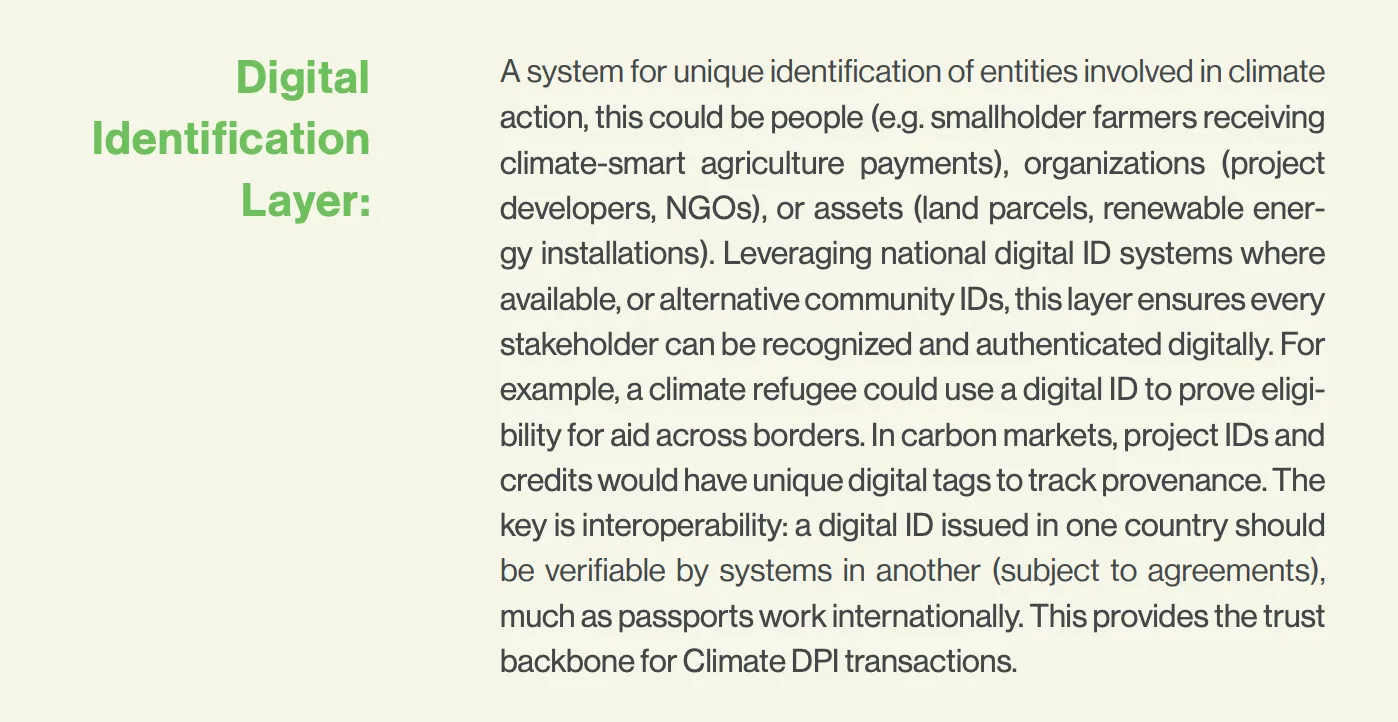
In the center is a digital identification layer, described as “a system for unique identification of entities involved in climate action”. This includes people, organisations, and assets.
As stated in the report, “Leveraging national digital ID systems where available, or alternative community IDs, this layer ensures every stakeholder can be recognized and authenticated digitally.”
The “dedicated Global Climate DPI” is described as a potential “game-changer in responding to the climate emergency” with the ability to “turbocharge climate action”. The report also recommends international governance “under the UNFCCC/COP framework to guide Climate DPI development, supported by an alliance of governments, technology partners, and civil society”.
One concrete example is the establishment of a UN Climate Change Council which is intended to act as a “political steward for Climate DPI”. The proposal for such a council was introduced only a couple of days ago by the hosting Brazilian president Lula da Silva in his Call of Belem for the Climate.4
Coincidentally, a similar mechanism was also suggested in last year’s essay A Logic for the Future by Rockefeller Brothers Fund’s president Stephen Heintz. As he put it,
Given the critical importance of avoiding climate catastrophe, it may be prudent for the Trusteeship Council to be replaced by a Climate Council that would incorporate, elevate, and strengthen the UNFCCC and its COPs and serve as a forum for implementation of agreed climate policies and actions.5
The Climate DPI report contains the basic requirements needed to establish an all-encompassing “all-seeing eye”, which can be integrated into the Global Government Technology Center’s vision of an AI-run Agentic State.
Welcome to Your Nightmare: The Externalization of the Agentic State
JACOB NORDANGÅRD · 15 Jul

Global Government Technology Centre in Berlin
As is stated in the report,
Climate DPI envisions integrating AI-driven systems to anticipate risks, optimize adaptation strategies, and support decision-making at all levels.
The coordinator of the report is the Brazilian lawyer Ronaldo Lemos who, unsurprisingly, was named a World Economic Forum Young Global Leader in 2015.
World Economic Forum is of course present at COP 30 and will launch the report Emerging Technology Solutions for Planetary Health in the Rockefeller Foundation-supported Planetary Science Pavilion, with the ever-present Potsdam Institute director Johan Rockström as a speaker.
Information Integrity on Climate Change
Another item on the COP30 agenda is “information integrity” (Key Objective #30). Brazil has launched the Global Initiative on Information Integrity on Climate Change, together with United Nations and UNESCO, with the mission of “investigating, exposing, and dismantling disinformation related to climate change.” The initiative was presented at the G20 Leaders’ Summit in Brazil last year, as a response to the Global Digital Compact (decided at the Summit of the Future in September last year).
The initiative will provide tools to “fight the coordinated disinformation campaigns impeding global progress on climate change.”6
One of the partners in the initiative is the global coalition Climate Action Against Disinformation (CAAD) assembling “90 leading climate and anti-disinformation organisations”.
Their definition of climate disinformation and misinformation is that it “undermines the existence or impacts of climate change, the unequivocal human influence on climate change, and the need for corresponding urgent action.”
In a recent newsletter the coalition raise the alarm that global belief in human-caused climate change has declined due to a “top-down campaign, backed by powerful financial networks that artificially inflates fringe opinions”.7
Examples of organisations in this network are the usual set of “villains” Heartland, CFACT, Leadership Institute and German EIKE, and of course the “techno-feudalists” in the Trump administration.
It is obvious that the rhetoric and actions by President Trump, the MAGA-movement and “Europe’s Anti-Democracy Coalition” will be used as a pretext to manage the flow of information on the Internet. This is how the powers behind the scenes use dichotomies to further the agenda.
“Wreck-it-Trump” provides the needed excuses for global control of the internet. In order to not “appease autocrats” like Trump, Climate Action Against Disinformation write in an Orwellian fashion that,
…regulation of these communications tools in this environment in order to protect democracy and the health of the people on the planet is going to be tough, but it is the only option for democracy and climate policy.
So what they essentially say is that a totalitarian surveillance regime is needed to save us from the authoritarians. “War is Peace,” “Freedom is Slavery,” and “Ignorance is Strength”.
Coming soon
Don’t miss our next newsletter with an updated list of WEF Young Global Leaders 1993–2025.
The translation of my 2022 book The Digital World Brain to English is now complete and will be available within the next couple of months. It is also under translation to German.
My latest book Temple of Solomon can now be shipped to the US again. Order it here.

Jessica Camille Aguirre (2024), “The warring conmen at the heart of a €5bn carbon trading scam”, The Guardian
David Goldmann (2025), “Bill Gates makes a stunning claim about climate change”, CNN
DPI for People and Planet (2025), Innovation Challenge Participant Application Guide,
Stephen Heintz (2024), A Logic for the Future, Rockefeller Brothers Fund
UN News (2024), “New UN initiative aims to counter climate disinformation”
Climate Disinfo Digest, “DATA MONITOR SEPTEMBER 2025: Make Europe Regress Again? Anti-Democratic Parties Copy US Climate Denial”
This article (COP30 proposal: “Global Public Digital Infrastructure for Climate” guided by a UN Climate Change Council) was created and published by Jacob Nordangard and is republished here under “Fair Use”
See Related Article Below
COP Isn’t Dead Yet. The Gang Is Creating A Slush “Fund for Responding to Loss and Damage” That Is Sure to Grow in Size and Power.
DAVID WOJICK
Guest Post from David Wojick via CFact.
Climate alarmism has been seriously stalled by a combination of President Trump and unfavorable economic conditions. So, the diplomats laboring at COP30 are working on long-term issues, hoping for better “weather,” as it were. They are still very busy negotiating the future.
Major policy initiatives often take a decade or more, so while subdued, the work has not slowed down. Rumors of the death of alarmism are greatly exaggerated. The greens are just biding their time.
Most of the issues are about money, of course, although the call for increased 2030 emission reduction targets is also on the table. The money issues mostly have to do with long-term objectives and mechanisms. This includes various global taxes such as on shipping emissions and airfare.

An unavoidable, immediate money issue is raising the supposed $100 billion annual payment by “developed” countries to “developing” countries. (This distinction between donor and recipient countries is based on two lists from 1992 that are long out of date.)
But even here, what was once talk of trillions has moderated to a mere hundreds of billions in the short term. Instead, they are supposed to develop a roadmap to get to $1.3 trillion a year some time from now.
On the new emission targets, there has been a distinct lack of ambition. Many developing countries have yet to submit theirs. One reason may be that these grand plans are all written as being contingent on funding from the “developed” countries. Raising these numbers could be a bad move politically.
The EU just squeezed its new target in. It increases the loopholes more than the target. Even at that, several member countries objected to it.
One of the biggest things happening is likely to fly under the news radar since it sounds vague and small. The new “Fund for Responding to Loss and Damage (FRLD)” has a mere $250 million, but COP30 will see the formal launch of the Fund’s first call for project funding requests.
These loss and damage response requests will be from developing countries hit hard by bad weather supposedly caused by climate change, or maybe by sea-level rise, or even by wildfires. The thing is that, at this point, we have no idea what qualifies as climate loss or damage. That vagueness makes this first proposal process a very big deal even if the money is next to nothing.
If every bit of big bad weather is a “climate event,” as they are now called, how do you decide which deserves a cash response? If only certain events qualify, then which are they? These are very difficult questions which the FRLD is launching at COP30.
Also, which countries qualify? It is sometimes said that this funding is intended for just the poorest countries. If so, then what is the qualifying threshold for compensation? How poor does a country have to be?
Ideally, these questions will be addressed in the call for funding proposals, but maybe not. For that matter, does the COP membership have a say in the answers? If not, then why is the call being made at the COP? If so, then it could produce some serious infighting.
As an aside, a recent study reported an interesting problem with countries taking FRLD funding. Some say they do not want to do it because their populace would then want to be funded for all weather-related loss and damage, not just what the FRLD funded.
Note that the FRLD could get sizable because developed countries already put a lot of money into disaster assistance. They could run it through the FRLD as a feel-good exercise, maybe even counting it toward the annual payment. A lot of foreign aid is already counted that way.
In summary, the popular idea that COP30 is a dead end is false. They will just give the busy-work program a future focus. Diplomats do that all the time.
Dr. David Wojick is an independent policy analyst and senior advisor to CFACT. As a civil engineer with a Ph.D. in logic and analytic philosophy of science, he brings a unique perspective to complex policy issues. He specializes in science and technology-intensive issues, especially in energy and the environment.
This article (COP Isn’t Dead Yet. The Gang Is Creating A Slush “Fund for Responding to Loss and Damage” That Is Sure to Grow in Size and Power.) was created and published by Energy Security and Freedom and is republished here under “Fair Use” with attribution to the author David Wojick
Featured image:bintmusic.com

••••
The Liberty Beacon Project is now expanding at a near exponential rate, and for this we are grateful and excited! But we must also be practical. For 7 years we have not asked for any donations, and have built this project with our own funds as we grew. We are now experiencing ever increasing growing pains due to the large number of websites and projects we represent. So we have just installed donation buttons on our websites and ask that you consider this when you visit them. Nothing is too small. We thank you for all your support and your considerations … (TLB)
••••
Comment Policy: As a privately owned web site, we reserve the right to remove comments that contain spam, advertising, vulgarity, threats of violence, racism, or personal/abusive attacks on other users. This also applies to trolling, the use of more than one alias, or just intentional mischief. Enforcement of this policy is at the discretion of this websites administrators. Repeat offenders may be blocked or permanently banned without prior warning.
••••
Disclaimer: TLB websites contain copyrighted material the use of which has not always been specifically authorized by the copyright owner. We are making such material available to our readers under the provisions of “fair use” in an effort to advance a better understanding of political, health, economic and social issues. The material on this site is distributed without profit to those who have expressed a prior interest in receiving it for research and educational purposes. If you wish to use copyrighted material for purposes other than “fair use” you must request permission from the copyright owner.
••••
Disclaimer: The information and opinions shared are for informational purposes only including, but not limited to, text, graphics, images and other material are not intended as medical advice or instruction. Nothing mentioned is intended to be a substitute for professional medical advice, diagnosis or treatment.
Disclaimer: The views and opinions expressed in this article are those of the author and do not necessarily reflect the official policy or position of The Liberty Beacon Project.


Leave a Reply