

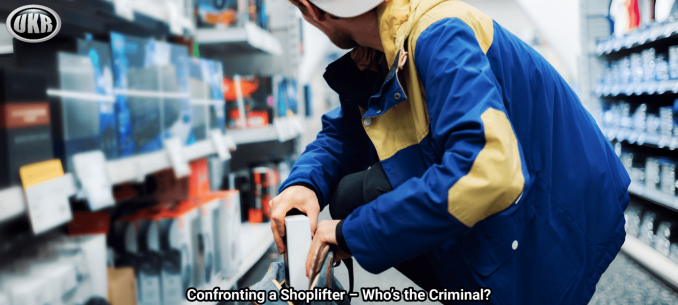
The Telegraph has a sorry tale about a member of the public who challenged a shoplifter in a Tesco branch, only to be vilified by the staff and ignored by the police. The Government has admitted that shoplifting has got out of hand while the policing minister Dame Diana Johnson has said shopkeepers need to do more to deter the thieves and keep expensive items away from the shop entrances.
The Telegraph’s correspondent has wisely maintained anonymity and not mentioned the location, but it’s no less dispiriting for that:
I was shopping in the Tesco Express on my local high street in South East London at 1pm last Sunday afternoon when I saw a bald, white man in his 40s use his arm to sweep an entire shelf of medicines into a gym bag. He was completely brazen about it: he wasn’t wearing a mask or hoodie to hide his face, he was in a bright-red tracksuit.
What made it even more enraging was that the Tesco staff could see him and they didn’t do a thing about it. They just stood there and watched, looking totally unbothered.
I was passing the shoplifter as he started sweeping a second shelf of medicines into his bag and I couldn’t stop myself: I loudly exclaimed: “Really?” It was almost a reflex – I was so shocked and angry.
In fact, the thief left in a casual and indifferent way. Stunned by the brazen incident and sobered by the thought that a knife might have been pulled (it wasn’t), the anonymous shopper turned to the staff and was met with not just a flat wall of indifference, but annoyance:
I started questioning them, asking: “Are you seeing this? Why did you just stand there? Why didn’t you say anything?” One woman who works there was just as unbothered as the shoplifter. She shrugged and said: “Oh, we’re not paid to confront thieves.” She pointed out that they’ve got CCTV, and she did say they would call the police later.
That’s true of course. The shop staff aren’t paid to confront shoplifters and nor are they provided with Robocop outfits and pump-action shotguns to see them off. The Thames Valley police and crime commissioner Matthew Barber has already told the public they should be doing more to try and cut thefts from shops, with the useful advice: “If you’re in a store and you witness shoplifting happening I think at the very least you should report that to the police, report it to the staff, perhaps take some mobile phone footage, shout at someone ‘put that back’.”
As it happens, the shouting in the Tesco Express came from the staff, but they weren’t addressing the thief:
But when I asked “Is this the new normal – are you just going to smile and nod?”, the staff started shouting at me…
Even more shocking, another customer (a man in his 50s with a long ponytail) then started screaming at me: “Leave it, just leave it!” He went purple in the face. He was furious that I’d said anything to the staff – he was angrier about that than about the shoplifter. I was completely stunned.
I felt like I was going mad. That’s why I’d said: “Are you seeing this?” – I was half wondering if I needed to visit my GP and get my eyes tested! The staff made me feel as if I was the person in the wrong.
The point of course is that the Telegraph’s anonymous shopper was describing an episode that epitomises a society slowly disintegrating. Law and order rely on willing compliance. It has never been possible for a state police force, however oppressive, to prevent crime completely.
The police, of course – proud possessors of Klingon cloaking devices unless accosting ordinary individuals for daring to express unauthorised opinions – were completely uninterested when the Telegraph shopper reported another incident directly to them:
I called the police afterwards and they sounded totally unfazed, even bored. I offered to stay until they came and give a description of the man, or send them the photos I’d taken of the mess, but they didn’t take me seriously. The policeman said: “Nah mate, you get on home.”

.
Such responses, of course, make it difficult not to see the police as complicit in the whole state of deterioration. Perhaps they’re not paid to tackle thieves either, though most of us have been labouring under the belief that they are – mainly because lots of us are obliged to stump up for their salaries.
Little by little, it’s all unravelling, whether in a Tesco Express or elsewhere. It turns out that even Tesco isn’t bothered:
After the second incident, when I’d confronted the shoplifter, I called Tesco headquarters. I explained that this might be happening on Sundays because for some reason they don’t have a security person on the door on a Sunday – on the other days of the week, the person in that role wears a yellow vest and a body cam.
The woman at Tesco HQ said they would think about having a security person on Sundays, but she quickly added that they wouldn’t physically stop a thief either, they would just record it.
Why would Tesco be bothered? Presumably they have long since factored in shoplifting to the prices, meaning that honest shoppers just cover the loss for the company.
It seems not many other people are either. The Telegraph shopper took to social media:
I posted about my experience in my local Facebook group, and I was baffled by the responses. Lots of people were vehemently against confronting shoplifters. One woman told me to mind my own business. If you even mention the idea, you get labelled socially conservative and it becomes political. Just for saying you’re against crime, really?
It seems then that the shoplifting crisis isn’t just about shoplifters, but a tired, brow-beaten country and population where initiative and community spirit are slowly being crushed out of existence. We all know too well that to raise a finger, to do anything to try and reverse the decline, even just to protest verbally, is far more likely to result in vilification by others and a knock at the front door – to say nothing of the possibility of being slashed with a machete.
In that sense, are we all to blame? Are we all complicit in some way? If we are, we are getting the Britain we deserve. Or is it the fault of the police, the courts that barely raise an eyebrow on the rare occasions a shoplifter appears before them, and the state? One thing is certain: the more people that get away with shoplifting, the more that discover there is nothing to stop them, the more of them there will be.
Look at what happened to the Wrexham shopkeeper who put up a sign calling shoplifters “scumbags”. Naturally, a member of the constabulary came to the shop and told him to remove the “provocative and offensive” sign after a complaint from a member of the public – even though, as Rod Liddle has pointed out in the Spectator – “of course shoplifters are scumbags”. Luckily, the shopkeeper has stuck to his guns, but he seems to be a lone voice.
The Telegraph piece is worth reading in full.
See Related Article Below
Immigration: concealing the effects
RICHARD NORTH
Something of a recurring theme of mine is the premise that much of the elite, the “establishment”, or whatever term you might prefer, seems to inhabit a different planet when it comes to addressing immigration and the attendant social ills which stem from decades of uncontrolled mass migration.
It is not only what members of this amorphous “community” says (or writes) about immigration – an area I touched upon recently but, in many cases, what they leave out, thereby concealing the effects of major policy failures.
An example of this latter phenomenon comes in the weekly column written by Alister Heath for the Telegraph, dedicated to the subject of shoplifting – one that has been much in the news of late.
Headed: “Labour’s shoplifting lies show that it doesn’t understand how angry Britain is”, his sub-head gives the broader clue as to his theme as he grandly tells us that: “Thieves have achieved what Marx could only dream of: the abolition of private property”.
The immediate focus of Heath’s piece is an instruction from policing minister Diana Johnson addressed to shopkeepers, telling them not to place “high value” items close to store entrances.
Heath makes much of Johnson’s comments on the BBC Radio 4 Today programme, where she says: “I think stores need to play their part in making sure that items that are high value are not at the front of the store because that is an issue in some stores, that they put bottles of alcohol at the front of the store which obviously people will nick”.
The Telegraph’s columnist sees in this a “grotesque moral inversion” exhibited by Labour, effectively blaming the victims of crime for enticing shoplifters.
He also takes issue – and rightly in the broader context of what is indisputably an “epidemic” of shoplifting – with Johnson’s use of the colloquial “nick”, which he says “trivialises the violation, demonstrates an inability to take shoplifting seriously and implies that it is a cheeky, opportunistic, almost child-like act of rule-bending”.
In the best part of a thousand words, he then launches into a high-flown discussion of the morality of theft and the motivation for stealing, before eventually finishing with a little homily about Lee Kuan Yew, Singapore’s former prime minister who, shortly after the war, visited London.
It was there that Lee spotted a newspaper kiosk in bustling Piccadilly that relied on the honour system. Anonymous customers dropped coins into a box, took out the right change, and picked up papers, unsupervised. They could have stolen but chose not to.
Such honesty, says Heath was a revelation for Lee, and the inspiration for Singapore’s low-crime obsession. By way of a conclusion to his piece, he adds that it should galvanise Reform and Tory politicians.
“Stealing from shops symbolises our decline, it should be taboo”, he declares, finishing with a triumphant flourish by asserting: “We need to become a high trust society again, and that requires waging a pitiless war on shoplifters”.
One has to stand back from this for a moment to take in fully Heath’s prescription for dealing with the epidemic of shoplifting: he wants us to become “a high trust society again”, and to achieve that “requires waging a pitiless war on shoplifters”.
If we are to take his nostrums at face value, the key factor in this crimewave – which last time I wrote about it cost retailers (and indirectly us) £2.2 billion on the year – is the breakdown of our “high trust society”. where customer no longer feel any moral imperative not to steal.
Coincidentally, Pete recently had a look at shoplifting and concluded that there are five basic types of shop theft.
The first of his categories is one that Heath also dwells briefly upon, encompassing the “desperates” (lifting one or two things they actually need – and feeling bad about it).
Coming next is the low-level criminal who takes what they can get away with because they just don’t want to pay, and then there are the addicts looking to feed their habits who choose shoplifting as an alternative to burglary as an easier option. Another category, unfortunately all too common in some urban districts, is shop looting – usually blacks with a sense of entitlement.
Then, there is organised theft – usually prestige retail goods and the more expensive items such as meat and booze. This category is undoubtedly the most serious, and is almost certainly the single most important cause on the increased losses experienced by retailers.
Now the point here is that this has absolutely nothing to do with “our decline” – as Heath puts it. This type of crime is mainly associated with Roma and Albanian immigrant gangs, with some other nationalities implicated.
In my earlier piece on this issue, I lifted a quote from Paul Gerrard, the public affairs director at the Co-op, published in the Guardian after he had spoken to the House of Lords justice and home affairs committee inquiry into shoplifting.
Then he complained that the 44 percent rise in retail crime his operation had experienced last year was caused by “people coming into stores with wheelie bins or a builder’s bag to steal the entire confectionery section or spirits or meat section”, rather than by individuals “stealing to survive”.
This phenomenon has been widely reported and, as this article reminds us that, last December, a Channel 4 investigation reported that a Romanian crime gang was behind the dramatic rise in shoplifting across the UK.
In the programme, reporter, Matt Shea tracked down a gang leader in Northampton, who had been linked to over £120,000 worth of stolen goods from Morrison’s supermarkets. The goods, such as Sudocrem, Sensodyne toothpaste, and Lemsip were sold to a local wholesaler with ties to an illegal Visa scheme.
Significantly, the gang leader, Gugulan, openly admitted that stolen goods had been sold in the UK to buyers from the Indian community, saying, “There are 1,000 Romanian thieves in England. Everyone steals in England, and they sell it to the Indians”.
Shea also uncovered the role of a wholesaler involved in selling the stolen items globally, including to the Middle East and Africa. The wholesaler revealed its part in a scheme arranging fake marriages for Indian and Pakistani nationals to secure UK residency. Thus, Channel 4’s investigation not only exposed the extent of the theft but also highlighted a black market thriving on stolen goods.
Crucially, both facets of this illegal enterprise involved immigrant communities – another example of the benefits of multiculturalism and diversity. This crimewave has nothing to do with the breakdown of “high-trust society” and has everything to do with an immigration policy that has gone badly wrong.
For him to be unaware of this, Heath surely would have had to have lived on a desert island for the last decade, cut off from any UK news media. Yet, for that period he has been an active writer for one of the UK’s major national newspapers.
For all that, there is only one reference to immigration in his piece, where he argues that amongst the many real losers from shoplifting are shop owners – usually, he says, “hardworking immigrant heroes”.
Apart from anything else, this is nonsense – the big losers are the multiple stores – the supermarkets and high street stores – which are taking a massive hit, mostly from immigrants which he fails to mention.
Thus, when it comes to dealing with shoplifting, Heath may correctly say that this requires “waging a pitiless war on shoplifters”. But that means recognising that this is organised crime, perpetrated on a huge scale by identifiable immigrant communities, the thieves amongst which should be ruthlessly deported and barred from returning.
To be fair, Heath is not the only one smitten by this selective myopia. The policing minister Diana Johnson is just as guilty of failing to pinpoint the major source of the problem.
Then we have Matthew Barber, the Conservative Police and Crime Commissioner for Thames Valley, who says it was wrong to think that tackling thieves was just a job for police. The public has a duty to stand up to shoplifters rather than relying solely on police officers.
Barber must wander round his parish with his head in a sack, if he fails to notice that shoplifting has become organised crime, perpetrated largely by immigrants. And that is precisely why it should be a police matter, with the active cooperation of the Home Office.
But, if nobody is talking about the real cause of the problem, we can hardly expect an effective response. As with so much of our failed immigration policy, the public takes the blame and pays the price.
This article (Immigration: concealing the effects) was created and published by Turbulent Times and is republished here under “Fair Use” with attribution to the author Richard North
****
Labour’s shoplifting lies show that it doesn’t understand how angry Britain is
Thieves have achieved what Marx could only dream of: the abolition of private property
Theft is wrong. Private property is sacrosanct. Shoplifting must be stamped out. We are governed by malicious, ignorant fools who cannot grasp the importance of such precepts, and who are vandalising our social order through their negligence, arrogance and suicidal empathy.
Take the grotesque moral inversion exhibited by Labour when it tells shopkeepers not to place “high value” items close to store entrances, in effect blaming the victims of crime for enticing shoplifters. A minister, Dame Diana Johnson, complained that “some stores…put bottles of alcohol at the front of the store which obviously people will nick.”
Note the use of the colloquial “nick”, which trivialises the violation, demonstrates an inability to take shoplifting seriously and implies that it is a cheeky, opportunistic, almost child-like act of rule-bending.
The rest of Johnson’s intervention is equally reprehensible. Why would a passer-by “obviously” feel compelled to grab a bottle if they happen to see it? What kind of excuse is that? Why couldn’t they choose not to steal? Do they entirely lack agency? Are we “noble savages”, unable to control our impulses, or are we civilised, demanding self-control, deferred gratification and respect for moral tenets such as “thou shalt not steal”?
Labour, in common with many Tories, civil servants, charities and the police establishment, succumbed long ago to “progressive” woke ideology. This divides the world into oppressors and oppressed, powerful and powerless, bad and good. Shop-owners are part of the capitalist class, and regardless of whether they are a major chain or the local independent corner shop, are tainted: they control the “power structure” and are inherently guilty of racism, sexism and every sin.
Shoplifters are defined, equally reflexively, as oppressed, latter-day Jean Valjeans, after Victor Hugo’s character in Les Misérables jailed for 19 years for stealing bread for his sister’s starving children.
Sadiq Khan, London’s mayor, was asked by the Big Issue last year “if you saw someone shoplifting essentials in a supermarket, what would you do?“ Khan’s answer, in which he also cited people stealing nappies: “I suspect I’d l take my wallet out, and I would pay for it.”
Yet in 99.99 per cent of cases, this would be the wrong strategy. It would hand moral victory to the thieves, legitimise their lifestyle choice and laziness, send a message that it’s fine to steal food, promote warped incentives, militate against work and self-reliance, and promulgate the incorrect view that shoplifting is the only way for tens of thousands of perpetrators to survive.
If they are not themselves hungry, thieves are seen by woke extremists as righteous activists fighting for “equity”. They are freelance socialists: the Tory-Labour duopoly hiked taxes to a near 80-year high, and drastically raised welfare spending, but that is not (and, short of full communism, can never be) good enough, so “social justice warriors” are engaging in their own redistribution.
“La propriété, c’est le vol!” – property is theft – as Pierre-Joseph Proudhon, the anarcho-Leftist thinker, put it, so shoplifting is a victimless crime, or so this deranged logic implies. This is nonsense: there are many real losers, including the shop’s owners (usually hardworking immigrant heroes), supermarket shareholders (including pension savers), employees whose wages will be depressed, consumers who pay higher prices, and people in high-crime areas turned into food deserts. Staff and security guards are harassed and assaulted.
Yet a store owner who understandably put up a sign criticising “scumbags shoplifting” was told by police to consider changing the wording because it was offensive. Once again, the victim is turned into a perpetrator. The authorities police speech rather than crime.
Matthew Barber, Thames Valley Police Commissioner, insists the public has a duty to stand up to shoplifters. Yes, in theory – but can we be sure the authorities will stand by citizens who make an arrest, or help to immobilise a thief? Won’t they be sued, or arrested, or beaten up by thugs? As on cue, Dame Diana warned the public against stepping in to confront thieves, claiming it isn’t “appropriate”.
Stealing from shops has been largely decriminalised. The police recorded a 20 per cent jump in shoplifting in the year to March 2025, despite extra security tags in shops, their highest level since statistics began in 2003.
The public, and the populists, are right, and the elites are wrong: this cannot go on. It is not just that Bonaparte was right that we are a nation of shopkeepers. Western civilisation and capitalism cannot survive if we cease to believe in, and enforce, private property rights. Doing so is what made Britain great.
The Telegraph: continue reading

••••
The Liberty Beacon Project is now expanding at a near exponential rate, and for this we are grateful and excited! But we must also be practical. For 7 years we have not asked for any donations, and have built this project with our own funds as we grew. We are now experiencing ever increasing growing pains due to the large number of websites and projects we represent. So we have just installed donation buttons on our websites and ask that you consider this when you visit them. Nothing is too small. We thank you for all your support and your considerations … (TLB)
••••
Comment Policy: As a privately owned web site, we reserve the right to remove comments that contain spam, advertising, vulgarity, threats of violence, racism, or personal/abusive attacks on other users. This also applies to trolling, the use of more than one alias, or just intentional mischief. Enforcement of this policy is at the discretion of this websites administrators. Repeat offenders may be blocked or permanently banned without prior warning.
••••
Disclaimer: TLB websites contain copyrighted material the use of which has not always been specifically authorized by the copyright owner. We are making such material available to our readers under the provisions of “fair use” in an effort to advance a better understanding of political, health, economic and social issues. The material on this site is distributed without profit to those who have expressed a prior interest in receiving it for research and educational purposes. If you wish to use copyrighted material for purposes other than “fair use” you must request permission from the copyright owner.
••••
Disclaimer: The information and opinions shared are for informational purposes only including, but not limited to, text, graphics, images and other material are not intended as medical advice or instruction. Nothing mentioned is intended to be a substitute for professional medical advice, diagnosis or treatment.
Disclaimer: The views and opinions expressed in this article are those of the author and do not necessarily reflect the official policy or position of The Liberty Beacon Project.


Leave a Reply