

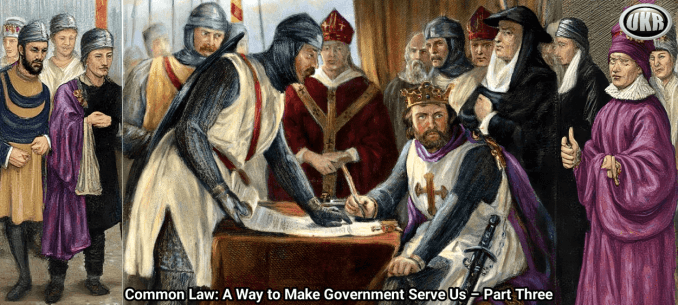
Magna Carta

IAIN HUNTER
It’s been a few months since I wrote Common Law Part Two and a return to the theme is long overdue. I had an idea of where I wanted to go in this Part Three but, in looking for the material I wanted to pull it together, I came across so much that I had to have a rethink.
You may be wondering about the relevance of the striking woman represented at the top of this article That is an artist’s depiction of Eleanor of Aquitaine (1124-1204), a figure of some significance in English (British) history, well up there with Boudicca and Queen Elizabeth I.
Eleanor became Duchess of Aquitaine on the death of her father William X, Duke of Aquitaine, when she was 13 years old. Almost immediately she was married to Prince Louis of France who soon became King Louis VII, making her the Queen Consort of France. However, that marriage ended in 1252 when she was 28 due to her failure to bear a male heir and for reasons of consanguinity. In the same year she married Henry, Duke of Normandy, who was eleven years her junior. Two years later he became Henry II of England thus making her a Queen Consort for a second time and bringing together the lands that made up the Angevin Empire. She bore Henry five sons and three daughters. Three of those sons, Henry the Young King, Richard and John would also become Kings of England.
Eleanor was at the heart of power of two kingdoms; she was married to kings and gave birth to kings, but it is for her recognition of the abilities of one William Marshall, Earl of Pembroke, for which she must be remembered here.
There are seven ‘Pillars of Power” – martial skills, diplomatic skills, intelligence gathering, economic understanding, financial ability, loyalty and the power to inspire it in others, and enforcement of the laws and taxes. William Marshall, later known as William the Marshall, had all these qualities in spades which none of Eleanor’s sons did, not even The Lionheart. Early in his service, William had saved Eleanor’s life, being wounded and captured in the process. Having realised his value to her, she paid a ransom for his return and made sure he was kept close to court thereafter. Had Eleanor not seen the special qualities William possessed, Magna Carta may never have happened. For that she deserves recognition. We’ll come back to William the Marshall later.
We know that her youngest surviving son John became a seriously bad king, but it was hardly surprising. He had been a member of a dysfunctional power family in which there had been much rivalry, strife and rebellion against the rule of Henry II, even involving Queen Eleanor herself. There have been stage plays and films about this period, the most well-known being the Lion in Winter. King John was an undoubted tyrant who mistrusted the people, treated them disgracefully, taxed them arbitrarily, seized lands and imprisoned, tortured and executed them. However, he made one huge mistake. He also did it to powerful people who could, and did, fight back – the Barons.
What was the Barons’ beef? Well, during the reigns of Henry I and II there had been a very rapid development of law and judicial practice which had been based on what had already existed for hundreds of years. What is often overlooked is that Anglo-Saxon England was very efficiently organised and administered. Government was by the King and the Church under laws developed over the centuries as described in Part Two of this series. The King was crowned by the Church in the course of which he took an oath – an oath to the Church and an oath to the people to govern according to the ancient law.
England was also very rich. It had been able to maintain a coinage of uniform fineness, recalling the coins and reminting them every three to four years. That was one of the chief reasons William the Conqueror had wanted England quite apart from his belief that it had been promised to him by Edward the Confessor. When they got around to assessing the spoils, William and the conquering Normans had never seen so much gold.
It is often said that nothing much changed in England as a result of the Norman Conquest apart from who formed the ruling class. That hides the truth that there was still resistance and five long years of campaigning to subdue England. One important, vital thing William did was to take London quickly and have himself crowned in Westminster Abbey which involved taking the oath, the same oath that Anglo-Saxon kings had taken. This meant that he implicitly accepted the ancient laws and would govern accordingly once the country was pacified. The Barons had to conform and adopt the system of laws which, they discovered, they rather liked. That explains how they came to rebel against a tyrant king a century and a half later.
Anyway, to Magna Carta: The first stumbling block we come across is what version of Magna Carta do we hold to be the operative one. Is it Magna Carta 1215, of which four copies exist, or is it the 1216 version? Or the 1217? Or the 1225? If you check the government legislation website you’ll find that the version of Magna Carta which the government thinks operates is, in fact, Magna Carta 1297. Of course it does, because in 1297, Parliament existed, and this version of Magna Carta was laid before it, first in 1265 and again in 1297. Many of the Articles have been repealed down the succeeding centuries because they are no longer applicable leaving the bare bones of the original document. The original Article 39 is now Article 29 and Article 61, the one which provides for four Barons of a Baronial Council of twenty-five to distrain upon the King for doing unKingly things is removed.
William Keyte of commonlawconstitution.org is adamant that it is Magna Carta 1215. Historian Professor David Starkey, on the other hand, thinks it is Magna Carta 1225.
This is the Starkeyite position: Magna Carta 1215 was a disaster because it effectively established a committee with absolute powers to oversee the King, a sort of Committee of Public Safety as would be established during the French Revolution over 575 years later. What this would have meant is that the country would be delivered into the hands of the nobles and it would have descended into a narrow aristocratic republic at war with itself and which would have been every bit as tyrannical as King John had been, much to the detriment of everybody.
As we know, neither King John nor the Barons adhered to the Charter and it was annulled a few months later, on John’s appeal, by Pope Innocent III on the grounds that it had been extracted from the King and sealed under duress and was therefore not lawful. The country became embroiled in another Barons’ war in the course of which in 1216 John lost his baggage train and his life while attempting to cross the fens.
This is where William the Marshall steps back into the picture. After all, it had been he who had negotiated the truce between King John and the Barons which lead to Magna Carta, and it was he who had encouraged its creation. He now pledged himself to the service of John’s son, the nine-year-old Henry III and he became his Regent.
What William did was to reissue Magna Carta in 1217 keeping all the good bits such as consent to taxation, the promise of impartial justice and uniform weights and measures while jettisoning those parts he thought too onerous and threatening to the King. He put them to one side with a promise to discuss them later. That discussion never happened, and Article 61 was permanently left out. William turned Magna Carta into a proto-constitutional document which was granted again in 1225 in exchange for an agreement to general taxation in return for redress of grievance. The idea that government answers to the governed was established along with the idea that all are equal under the law.
William the Marshall didn’t live to see the re-issue of Magna Carta in 1225. He died peacefully at his home in Caversham in 1219 but, ever the warrior, not before leading a cavalry charge in the Battle of Lincoln in 1217 at around the age of seventy.
Contrary to popular belief, two things that weren’t specifically included in Magna Carta were Trial by Jury and Habeas Corpus, although something akin to Trial by Jury had been in existence in the ancient Anglo-Saxon dooms. By happy coincidence, something else happened in 1215 which was equally important to the development of English law and custom. The Lateran Council, called by Pope Innocent III in 2013, finally took place in November of 1215.
In one of the Canons issued at the council it reduced the prohibited degrees of consanguinity in marriage from seven to four which meant that marriage between people with a common grandparent (first cousins) was forbidden. This, as much as anything according to David Starkey, contributed to the ending in British culture of the clan system and prepared the ground for the nuclear family and laws of contract.
The second change was that priests were forbidden to officiate at trials by combat and trials by ordeal. Clerics were forbidden to pronounce or execute a sentence of death. Nor could they act as judges in extreme criminal cases, nor take part in matters connected with any judicial tests. This created the grounds for the development of Trial by Jury.
The Magna Carta of 1297 granted by Edward I was simply a re-issue of Magna Carta 1225 which had also been re-confirmed in 1237, 1253 and 1265.
If all this is true, why then did we celebrate along with Queen Elizabeth II, the 800th Anniversary of Magna Carta on June 15th 2015, and not June 15th this year, 2025? Why did four Peers of the Realm petition the Queen in March 2001, invoking Article 61 over the Treaty of Nice on the grounds that, by giving away sovereignty to the European Union, she was endangering the ancient rights and freedoms of the British people, in effect betraying her Coronation Oath? The petition had no effect because, apart from anything else, the Committee of Twenty-Five Barons had not the means to:
“distrain and afflict us by every means possible, by taking castles, lands and possessions and in any other ways they can, until it is rectified in accordance with their judgment, albeit sparing our own person and the persons of our queen and children”.
And why did the Magna Carta Project, which aimed to provide a commentary and resources for scholars, schools and the general public, start its research and time its activities and lectures around the 800th anniversary on 15th June 2015?
Researcher Edward Fitzgerald, in his book Smoke and Mirrors, gives his rationale for insisting that it is still Magna Carta 1215 which is valid [my parentheses]:
Multiple amendments subsequent to the 1215 original Magna Carta signed in Runnymede on 15th June 1215 [King John did not sign it, he sealed it] were made by various Kings (and a Regent) – [William the Marshall] during troubled times and with a far less conspicuous list of witnesses than the 1215 agreement. I refer to the detailed article by Dr Sophie Ambler [on the Magna Carta Project Website].
The 1225 version was subsequently debated in 1265 in the first assembly of Parliament and is regarded as the version appearing on the Statute Book since 1297. The 1297 version has since had much of its text repealed and it is the only version considered ‘valid’ by those in Parliament. As a settlement of armed conflict with the Barons (representing the men and women of the land) and King John due to him breaking his Coronation Oath, it is a preposterous view of Parliament, since the 1215 Magna Carta (Charter of Runnymede) stands superior in perpetuity and is not repealable.
The Article by Dr Sophie Ambler was a feature of the month on the Magna Carta Project website in July 2014 under the title The Witness Lists to Magna Carta 1215-1265. It is a very interesting account of the trials and tribulations of the times and the years immediately after 1215. If you are interested, you can read it here.
We are where we are with this. Edward Fitzgerald and William Keyte and many of the rest of us may insist until the cows come home that it is Magna Carta 1215 that is still valid. Parliament will deny it. David Starkey provides a very useful historian’s interpretation and an understandable word of caution in the realms of what ‘would have’ occurred. What would be intriguing would be a debate between him and either William Keyte or Edward Fitzgerald on the subject. However, I doubt that a conclusion would be reached, and the argument will probably rage on forever.
Trying to use Magna Carta 1215 Article 61 to reign in a tyrannical government is somewhat hamstrung by the fact that the Monarch is not at present the effective part of the executive arm of government that the constitution permits. He is captured by Parliament. There would undoubtedly be a constitutional crisis were he to attempt to withhold his assent to any Act being implemented by the elected government. That said, there is one part that we all should know and have engraved on our hearts, whether it’s from Magna Carta 1215, 1216, 1217, 1225 or the remnants of 1297 which are on the Statute Book and it’s this:
No free man is to be arrested, or imprisoned, or disseised, or outlawed, or exiled, or in any other way ruined, nor will we go against him or send against him, except by the lawful judgment of his peers or by the law of the land.
If Lucy Connolly, or any of the other people imprisoned in 2024 as a result of the protests following the Southport atrocity, had been made aware of this and felt that they were being unjustly tried, they could, and should, have claimed their right to a Trial by Jury. While they would have had a Jury Trial, not a Trial by Jury, and the outcome would have been uncertain, at least they would not then have been left to the sole mercy of a grand-standing, activist judge.

This article (Common Law: A Way to Make Government Serve Us – Part Three) was created and published by Iain Hunter and is republished here under “Fair Use”
See Related Article Below
A Return to Natural Justice
Universal human rights are a moral fallacy.
JUPPLANDIA
The single greatest error of the Enlightenment was the concept of universal human rights. Of course it wasn’t entirely a concept that popped into existence during the Enlightenment, but the idea that all law could be be created from scratch, ignore all prior tradition or moral guidance, and theorise into existence a perfect political settlement, probably was. Even Aristotle’s philosopher-king was not so boldly hubristic as the notion of universal human rights enforced across vastly different nations by some as yet undefined Authority backed primarily by abstract Proper Nouns.
Are there really things which every man, woman and child is entitled to, or people we would trust to deliver them?
No.
There are no universal human rights. All rights are conditional and contextual. All rights are differentiated.
Should I suppose that a citizen and a non citizen have the exact same rights? In that case I destroy the reality and purpose of citizenship.
Should I suppose that a child raping foreigner has the exact same rights as a citizen who is a loving, decent, protective parent? In that case I reward child rape equally with good parenting, which is a moral obscenity.
Should a nation concern itself more with the rights of people with whom it is at war, than it does with the protection and defense of its own civilians? In which case one asks the people it rules to take on all the risks and sacrifices of war, while offered none of the advantages and protections of a different status to the enemy.
Are the rights of a child identical to the rights of an adult? If they are, then society may make no sane and sensible recognition of the basic facts of human experience, either by recognising the vulnerability and immaturity of children, or by recognising the wisdom and experience of age.
The moral foundations of proper action do not rest in universal human rights. They rest in natural justice. Natural justice is fitting your thoughts and actions to what is most natural-a framing which instantly tells us that of course the rights of a child and an adult are different, of course the rights of a human being and an animal are different, of course the rights of a citizen and a foreigner are different, and of course justice discriminates and selects according to context and objective reality rather than according to the universal application of the same abstraction in every instance.
For example I do not have a universal right to violence. But if I am being physically attacked, my right of response changes, because it is natural and just to defend oneself. The context matters and alters the rights I possess.
As does the difference between me pursuing a thing freely, and being granted it by others. There isn’t a universal human right to a family life. Natural justice is sufficient to tell us that if someone slaughters an innocent family, that is a wicked thing. But asking others to feed and house my family and preserve our connection despite me doing criminal and stupid things that break it (like entering another country illegally)? No, that is not a natural right at all. The Declaration of Independence, which is a very Enlightenment document in its framing of grand rhetoric….nevertheless has the profound wisdom to point out that it is the pursuit of happiness which is a right, and not the possession of it.
But in practical terms even life and liberty are not absolute universal rights. Or else we would have no laws and prisons at all. Life and liberty are rights which a government is legitimately equipped only to defend as much as it may for its own citizens, an even there may be morally required to limit for the protection of others.
It’s quite clear today that our entire social ethics and legal systems have however become corrupted by the misapplication of universal rights. The practical instances of human rights lawyers and systems becoming perverse impediments to real justice are manifold. It is the universal human rights industry that forces western nations to fund their own erasure. It is the underlying belief that there are no distinctions between the basic rights human beings possess that ends of prioritising foreigners above citizens and criminals above the law abiding. Human rights lawyers become the most highly remunerated defenders and supporters of the most vile people on the planet. In the name of universal human rights, terrorists can kill innocent people, and then while evading justice for their crimes in some Third World desert or mountain range ring lawyers in London to start insisting on their alleged rights, with this assistance in the end being paid for taxpayers who might well have been the targets of their terrorist bombings.
More widely, virtually every extreme perversion, depravity or anti social lunacy and fetish advances itself on the basis of alleged universal human rights. It is an insult to these universal rights if an Army doesn’t want to arm and train people on who are on mind and body altering drugs. It is a contravention of human rights to protect your citizens from foreign crime cartels. And it’s a terrible human rights tragedy if somebody doesn’t conform to demanded imaginary pronouns. Apparently there is now a universal human right for a man to dress as a woman before sexually grooming childen.
What might be called universal human rights extremism dominates the legal system and modern ethics. Similarly, race based modern denials of basic rights to white majorities are predicated on the idea that obviously anti-white legal disparities are actually ‘social justice’, that is, a means of protecting the universalism of human rights within society as a whole.
In contrast to these things I’m going to use the term natural justice, but I should explain that a little. Natural justice has a different historic meaning and a specific legal meaning too. Historically, Classical Roman and Greek philosophers and lawyers meant something slightly different by natural law than was meant by medieval writers who discussed the same thing, and Thomas Aquinas may have commented on Aristotle’s idea of natural justice in a far more extensive way than Aristotle himself opined on it. Aristotle though seems to have contrasted laws which are particular to a specific region or culture, reflecting its nature, to laws which might be said to be more widely found, appealing to what seems natural to all men in all places:
“Universal law is the law of Nature. For there really is, as every one to some extent divines, a natural justice and injustice that is binding on all men, even on those who have no association or covenant with each other. It is this that Sophocles’ Antigone clearly means when she says that the burial of Polyneices was a just act in spite of the prohibition: she means that it was just by nature:
“Not of to-day or yesterday it is, But lives eternal: none can date its birth.”
And so Empedocles, when he bids us kill no living creature, he is saying that to do this is not just for some people, while unjust for others:
“Nay, but, an all-embracing law, through the realms of the sky Unbroken it stretcheth, and over the earth’s immensity.”[24]”
In other words we might distinguish written down local, regional and cultural laws from ‘laws of nature’ which are not necessarily written down but which appeal to the heart as natural and just. Laws against robbery may differ, but every man feels the injustice of being robbed. Codes of marriage and property vary, but every culture works out some kind of system for these and men and women may be aggrieved or pleased by similar things across different cultures.
In English and English derived law, natural justice is more specifically about legal practices designed to combat bias and unfairness. The concept of fairness was a very, very dominant one in English law and culture and in Anglo descended understanding of what justice is. So ‘natural law’ in English derived legal codes means rules for instance against judges and juries being biased, rules designed to ensure equal treatment of different persons (equality under the law) and rules regarding the ethics of those enacting the law.
In a strange way what we have then in something like a contest between ‘social justice’ and ‘natural justice’ is two competing and exactly opposite visions of how you obtain fairness and equality (early English jurists even spoke about equity, but in an entirely different way to modern radical progressives). In the traditional version of fairness, the law applies universally in the way it is conducted, following the same fair practices to limit bias. Within that, it can still recognise contextual and status differences, like the difference between a citizen and a non citizen and them having different rights. What’s universal is not the outcome, but the application of the process. The same kind of crime is dealt with in the same way without personal bias intruding. That’s justice. But in modern social justice, it’s alleged that some imported and alien groups are automatically unfairly treated, so the job of the law is to shift its treatment depending on who appears before it. For those who believe in older conceptions of anti bias and anti personal prejudice means of enforcing fairness, this ‘adjusted justice’ is inherently unfair and unjust (and they are right, it is).
Under modern social justice and universal human rights bias, then, the law becomes just by extending the same or even superior rights globally, to people who aren’t citizens and in ways that prioritise groups that in a pre-determined manner (derived from grievance hierarchy charts) are considered automatically oppressed.
There are some ways then in which the consideration for fairness and the idea of equality under the law applies to both modern injustices and traditional protections of justice, and just as the prioritisation of non white minorities can begin with classical liberal movements addressing genuine injustice, so too can the equality under the law aspects of a natural law approach be used to justify treating non citizens as if they were citizens or treating proven violent criminals as if they were law abiding persons with special rights that matter more than actual justice. What we see of course in both instances is the corruption of an idea into its eventual opposite, a process particular.y evident in how we have gone from granting blacks or gays equal treatment to giving reduced sentences based on skin colour or to pretending that public indecency is fine from certain groups.
For the purposes of this article though my definition of natural justice does not require knowledge of the history of English jurisprudence or of what Cicero, Aristotle, and Aquinas said about natural justice either. For me, natural justice means what would clearly and obviously strike the average person (the Man on the Clapham Omnibus, unencumbered by extreme modern distortions) as fair and just because it accords with very obvious and very sensible truths that are recognised in the things which disgust and revolt us as well as the things which defend and protect us. Natural justice does not say that the whole world is subject to the same abstract rights. It says that it is perfectly normal, natural and sane to in our portion of the world frame rights in accordance with our safety, security, culture and identity without any shame in prioritising our own citizens and culture.
And when we think of things that are morally universal and should be treated in the same way regardless of who does them, we are not thinking that an asylum seeker has the exact same rights to remain in our country as a citizen has, but that each and every child in our country has the right to expect that the law will punish people who rape them and seek by every possible means to ensure that they aren’t raped.
People who believe in universal human rights will say that they only assert things which are themselves naturally just, such as a right not to be tortured in vile ways. But this moral argument for universal human rights is in fact a false one. Ultimately, it is not the innate rights of another that tells us not to torture innocent people. It is a moral stricture we apply to ourselves, so that we might be better than rabid animals. Disgust at the transformation done to ourselves, shame at bestiality and barbarism in ourselves, and guilt in response to loss of self control and self restraint, are in reality more certain restraints on behaviour than any external, abstract and universal declaration of the rights of another. It is not the purpose of the law to offer kindness to terrorists, rapists and murderers. It is the purpose of the law to prevent these actions and punish these people. The law can’t teach people decent morality after the crime by being nice to them. The decent moral expectations exist first, provided by tradition and culture, and the law then enforces them for the protection of every innocent citizen. And the decent moral expectation requires harsh treatment of vile actions.
If a terrorist were equipped with shame and guilt regarding the murder of innocents, he would police himself more effectively than any State apparatus of surveillance and law can manage to do. What the abstract declaration of a universal right distorts and replaces is the necessity of moral teaching which allows a natural human capacity for shame and guilt to be nurtured in sane and responsible ways. When human beings behave in vile and unnatural ways, it is in some instances due to some physiological disorder or incapacity, but far more often it is due to depraved example and cultural and religious instruction which applies shame and guilt to the wrong things. Just as with individuals, moral systems themselves do not have universal rights, and should not be treated as exactly the same regardless of the morals they instill. Some are good and beneficial and some are evil and harmful. Therefore some have rights which others do not. Pretending otherwise is a natural injustice.
If I say that human rights are universal, really I am saying that a bestial, savage terrorist has a humanity that is somehow the same as the humanity of his victims, and that his rights are the same and as important as the rights of those he murders. But this is not true. By his actions being less human than theirs, so too are his rights lower than theirs, and natural justice knows that to fail to distinguish between him and them is to do an injustice.
Status can justly moderate rights, as with the citizen and the non citizen, or as with the child and the adult. Behaviour, too, can and should moderate rights, as with the innocent and the guilty, the responsible and the feckless, the law abiding and the criminal. In this context then what does an abstract declaration of universal rights do, except extend the protection some by natural justice deserve, to those who by natural justice are not deserving of it? Even when we distinguish those being deserving of extra protection within society, considering action against them particularly heinous, there is a natural justice to follow which guides us better than universal declarations do. It is natural and just to be more protective of children and the elderly, in recognition of their real and unavoidable vulnerability. Yet today we say ‘vulnerable groups’ and by that designate skin colour, or foreigners, or migrants and asylum seekers, or exotic religion, and pretend that these innately deserve extra protection, when they do not.
What we have seen with universal human rights, is that they become the means by which natural justice is denied. Beginning from the idea that everyone,no matter their status or actions, is entitled to the same things, obliterates the natural justice of recognising degrees of moral standing and innate differences of true worth. A brutal killer is not the same as an innocent child. The same treatment offered to the innocent and guilty alike, becomes an injustice to the innocent. And it is never the case that universal human rights confine themselves to their original idealistic purpose. They never limit themselves to natural justice, since they are considered superior to natural justice.
Therefore something benign in seeming, like an assertion of basic human dignity, becomes malign in consequence, like a system which in the name of universal rights refuses to deport brutal savages of foreign extraction, or which lets terrorists play a legal game of demands and blackmail from their prison cells, or avoiding a cell altogether. The abstract principle of a universal right sees murderers demanding sex change operations at public expense, or foreign murderers being allowed to remain in a country because they supposedly have a universal right to a family life. These are in every case of injustice and absurdity things which obviously revolt the true order of natural justice, and things which render the system that allows them unjust to the decent majority of people.
Similarly the universal right to free speech, if applied in all ways to all men, sees a State striving to protect its own enemies and the enemies of the majority of its people, asserting that those who publicly and loudly support terrorist groups killing us have the same rights to say such things as we have to speak in our defence. Natural justice though tells me that when the State denies the freedom of its own people to speak in criticism of their government or in criticism of foreign enemies, that is an injustice and absurdity which only tyrants impose, whereas when the State prevents those aligned with foreign ideologies and terrorist groups from voicing their desire to see us killed, that is a sensible, just and sane protection to which we are rightfully entitled. Both what is said and who is speaking it matters, and this contextual reality is never acknowledged by providing the same abstract right to say anything…..regardless of who receives it.
I do not believe in advocating for the rights of Hamas terrorists, or for the rights of a depraved, terror led and terror driven culture like that of the Palestinians. I do not believe that traitors and child abusers and murders have the same rights as innocents. I do not think that backwards barbaric cultures have the same rights as advanced and decent ones. I do not see why I should offer rights to those who offer me death. I’m tired of our culture pretending that alien foreign filth who desire to see innocent deaths among my people possess some set of universal considerations they themselves do not offer to anyone.
I suppose the argument can be made that if we wish to be considered better than these people, then we must behave differently to them. We must be nobler and kinder. But the thing is I think in most instances, and this applies to the barbarians and savages we have raised amongst us regardless of their origins, the distinctions between the innocent and the guilty, between those we must protect and those we must detest, are actually very clear. I would rather that attention was focused on remembering who and what is worth protecting, rather than extending protection and consideration to our internal and external enemies.
After vile filth use public platforms to call for our murder or the murder of genuine innocents, I’m genuinely uninterested in the centrist and classical liberal approach of saying that we must honour the rights of traitors, invaders, leftists and Islamists because it is the perverse extension of protection to our vilest enemies that makes us better than them. Whether you are talking about a Third World savage storming a beach, an Islamic rapist targeting our children, a leftist progressive supporting terrorist organisations or an unintegrated immigrant ranting with spittle flecked hate against Jews, white people and western civilisation as a whole, I really, really no longer give a fuck about their free speech. I don’t.
The right is conditional, and they have broken the conditions.
Or the right is specific, and they were never endowed with it in the first place.
I believe for example in specific forms of liberty. I believe that Americans have a Constitution that is specific to America and the American people. Whilst couched in Enlightenment language and universal declarations of rights it is in fact only just when it applies to a specific people, when it applies to Americans. It’s their creation and their protection. I do not believe the framers of the Constitution really did consider the rights of a non citizen to be the same as the rights of a citizen. I do not believe they intended the Constitution as a shield for the protection of those who move to America but detest it and destroy it. Not only did they think that everything they were creating was for a specific people, some of them even outright declared that it was for a specific version of those people-for them as a moral, Christian people, and sure to be lost if they became something else.
Similarly I believe in the rights of a freeborn Englishman, as traditionally defined, and as inalienable to me and mine as the rights enshrined in the Constitution are to Americans. But in both cases the principles of our rights are not really universal at all, but inherently specific to our own people, our own kind. The act of writing these down or enshrining them in law is not the thing that makes them sacred. It is natural justice which makes them sacred. They are, then, sacred in their specificity, and without that specificity….no longer sacred, rather like the Covenant between God and Israel. As soon as it includes everyone, regardless of status, behavior or context, it becomes meaningless. The rights of the freeborn English, for me, are naturally superior to those of a Communist traitor or a foreign immigrant, and can and should be so, and always were before the absurdity of abstract universals intruded.
It is the job of my government, my State, my nation, my leaders, to defend and protect and enshrine my liberty. Nobody else’s but mine and my people. That’s the sole reason for the existence of my nation state, for the legitimacy of laws and powers it possesses, the sole determinant of whether I am obliged to defer to its authorities and submit to its rules, by choice, since I can see that they are working for me and mine. My Nation State has no higher purpose or duty than that. It has no rights outside of those which are my rights, extensions of my interest. It has no duty of care for foreign citizens, asylum seekers, immigrants and strangers. It has no right to pretend an equivalence or match between the things that are due to me, the citizen, and the things due to others. If some other group arrives and is placed before me, in law and treatment, then that insults natural justice and the purpose of nationhood.
Ultimately the rights of foreigners are in the consideration and care of their own nations, and nothing to do with the purpose of my nation. This is not by the way the same thing as extreme isolationism. There may be such a thing as a genuine alliance with other nations and other people, which like friendship between individuals can impose duties actions on us. But these other nations must be real and genuine friends, which are exceedingly rare, and helping them must never take precedence over our own protection. Again, natural justice tells us when their actions are just, too, and how absurd it is to suffer or spend on behalf of an enemy out of some universal claim which can cite no real examples of friendship in both directions.
Aiding an ally when it benefits us too makes perfect sense. A universal principle of foreign aid does not. Welcoming an immigrant who genuinely wishes to adopt our ways and be loyal to us makes sense, where adopting savages who will not integrate does not. These are very simple and obvious distinctions which natural justice, doing that which morally fits human nature and experience in a natural way, recognises and honours. Such distinction are obliterated by universal human rights, which show no modification by the differences applying to particular cases.
The following things are true:
- A universal abstract rule is the delight of the theoretician and the bane of true and natural justice. What the theorist delights in will nine times out of ten make the majority of people suffer. The best ideas become restraining morals we impose on ourselves. The worst ideas become oppressive perversions we impose on others. Most theorists are better at construction the latter rather than the former. So the first problem is the inability of an abstract universal to deal with reality, which is always paricular and contextual.
- The universal human right inevitably includes human beings who don’t deserve it, and can be an automatic injustice when it protects and defends those who neither warrant nor deserve the kind of defence and protection one should apply to the worthy and the innocent.
- Over time the malign and the corrupt will exploit a universal abstract right to play the system and get what they want, and in every instance this will gradually result in the universal human right to do harm in one form or another or the exploitation of these rights for the purposes of evil.
- Many of the worst injustices of modern times in the western world derive from the distortion of a claimed universal human right, and the abandonment of any older sense of natural justice and an older and more just discrimination of rights based on traditional and reliable moral codes.
We need to abandon the concept of universal human rights before we can again assert the rights which are most natural and just. Natural justice is superior to its replacement and developments in the last 60-80 years have proven this to be true.
This article (A Return to Natural Justice) was created and published by Jupplandia and is republished here under “Fair Use”
Featured image: x.com

••••
The Liberty Beacon Project is now expanding at a near exponential rate, and for this we are grateful and excited! But we must also be practical. For 7 years we have not asked for any donations, and have built this project with our own funds as we grew. We are now experiencing ever increasing growing pains due to the large number of websites and projects we represent. So we have just installed donation buttons on our websites and ask that you consider this when you visit them. Nothing is too small. We thank you for all your support and your considerations … (TLB)
••••
Comment Policy: As a privately owned web site, we reserve the right to remove comments that contain spam, advertising, vulgarity, threats of violence, racism, or personal/abusive attacks on other users. This also applies to trolling, the use of more than one alias, or just intentional mischief. Enforcement of this policy is at the discretion of this websites administrators. Repeat offenders may be blocked or permanently banned without prior warning.
••••
Disclaimer: TLB websites contain copyrighted material the use of which has not always been specifically authorized by the copyright owner. We are making such material available to our readers under the provisions of “fair use” in an effort to advance a better understanding of political, health, economic and social issues. The material on this site is distributed without profit to those who have expressed a prior interest in receiving it for research and educational purposes. If you wish to use copyrighted material for purposes other than “fair use” you must request permission from the copyright owner.
••••
Disclaimer: The information and opinions shared are for informational purposes only including, but not limited to, text, graphics, images and other material are not intended as medical advice or instruction. Nothing mentioned is intended to be a substitute for professional medical advice, diagnosis or treatment.
Disclaimer: The views and opinions expressed in this article are those of the author and do not necessarily reflect the official policy or position of The Liberty Beacon Project.


Leave a Reply