

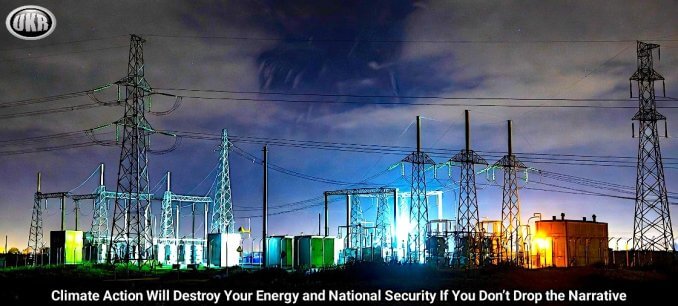
A Lesson for the West: Climate Action Will Destroy Your Energy and National Security If You Don’t Drop the Narrative and Get Serious
THOMAS J SHEPSTONE
Kathryn Porter is from the UK and is “an independent energy consultant with experience of physical and financial electricity, gas and oil markets” with “significant experience in financial services.” She also has an increasingly popular energy-focused website called Watt-Logic and has written an outstanding post about Europe’s rapidly eroding energy security.
Here is the intro to Porter’s year-end reflections:
[The year] 2025 could come to be characterised as the year the lights began to flicker across Europe as threats to energy security begin to manifest. We almost ran out of electricity in Britain in January. We did have a blackout at Heathrow Airport in March and Iberia suffered a full peninsular blackout in April. We also had warnings that accelerated decline of North Sea gas production might threaten the viability of key pipelines leading to winter gas shortages that would threaten the power sector.
Well, that should get your attention, but there’s much more in this, and it applies to the West as a whole, not just Europe. Here is the meat of the article’s conclusions (emphasis added):
What happens next depends on whether policymakers, regulators and grid operators recognise these risks and act on them appropriately…
The Labour Government remains committed to killing off the North Sea despite widespread criticism from everyone, including normal allies such as the unions. Privately, Labour MPs express concerns, but so far Energy Secretary Ed Miliband is ignoring them.
But the wider political environment for the Government is challenging. There is a general expectation Labour will do very badly in this year’s local elections, which may well lead to a change in Prime Minister with key Cabinet members also being replaced. The rumour mill suggests Miliband will not be safe from this pressure…
Germany’s industrial base is still exceptionally energy-intensive. High energy prices have eroded competitiveness, shifted cost structures relative to peers, and accelerated offshoring of heavy industry. These pressures are structural, rather than not cyclical, meaning they are not easily reversed by short-term fiscal stimulus. Even if fiscal measures support demand domestically, they do not fundamentally fix energy cost disadvantages in global markets (which remain a primary driver of German industrial strength).
US tariffs and global trade frictions continue to weigh on Germany’s export performance, making a healthy recovery reliant on external rather than internal demand, which is a significant structural vulnerability. Mechanisms such as the Carbon Border Adjustment Mechanism (“CBAM”), intended to level the playing field on carbon costs, also have inflationary implications for German industry as they raise costs for carbon-intensive imports, may not fully protect domestic producers and could further dampen domestic demand if manufacturing margins are squeezed.
The IMF and other observers warn that higher debt levels must be paired with structural reforms or Germany risks weak growth and entrenched underperformance relative to peers. Germany has now experienced four years with no economic growth with the IMF saying it needs to slash “excessive red tape” and “boost productivity and entrepreneurship”.
The EU’s CBAM (also being adopted in the UK) risks compounding Europe’s economic problems rather than solving them. By raising the cost of foundational inputs such as steel, cement, fertiliser and electricity, the CBAM is inherently inflationary and feeds through into construction, infrastructure and food prices at a time when growth is already weak.
While framed as a tool to protect European industry, the CBAM does nothing to address the core competitiveness issue of high energy costs and instead risks accelerating deindustrialisation through demand destruction, higher compliance burdens and trade retaliation. In practice, it looks less like a climate solution and more like a mechanism for exporting Europe’s policy costs, only for them to return via higher prices and weaker growth.
And key trading partners are not responding by lowering the carbon intensity of the goods they export to Europe. India has rejected EU proposals to increase its domestic carbon tax in response to the CBAM and has indicated it may pursue World Trade Organisation (“WTO”) action. South Africa is also considering making a formal complaint at the WTO. China is vocally critical of the CBAM and is calling for multilateral discussion on its compliance with WTO rules.
For large, advanced, non-EU economies, CBAM is not strong enough on its own to force industrial transformation, nor is it credible as an external constraint in the way EU policymakers often assume. Even where countries appear to be adapting, they are motivated by their own internal climate goals rather than compliance with EU policy objectives.
Europe’s climate programs have wrought huge damage to economies and, combined with excessive spending by the biggest nations, have pushed the continent to the edge in terms of energy and national security. That’s the lesson for the rest of the West, and only America seems to be seriously addressing the issue: that trying to solve a non-existent climate crisis with subsidized green energy is simply a ticket to economic disaster.
Moreover, Europe’s leaders are incapable of speaking truth or doing anything about the real crisis because they have a press that’s sold out to the climate blob and they foisted anti-speech laws on the public to prevent criticism, making themselves the victims of their own policies. Climate needs to be de-clawed as an issue and free speech restored ASAP for there to be and meaningful change iin what is eating away at the energy and national security of Europe, Australia and Canada.
This article (A Lesson for the West: Climate Action Will Destroy Your Energy and National Security If You Don’t Drop the Narrative and Get Serious) was created and published by Thomas J Shepstone and is republished here under “Fair Use”

••••
The Liberty Beacon Project is now expanding at a near exponential rate, and for this we are grateful and excited! But we must also be practical. For 7 years we have not asked for any donations, and have built this project with our own funds as we grew. We are now experiencing ever increasing growing pains due to the large number of websites and projects we represent. So we have just installed donation buttons on our websites and ask that you consider this when you visit them. Nothing is too small. We thank you for all your support and your considerations … (TLB)
••••
Comment Policy: As a privately owned web site, we reserve the right to remove comments that contain spam, advertising, vulgarity, threats of violence, racism, or personal/abusive attacks on other users. This also applies to trolling, the use of more than one alias, or just intentional mischief. Enforcement of this policy is at the discretion of this websites administrators. Repeat offenders may be blocked or permanently banned without prior warning.
••••
Disclaimer: TLB websites contain copyrighted material the use of which has not always been specifically authorized by the copyright owner. We are making such material available to our readers under the provisions of “fair use” in an effort to advance a better understanding of political, health, economic and social issues. The material on this site is distributed without profit to those who have expressed a prior interest in receiving it for research and educational purposes. If you wish to use copyrighted material for purposes other than “fair use” you must request permission from the copyright owner.
••••
Disclaimer: The information and opinions shared are for informational purposes only including, but not limited to, text, graphics, images and other material are not intended as medical advice or instruction. Nothing mentioned is intended to be a substitute for professional medical advice, diagnosis or treatment.
Disclaimer: The views and opinions expressed in this article are those of the author and do not necessarily reflect the official policy or position of The Liberty Beacon Project.


Leave a Reply