


STEWART SLATER
Shoplifters and Liberal Democrats have more in common than either group might care to admit. When one walks out of a shop with a packet of butter down their trousers (for whatever later use…) or the other blocks a development to preserve the value of their property, both are seeking to maximise their own benefit. Neither is thinking about the good of society, but only their self-interest.
There has been increasing chatter over recent years about the failure of liberal democracy, its fatal flaw often seeming to be that it allows people to live lives of which the critics disapprove. The solution, to some on the left, is to bring back some form of William Morris–style yeoman socialism; to some on the right, to install a Catholic theocracy. There is no need, they believe, to debate whether this will happen. Liberal democracy’s collapse is inevitable given the weight of its contradictions – the only question is, what form it will take.
Political systems are technologies which allow people to lead the best lives they can. They therefore rely on an eco-system of cultural assumptions about what a good life looks like. For most of history, this account has been provided by religion, God, or an especially enlightened human being, providing an account of life’s purpose. To Christians, Muslims and Buddhists, the material conditions of one’s existence are far less important than one’s behaviour. It is the latter, not the former, which will decide one’s post-mortem destination.
Christianity, in particular, was the background against which modern democracy arose. The purpose of life was not, as it had been to the Romans, the accumulation of honours and baubles, but to live in such a way as to be allowed through the Pearly Gates. This provided a source of restraint – people were motivated not to seek to maximise their own earthly benefits if that impacted their eternal afterlife. No matter what one’s peers were doing, God was always watching and taking notes. Freedom could be maximised, because people could be trusted not to maximise their freedom.
Non-Christian countries which have become successful democracies like Japan and Singapore have found social ways to inculcate restraint, whether, in the former through culture or, in the latter, through a hyper-vigilant and hyper-active government. Neither to be fair, has seen the regular transitions of power which have marked the West’s experience of democracy. The Arab world may, in Islam, have a similar source of restraint, but retains a tribalism (reduced in Europe when the Catholic Church banned cousin marriage) which tolerates acting in favour of the clan over acting in the favour of society.
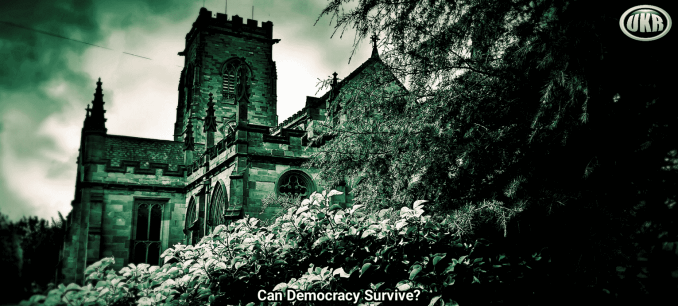
Although there are tentative signs of re-Christianisation in the West, the overall trend over recent years has been towards secularisation. Beyond the obvious impacts such as an increasing number of ornate but idle buildings, the decline in religion has completely changed the way we understand ourselves. No longer are we children of a beneficent God, now we are lumps of carbon in an uncaring universe. No longer do we have a purpose. Instead of seeking to maximise our afterlife, our current account tells us to maximise the one life we know we get – there will be no consequences.
With the exception of some hermits, man does not live by religion alone. Under-discussed in debates over liberal democracy is the fact that it arose roughly contemporaneously with the Industrial Revolution which brought about an explosion of living standards and ushered in a period of permanent growth. Before the rise of the machines, one wag remarked, an economic history of the world which dedicated a chapter to each century would have to end each with the words, “But nothing had really changed.” Our recent history is unusual in that, once the pie started to grow, it didn’t stop. This too promoted restraint. There was no need to beggar thy neighbour when secular phenomena were making the whole street richer.
In Western Europe, over recent years, this growth has come to a juddering halt. Between 1950 and 2007, growth per capita in Britain averaged 2.1%, while wages grew 2-3% in real terms annually. Since the Financial Crisis however, growth has fallen to 0.4% with the median hourly wage now lower than it was pre-Lehman, resulting in an annual loss of income of c. £1,000. America has outperformed, its economic growth trebling since 1980, but the rewards of that growth have not been widely shared – median wages are merely 13% higher today than they were at the start of the period. In the States, the rising tide is no longer lifting all boats; in Europe, there is no tide.
The end of the Age of Growth need not mean the end of democracy. Japan has tolerated its recent lost decades. But it retains a culture which promotes restraint – the nail which sticks up gets hammered down. Scandinavia with an egalitarian culture and “Jante’s Law” warning against the desire to stand out might do too. What of us though? For we face an unusual confluence of risks. In the 1930s, growth stopped but religion still provided restraint. In the 1960s, religion was ebbing, but growth was still strong.
If people wish to maximise their benefits and society does not provide a way for them to do so, the only solution will be to reduce the benefits of others, to turn politics into a zero-sum game with winners and losers. Which is a fair description of the current political moment.
For while politicians genuflect towards the idea of growth, their policies reflect nothing more than the transfer of money from one group to another. To the government, improvements to the state school sector must be paid for by parents in the private school sector. To the Lib Dems, the rich can pay for everything – they have enough money that there is no need for the sort of nasty development which growth might require. To Reform UK, all one needs to do is stop Green policies and everyone can have what they want. To each party, there are winners who will benefit from the harm they will inflict upon the losers.
Zero-sum politics can, however, swiftly become self-reinforcing. Raising taxes on non-doms, for example, appears (surprise, surprise!) to drive them out of the country, reducing the capital available to fund future growth. A development blocked today reduces the incomes which will support house prices tomorrow. By seeking to have it all now, we reduce the amount available in the future, forcing us to claim an even bigger slice of that pie.
The consequence is to raise the political temperature. If our conception of the good life is purely material, and our affluence depends on which party is in power, then it becomes a matter of pressing concern that our side win. The January 6 riots show what can happen if one side believes it has lost an election it cannot afford to lose.
It is possible that we develop a new source of restraint, but it is unlikely. Secular humanism, the milquetoast Christ-less Christianity to which we have defaulted, lacks the supernatural carrot and stick which compelled obedience in its religious forebear. Our focus on maximising our own earthly enjoyment flows naturally from the universe we believe ourselves to inhabit, just as that of the ancient Epicureans flowed from their similarly unfeeling cosmos. Imposing a new belief system has not, historically proven easy to do nor easy to sustain. Some form of new growth source is, perhaps, more likely, but will need to be sufficiently attractive (and to have sufficiently few current downsides) to avoid society’s veto-wielders.
In the absence of these, a prolonged period of increasingly bitter conflict seems likely as different interest groups struggle to dominate an ever-shrinking pile of resources. Rome, even with a growing economy due to the Empire, was unable to avoid the damage caused by the decline of mos maiorum (the ancestral code which had led Cincinnatus to give up absolute power and return to his plough and Scipio Africanus to reject the offer of the consulship-for-life), political actors seeking to have it all. With politics reduced to a bloodsport, the solution was the Principate – rather than all contending to maximise their share, one man decided what that share should be. A loss, no doubt, to retrospective romantics, but perhaps not to the man on the Via Appia, sick of constant civil strife.
For the city found itself with a system designed for a different group of people. By the end of the Republic, it was like a recent amputee driving the car he used to own. It was no longer possible for it to work well. Recent history shows that liberal democracy is not the universal human aspiration its post-Cold War cheerleaders thought. It was the product of a certain people at a certain time. If that time comes to an end, it will not be, as many hold, that Liberalism Failed, but that we failed Liberalism.
Stewart Slater works in Finance. He invites you to join him at his website.
If you enjoy The New Conservative and would like to support our work, please consider buying us a coffee or sharing this piece with your friends – it would really help to keep us going. Thank you!
This article (Can Democracy Survive?) was created and published by The New Conservative and is republished here under “Fair Use” with attribution to the author Stewart Slater

••••
The Liberty Beacon Project is now expanding at a near exponential rate, and for this we are grateful and excited! But we must also be practical. For 7 years we have not asked for any donations, and have built this project with our own funds as we grew. We are now experiencing ever increasing growing pains due to the large number of websites and projects we represent. So we have just installed donation buttons on our websites and ask that you consider this when you visit them. Nothing is too small. We thank you for all your support and your considerations … (TLB)
••••
Comment Policy: As a privately owned web site, we reserve the right to remove comments that contain spam, advertising, vulgarity, threats of violence, racism, or personal/abusive attacks on other users. This also applies to trolling, the use of more than one alias, or just intentional mischief. Enforcement of this policy is at the discretion of this websites administrators. Repeat offenders may be blocked or permanently banned without prior warning.
••••
Disclaimer: TLB websites contain copyrighted material the use of which has not always been specifically authorized by the copyright owner. We are making such material available to our readers under the provisions of “fair use” in an effort to advance a better understanding of political, health, economic and social issues. The material on this site is distributed without profit to those who have expressed a prior interest in receiving it for research and educational purposes. If you wish to use copyrighted material for purposes other than “fair use” you must request permission from the copyright owner.
••••
Disclaimer: The information and opinions shared are for informational purposes only including, but not limited to, text, graphics, images and other material are not intended as medical advice or instruction. Nothing mentioned is intended to be a substitute for professional medical advice, diagnosis or treatment.
Disclaimer: The views and opinions expressed in this article are those of the author and do not necessarily reflect the official policy or position of The Liberty Beacon Project.


Leave a Reply