

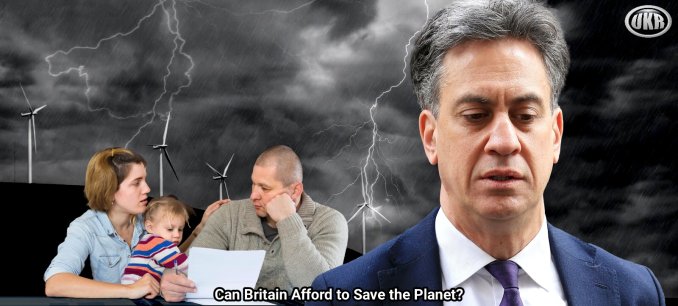
Sarah Ingham: Can Britain afford to save the planet?
SARAH INGHAM
Dr Sarah Ingham is the author of The Military Covenant: its impact on civil-military relations in Britain.
As we shivered in sub-zero temperatures this week, the follies and failures of Britain’s energy policy hit home. Or rather hit the homes of many, particularly the elderly and less well-off.
The yearning to turn up the central heating competed with fears about the eventual bill. As they put on more layers and huddled under duvets, many must have wondered about Labour’s manifesto pledge to cut £300 from their energy bills, its zigzagging over the Winter Fuel Allowance and why domestic energy prices are among the highest in Europe.
The UK’s “dash for gas” in the 1980s gave way to “slash the gas” from 2008 as successive governments embarked on their quixotic bid to decarbonise the national power supply.
Demonising fossil fuels, the UK’s carbon net zero fanatics insist that the world will follow Britain’s example. PM Boris Johnson stated in the October 2021 Net Zero Strategy: Build Back Greener: “ … The likes of China and Russia are following our lead with their own net zero targets, as prices tumble and green tech becomes the global norm.”
This hyperbolic tosh came three months before Russia invaded Ukraine, action which further accelerated Europe’s already sky-rocketing energy bills. But Moscow’s “special military operation” provided yet another justification for Britain’s decarbonisation quest: national security.
Wind fan-boy Ed Miliband hits Johnsonian heights in his flights of fancy about how renewables free Britain from being “at the mercy of petrostates and dictators”. Somehow, the Energy Secretary overlooks how Britain is instead at the mercy of China, which in 2024 supplied 68% of the UK’s solar panels – many of them produced with the help of coal.
Hubristic notions concerning the UK’s global leadership, national security and domestic jobs thanks to a “Green Industrial Revolution” have now overtaken the original impetus for Net Zero: the climate.
Today, with even Greta Thunberg more preoccupied by Gaza than greenery, the “climate emergency” seems less pressing than in the 2015 Paris Climate Accord era. Extinction Rebellion is now focusing on dirty water, while Just Stop Oil is concentrating on how “the rich are killing us.”
Dare it be suggested that, like yesteryear’s trend for mullets and perms, the hysteria around the climate crisis might have been a fad? If the planet really is on the brink of extinction, its governments seem oddly relaxed about the prospect.
November’s United Nations’ COP30 climate jamboree achieved very little, with even the EU Climate Commissioner describing it as “chaotic and messy”. Having flown out to Belem in the middle of the Amazon rain forest, the 50,000+ attendees failed to register the irony of haranguing the rest of us about our carbon footprints. After a road was hacked through the jungle for their benefit, these green grifters have no business lecturing anyone else on biodiversity loss.
Last month, cyclones swept across Asia, resulting in severe flooding and landslides in Sri Lanka. Up to 1,000 lives, and many more homes, were lost. A few weeks on, the country has returned to business-as-usual, the roads and railways re-opened. But like the tsunami which hit the island in 2004, the scarred landscape of uprooted trees reduced to kindling reflects the power of nature.
ITV reported that although cyclones are a regular event, because of climate change these storms are more intense, carrying far greater volumes of water. Sri Lanka does not have the infrastructure to lessen their impact.
If climate change is the problem, is the only solution Britain’s costly decarbonisation? Might an alternative solution be mitigation, such as improved flood defences in places like Sri Lanka, and indeed in this country?
The exact cost of Britain reaching Net Zero is opaque. Figures from the National Energy System Operator suggest it could reach an eye-watering £460 billion by 2029 – about the price of the economy-destroying lockdown. By 2050 costs will halve but remain at 5-6% of GDP every year.
Across the country, businesses are closing daily, with high energy costs a factor. Whole swathes of manufacturing are being sacrificed, including the ceramics industry, which spends £875 million on energy a year, or 70% of turnover, says the GMB. Meanwhile, as British jobs go to the wall, Denmark’s Vestas and the German-Spanish Siemens-Gamesa are doing very nicely thank you, making Britain’s wind turbines.
Britain has already slashed its carbon emissions, but the lower bills promised by cleaner energy remain mirage-like, always just-out-of-reach.
The climate still represents a get-out-of-jail free card.
It precludes any rigorous cost-benefit analysis over reaching Net Zero (including opportunity costs), while enabling government to pile extra taxes on commercial and domestic energy consumers under the guise of numerous “green levies”. It allows Alice-in-Wonderland policy inconsistency, for example, over gas boilers and electric cars, as well as a labyrinthine energy pricing system. Not least, it is a handy excuse for abject corporate mismanagement, seen this week with South East Water whose boss partly blamed “really extreme weather events” for Tunbridge Wells’ water outage.
Conservatives should of course want to conserve the planet. But we need to remain, er, down-to-earth about the limits of this country’s moral influence and the global impact that further cutting Britain’s carbon emissions will make.
Wednesday morning, 18 years after the first Climate Change Act and billions of pounds later, renewables generated 8.8% of Britain’s energy.
See Related Article Below
A trashed economy is the prize in the one-horse race to Net Zero
IVOR WILLIAMS
YOU want to save the planet? You want to stop the world getting hotter and the weather getting worse? Read on. But first, to calm your anxious mind maybe take a look at what’s actually happening.
The world is not getting hotter. It just seems to be warming very slightly. The UK official mean temperature for 2025 is 10.09 deg C, which is precisely three tenths of a degree warmer than last year. That increase, imperceptible to the average human being, might have been expected as it was also the sunniest year since records began in 1910. But never mind the evidence, keep pushing the story. ‘This,’ says the Met Office, ‘is a clear demonstration of the impacts of climate change.’ Can three-tenths of a degree really be called an impact?
The Guardian said it was ‘the hottest’ year and the Daily Mail described it as ‘balmy’. Ten degrees Celsius would only be called hot or balmy by the scientific folk in the middle of the Antarctic winter who gladly shed two layers of clothing when it’s only -20C.
The weather may be getting worse, or it may not. We only have detailed worldwide weather reports from the last 120-odd years and know very little or nothing about what happened for the 10,000 years before that. Have you come across any complaints in your Latin studies about how the storms hampered the Roman legions building Watling Street? No? I thought not. Have you read any harrowing details about the terrible weather in Africa in the 13th century BC? Of course you haven’t.
Still want to help? There are many websites eager to tell you what to do. They mostly begin the same way: first insulate your home then install a heat pump, batteries and solar panels. Maniacal Miliband has just dreamed up (I use those words deliberately) yet another of his whimsical schemes. This time he will seemingly give some of us about half the money we need to do all that so we’ll have cost-free energy for ever more. Except for paying back the interest on the other half.
Clearly he’s realised that there’ll never be enough wind turbines and solar farms to cope with the UK’s growing demand for electricity so wants us all to help. This is the man who said in February 2009: ‘Absolutely we understand the importance of oil and gas . . . If we were really relying on renewables, then we would be putting ourselves in a vulnerable position.’ That seems to have been the last time he had any common sense.
Continuing the feel-good-about-global-warming list (from the United Nations): walk and cycle everywhere, use an electric car only if there’s no public transport. Take fewer flights or better still don’t go anywhere. Eat more vegetables and less meat and dairy. Recycle everything possible – but that’s important anyway.
Before you order the electric car, cancel your week in Spain and swear not another bit of beef will soil your mouth, maybe we should look at what’s really happening.
Official government information for 2024 says that we consumers caused 26 per cent of the UK total emissions. Now we know that the UK’s proportion of global emissions is around 0.7 per cent (the same as Egypt). A little maths brings out that we are contributing 26 per cent of 0.7 per cent, or about one-quarter of the UK’s already tiny total.
Which means that if we gave up everything, ate nothing but vegetables, never used gas or electricity or any kind of carbon-based fuel and stayed permanently at home, the reduction in global emissions would be too small to show up in the data. Think about it. If you’re now asking what is the reason we’ve all been inflicted with this climate hysteria, I’ll tell you.
Once upon a time (December 2015, in fact) there were 40,000 wildly enthusiastic participants at a United Nations climate conference (COP21) in Paris. They produced a legally binding agreement on climate change; the global average temperature increase was to be held at less than 2C above pre-industrial levels and hopefully try to limit the rise to 1.5C by the end of this century. The release into the atmosphere of carbon dioxide and other noxious gases would have to be curtailed drastically.
There was loud cheering as this resolution was adopted by the 195 nations’ representatives. What a glorious achievement, they thought. But 191 of them were quite happy to sign as their country was emitting either nothing or very small amounts. China, the US, India and Russia were at that time shoving out more than half the global total and still are in 2024.
The following year (2016) it was manic Miliband who introduced a cross-party amendment calling for a move to Net Zero emissions, but it took until Theresa May’s collapsing government in June 2019 for this to become law with a target date of 2050. And it’s all gone downhill since. Got much worse, in fact. Somehow this became known as ‘the race to Net Zero’ even though the UK seemed to be the only competitor.
Climate zeal was reborn with the 2024 Labour manifesto and its avowed aim (on page 49) ‘to make Britain a clean energy superpower by 2030’. All the turbines, solar farms, heat pumps and electric cars are because we are going for clean power. Then we suffer repeated exhortations about not eating beef, buying a bike and banning all thought of going anywhere near an aeroplane, all because we’re in this ridiculous ‘race’. Yet the UK is one of the 191 countries which are insignificant emitters of greenhouse gases.
None of the emission reductions we might make in both energy generation and private life will have more than the most infinitesimal effect on the global total.
We’re watching the economy being trashed. That’s all.
Updated 1.25pm Jan 10
This article (A trashed economy is the prize in the one-horse race to Net Zero) was created and published by Conservative Woman and is republished here under “Fair Use” with attribution to the author Ivor Williams


Leave a Reply