

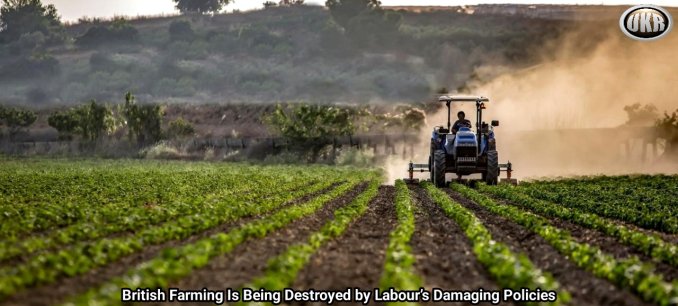
Labour is crushing Britain’s farmers
Who else will feed the nation?
JAMES REBANKS
For years, British farmers have warned that the nation’s food system is broken. The government insists that there is no need for a fuss, accusing farmers of being tax dodgers, out of touch, or worse, Conservatives. Yet if you listen to people from rural communities, you’ll know the truth is grim. The government has made farming so difficult, and so unprofitable, that the UK is losing farms at an incredible rate, and this is making the country dangerously food insecure.
Just about the only attempt the current government has made to engage with farmers was to appoint Baroness Batters, the former president of the National Farmers’ Union, to do a review of farm profitability. She handed her report in to the Department for Environment, Food & Rural Affairs (Defra) last month, and then… well, nothing. Last week, sources told The Times that the report had been “buried” by the Treasury until after the Budget. This is outrageous: surely the Treasury needs to know what the issues are to shape the Budget accordingly. Surely they should be working with farmers, not burying the facts.
The apparently “locked away” review is expected to call for an urgent reset of the relationship between government and farmers. My guess is that it highlights what a shitshow the government has created for farmers, leaving them unsupported, exploited and barely able to function to provide the food we need. My suspicion is that burying all this avoids further embarrassment to Chancellor Rachel Reeves, who seems to have chosen farmers as her sacrificial victim.
The scale of the problem facing farmers was revealed in a separate report published earlier this month by McCain Foods, which found that one third of British farmers made no profit in the past year. More than half have considered leaving farming in the past year because of its dire finances; 40% think they will be forced to leave the industry in the next decade. And 92% of farmers think the greatest threat to the long-term growth of British farming is the government.
You might think these awful statistics would trouble our political leaders or make them wonder whether they’d got farming policy right, but we’ve seen no sign of any soul-searching yet. We’re told in soundbites that the government cares about farming — but their policies suggest otherwise, making real life on farms often close to impossible. According to the McCain report, only 4% of British farmers believe that current government support and protection is adequate.
Someone’s narrative about British farming is wrong. And I’d suggest you make a judgement: either farmers are all crazy, or else something has gone catastrophically wrong with the relationship between British politics and farmers.
It is worth acknowledging at this point that no one thinks the problems with our food system began with the current Labour government. But all serious commentators agree that this government, and the last, have screwed up massively — and worse, are actively choosing to double down on their stupidity.
Let’s remind ourselves how we got into this mess. Before Brexit, Britain was part of an EU system— the Common Agricultural Policy, or CAP — which, though far from perfect, at least attempted to protect farmers. The system often ripped off farmers by asking them to sell products below the real cost of production but bailed them out each year with production subsidies. That meant my dad scraped a living working long hours on our little farm in Cumbria, with nonsensical subsidised accounts that barely got above break-even. Still, the subsidies kept his farm afloat. Under this system, the consumer benefitted from plentiful supplies of cheap food, while British farmers were protected by the Italian and French farm lobby and by EU bureaucrats who understood the boring vagaries of food systems.
The British Left hated this system: in their view, farmers seemed kind of “rich” — so why would anyone give them money? — and they certainly didn’t vote Labour. The old-school Tory toffs supported the CAP because it kept their tenant farmers happy, but when the last of these “wets” were pushed out post-Brexit by Boris Johnson and replaced by free-market lunatics, all sympathy for farmers died in British politics.
After Brexit, Britain scrapped the CAP system and decided, thanks to Michael Gove, an enthusiastic Defra reformer, to implement a system that delivered way more nature on farms. The new mantra was “public payments for public goods”. We were promised that farmers would receive the same amount of money as always, though rather than being subsidised to produce bacon, milk, or bread, they would be paid to deliver good environmental stewardship by planting trees or wildflower meadows, making soil healthy, or creating ponds. The farmer would become a service provider, committed to restoring nature; meanwhile, food production would be left to the free market.
Everyone back then, including Labour, seemed to agree that the environment was a big deal. The Left’s distaste for farmers was assuaged with promises of more butterflies and birds, and the Right’s by the fact farmers would no longer be paid a “subsidy” but instead would receive the market rate for public goods.
The new system sounded promising. Yet the Conservatives failed to pay for it properly, breaking their promise that every farmer could receive the same amount of money for nature restoration as they’d previously got for food production. (This is when things began to go very sour, because farmers took the government at its word, and then it failed them). It also took Defra ages to create the new system, and when it was just about functioning and starting to look, dare I say it, quite good, the Conservatives lost a general election and Labour came into power. Since then, the whole damn thing has gone into freefall.
The Treasury, under Reeves, then pleaded ignorance that any such “public payments for public goods” contract existed with British farmers. Labour didn’t even attempt to make the new environmental schemes available to all farmers, instead making them competitive — so many, perhaps most, farmers have not got any kind of new deal. The schemes that do exist are either paused due to over-subscription, or have already fallen way behind inflation, so the funding is in real terms a fraction of the pre-Brexit investment. The result is this: half the farmers in England have been stripped of their production subsidies and left to the mercy of the global markets, where they must compete with generously subsidised farmers from other nations; the other half are being paid by the government to take land out of food production for nature restoration. But it doesn’t seem to have occurred to anyone at the Treasury that this might make food scarcer or more expensive, or force farmers out of business.
This government is fond of saying it has put more money into supporting farming than any previous government. But they are either lying, or are incredibly ignorant, because the “farming support” they now speak of basically doesn’t pay for any farming; it overwhelmingly pays costs for nature restoration. The argument here is not that we don’t need more nature — we do — but that we also need to produce enough food, and to ensure our farmers make a decent return on their work.
Barely any British politicians, and apparently no one at the Treasury, understands the dire position British agriculture is now in. After all these years of government ineptitude, I have concluded that we are, as a society, agriculturally illiterate. People increasingly talk about farmers like they are some archaic vested interest group, like miners, whereas they actually feed millions of people every day. Our politics merely magnifies that illiteracy, creating rooms full of people at the Treasury who don’t even understand the basics making decisions with massive implications for our food system.
One person who clearly has no clue is Reeves, who last autumn delivered her coup de grâce: reforming inheritance tax so that farmers lost one of their remaining sops in a lifetime of being ripped off. In the past, farmland had been exempted from the tax, but from April next year, farmers will have to start paying. But farmland isn’t cash, nor does it generate much cash — so farms will inevitably have to sell land, making them less likely to survive in the future. To farmers, this doesn’t make any sense.
You can’t understand the inheritance tax angst in farming communities without understanding the context and history. The slightly crap pre-Brexit deal said to farmers like my dad: if you work hard to produce food for minimum wage, you can at least keep your farm, and hand it on to your kids. Reeves’s new deal means that farmers are going to be ripped off their whole lives, blamed for everything, and when they die their farms will incur a staggering death tax that might take the farmer’s loss-making, or already half-broke, descendants as many as 20 years to pay off. Somehow the media managed to make this a story about Jeremy Clarkson avoiding tax by playing farming for a TV show; the real plight of the farmers ended up less than a footnote.
If farmers were fairly treated and had a decent chance of profitability, then I, for one, think they could and should pay the same taxes as everyone else. But the fact is that they’ve been exploited for decades. And the inheritance tax changes were the last straw.
One response to all this, perhaps from the Left, might be: Who cares? These farmers are always whinging and are just another vested interest group that wants more handouts.
And yet if we abandon our farmers, everyone will ultimately suffer: you, me, the environment, and the poorest people in our society. Farmers are the basis of our food system; if they withdraw their labour and capital because they can’t afford to keep farming, then who will feed the nation? So even if you think you don’t like farmers, going after them is still terrible politics. We need them to do their jobs.
We’re already beginning to see the inevitable and widely predicted consequences of our nation’s agricultural policy. Inflation is currently exceeding government targets, causing the Treasury terrible problems. And one of the key drivers of this is food price inflation, running at just below 5%, way in excess of the overall government inflation target of 2%. Food prices have risen by around 37% in the last five years. And this is disproportionately hitting the poorest in our society, who spend a greater part of their weekly budget on food.
This inflation is partly due to what’s happening on our farms. Since it has become very difficult and expensive to produce certain farm products without subsidies or protection, some farmers are simply producing less. And so prices are going up. Cattle prices have almost doubled in value since 2020, as farmland has gone out of production. And the number of dairy farmers has dropped by 56% in the past 20 years — some experts estimate that one dairy farmer a day goes out of business.
Then there’s the question of food security. Get support for farmers wrong and you’re taking a gamble that there won’t be enough food to feed the nation. Currently, according to Professor Tim Lang, the UK’s leading expert on food security, Britain’s food system is over-reliant on foreign imports and highly vulnerable to shocks and crises, such as disease outbreaks, extreme weather, or geo-political instability. Already, repeated droughts are impacting crop yields in the south-eastern triangle of England, which produces massive amounts of our food.
When the First World War broke out, Britain only had six weeks of food reserves, and the government was terrified. Now, that is down to about six days, and government keeps telling us we have “food security”, which is nonsense. People blithely assume that we have food stores somewhere for a moment of crisis, but we don’t.
At the rate we’re going, the situation will only worsen. Earlier this month, a report from the All-Party Group on Science and Technology, “Feeding Britain sustainably to 2050”, warned that if the UK continues to prioritise housing, Net Zero, tree planting, and nature restoration, it could lose around a quarter of its productive farmland by 2050. This would see domestic food production reduced by a third, while the population continues to grow, leaving the UK far more reliant on imports.
Free-market ideologues say we can just import more food if we need to, but we’re living in La La Land if we think that’s a good idea in today’s unstable world. The rest of the world is increasingly focused on feeding their own growing populations, and climate change is already threatening global food supply chains. Almería in Spain, which has long fed Britain, is already drying out. Meanwhile, once-reliable exporting nations are now erecting trade barriers because of Trump-like protectionism. As an island nation, which now stands outside the EU, the UK is particularly vulnerable.
Farmers understand this, but it appears the Labour government does not. Our politicians would be wise to learn the lesson of rural America. When the grown-up parties of government fail to care about, and act upon, the pain of rural communities, the political fall-out becomes toxic. Social media finds disillusioned people and stokes their anger and alienation. This is happening now in online farming forums where Right-wing memes and explanations for the assault on farmers are spreading like wildfire. Reform knows exactly how to exploit this political failure to their advantage.
To be honest, I’m not really surprised that this government isn’t great at food, farming and the environment. All governments have blind spots and make mistakes. I can even forgive them some bad decisions. The issue is that they have refused to listen as the problems become ever more serious. The Treasury in particular seems to stubbornly dig in behind terrible policies — keener to bad-mouth farmers than hear them out. And now, at a time when we need an expert’s insights and analysis to inform a Budget, the government has buried its own farming review. It is shameful. Publish the review right now. And act upon it.


Leave a Reply