

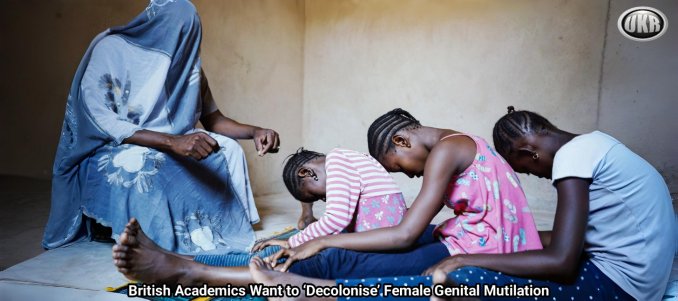
British Academics Want to ‘Decolonise’ Female Genital Mutilation

A new paper paints those fighting abuse as the “bad guys.”

MICHAEL CURZON

new paper in a highly regarded British Medical Journal publication has sparked outrage for attempting to launch a debate on the so-called “harms of the current global anti-female genital mutilation (FGM) campaign.”

It says coverage of the practice, where the female genitals are deliberately cut, injured or changed, often relies on “titillating sensationalism,” and complains that this “leads to vilification of migrants, infantilisation of people and their cultures, and failure to recognise the agency of the women concerned and their communities.”

Among the authors’ most controversial claims is that “the time has come to recognise the harm caused by the ‘FGM’ acronym”—like that’s the problem here!—and the suggestion of “more neutral expression[s],” like “female genital practices” (emphasis added).

Writer Jean Hatchet, “disgusted” by the journal article, summarised it as

An attempt to say FGM is not mutilation, not harmful, is celebratory, makes sex better, is just like adding a piercing, happens to boys too really, happens to trans people too and you’re racist if you say it’s bad.

It also effectively asks readers to consider more the harmful impacts on migrant communities of the FGM debate, which “leads to vilification of migrants, infantilisation of people and their cultures, and failure to recognise the agency of the women concerned and their communities.”

One interesting passage says that FGM is perhaps not traumatic for some women, even if “decisions are not always taken by individual selves”—in other words, the practice is forced upon them—because of the “cultural context.” That is, most other women in said ‘culture’ undergo the same practice, creating a “strong sense of identity,” meaning the “derision” of the practice “may itself be traumatic.” God forbid one risks causing upset by speaking honestly.

The paper predictably suggests that the number of FMG practices carried out by migrants living in the West is wildly exaggerated—again, resulting in “harmful consequences for the girls and families involved.” Yet in the Scottish city of Glasgow alone, more than 1,200 women have been treated for FGM since 2019, when still unimplemented laws designed to protect girls were passed there. It is likely that many more cases have gone untreated.

Likewise, we previously reported that more than 35,000 women and girls living in Belgium have either been, or are at risk of being subjected to FGM, with over a third of them being underage.

Belgium: Over 35,000 Women and Girls Subjected to Genital Mutilation or Are at Risk

The authors also say there is a “double standard” in the West, since, for example, “cosmetic surgery in which the female genitals are pared and reshaped is gaining popularity,” although readers are likely to question this comparison.

And they claim that anti-FGM “narratives inherently downplay or denigrate the ceremonial and cultural importance of the practices, an importance which often supports the self-esteem of the women who experience it.” This, of course, begs the uncomfortable question—is the self-esteem of those already victimised more important than working to reduce the number of future victims?

The Women’s Rights Network campaign group said it was “shocked” by the paper because “FGM causes nothing but pain and harm to women and girls. There are no benefits at all.”

It is pure hatred of the female sex and has no place in a world that too often fails to treat girls and women as human beings.

Tory MP Katie Lam described the academics’ claims as “dangerous, disgusting and deranged.”

Journalist Róisín Michaux added that it was the latest example of “the ‘decolonising’ of FMG,” which she said “continues apace.”

Most seriously, Janice Turner wrote in The Times that rather than help to “end a hideous form of child abuse,” the paper uses “abstruse language to muddy the ethical waters” and “sophistry to turn those fighting abuse into the bad guys,” meaning—“voilà!—the problem magically disappears.”

Michael Curzon is a news writer for europeanconservative.com based in England’s Midlands. He is also Editor of Bournbrook Magazine, which he founded in 2019, and previously wrote for London’s Express Online. His Twitter handle is @MichaelCurzon_.


.

••••

The Liberty Beacon Project is now expanding at a near exponential rate, and for this we are grateful and excited! But we must also be practical. For 7 years we have not asked for any donations, and have built this project with our own funds as we grew. We are now experiencing ever increasing growing pains due to the large number of websites and projects we represent. So we have just installed donation buttons on our websites and ask that you consider this when you visit them. Nothing is too small. We thank you for all your support and your considerations … (TLB)

••••

Comment Policy: As a privately owned web site, we reserve the right to remove comments that contain spam, advertising, vulgarity, threats of violence, racism, or personal/abusive attacks on other users. This also applies to trolling, the use of more than one alias, or just intentional mischief. Enforcement of this policy is at the discretion of this websites administrators. Repeat offenders may be blocked or permanently banned without prior warning.

••••

Disclaimer: TLB websites contain copyrighted material the use of which has not always been specifically authorized by the copyright owner. We are making such material available to our readers under the provisions of “fair use” in an effort to advance a better understanding of political, health, economic and social issues. The material on this site is distributed without profit to those who have expressed a prior interest in receiving it for research and educational purposes. If you wish to use copyrighted material for purposes other than “fair use” you must request permission from the copyright owner.

••••

Disclaimer: The information and opinions shared are for informational purposes only including, but not limited to, text, graphics, images and other material are not intended as medical advice or instruction. Nothing mentioned is intended to be a substitute for professional medical advice, diagnosis or treatment.

Disclaimer: The views and opinions expressed in this article are those of the author and do not necessarily reflect the official policy or position of The Liberty Beacon Project.

Be the first to comment

Leave a Reply

Your email address will not be published.


*