

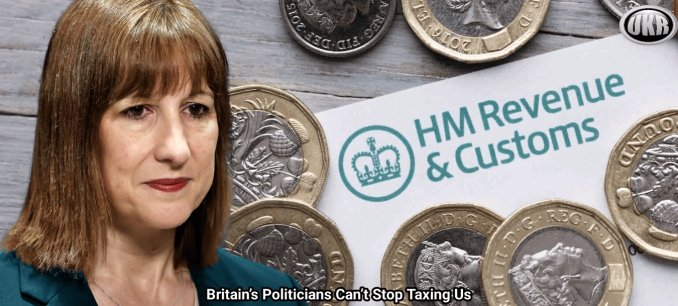
Britain’s politicians can’t stop taxing us
DARWIN FRIEND
For years now, the TaxPayers’ Alliance’s ‘Tax Briefing Room’ has been a go-to resource for campaigners, policymakers, politicians and ordinary taxpayers seeking to brush up on the UK tax system.
Keeping it up-to-date is an arduous task. Given the endless meddling of UK policymakers, significant parts seem to become outdated every time a Budget comes around. That has certainly been the case since the last time we updated the Briefing Room, in late 2022.
This would be fine if all that meddling was focused on simplifying the system through equalising thresholds, abolishing exemptions and removing entirely unnecessary taxes. Even better if the meddling involved slashing or removing marginal rates of tax.
Unfortunately, our latest edition, published today, shows that over the past two years, our politicians and policymakers have delivered a tax system that is even more burdensome and complicated than before. Which is quite some feat.
First, there is what hasn’t changed. Notably tax thresholds. Two more years have passed, yet income tax thresholds remain fixed where they were in 2021-22. Particularly damaging is the extraordinary 40p rate paid by those earning £50,270 or more – not much higher than the median full-time pay of a London employee – along with the 60p rate on earnings from £100,000 to £125,140, as a result of the withdrawal of the personal allowance. Compare these to the United States, where the highest marginal tax rate is 37%, and even that only kicks in at a handsome $609,351 per year (or around £530,000).
Then there are the ways the tax system has become even more onerous. The list is long, but it includes: a reduction in the first-time buyer rate for stamp duty land tax; above-inflation hikes in tobacco duty; increases in the licence fee and air passenger duty; and reductions in both agricultural property relief (APR) and business property relief (BPR) for inheritance tax purposes. And, surely the worst of all, the increase in the employers’ rate of National Insurance, plus the reduced threshold at which it’s paid.
There have been almost no improvements to our tax system, aside from the 4p cut to employee National Insurance. That represents a shocking failure on the part of our political class.
A huge amount could be done to improve taxpayers’ economic incentives without damaging tax revenues. The economic boost from abolishing the 60p effective marginal income tax rate would likely make such a move not far off revenue neutral. The same is true for the abolition of stamp duty. Instead, politicians seem to be engaging in their own personal experiments of where the Laffer curve sits with each tax, with little attention to the results. To take just two examples, increasing rates on capital gains tax and tobacco duties have led to shrinking revenues in both cases.
The real horror, though, is that despite the situation we find ourselves in – low growth, high inflation, increasing levels of worklessness, declining business confidence – things look set to get worse. Just this week, the conversation has turned to exit taxes which, as the tax expert Dan Neidle points out, are an extraordinarily damaging prospect, even if they remain just an unrebutted rumour, due to the impact on peoples’ behaviour. The Government has, it seems, ruled out a wealth tax, although it would be an exaggeration to describe its statements on the subject as unequivocal. But that’s not a victory for low, simple tax advocates – just the avoidance of a catastrophic defeat. Dunkirk comes to mind.
What’s remarkable is the way in which so much tax policy in recent years has not just been economically damaging, but politically damaging as well. Any economist could tell you that broad-based taxes on consumption and income are the least damaging ways to raise large amounts of revenue, while cutting or abolishing taxes on particular behaviours or activities are the best way to boost economic growth with minimal losses to receipts. The same applies to politics: small changes to broad-based taxes may impact a lot more people than major changes to smaller taxes, but it is the latter which usually cause the biggest headache politically. And yet the Sunak government left stamp duty untouched while cutting National Insurance, while Reeves tried to use VAT on private schools and a reduction in APR and BPR as revenue raisers and left National Insurance on employees, VAT and income tax untouched.
If there is a lesson from the extraordinary range of taxes detailed in our tax briefing room, it is that a policy like the TPA’s single income tax is the only way forward. Focusing on broad-based taxes levied on income and consumption, with an abolition of taxes on business, property purchases, wealth and investments, will drive growth and prosperity for all.
This article (Britain’s politicians can’t stop taxing us) was created and published by CapX and is republished here under “Fair Use” with attribution to the author Darwin Friend
See Related Article Below
Aarti Joshi: Labour’s taxes are making us all poorer
AARTI JOSHI

••••
The Liberty Beacon Project is now expanding at a near exponential rate, and for this we are grateful and excited! But we must also be practical. For 7 years we have not asked for any donations, and have built this project with our own funds as we grew. We are now experiencing ever increasing growing pains due to the large number of websites and projects we represent. So we have just installed donation buttons on our websites and ask that you consider this when you visit them. Nothing is too small. We thank you for all your support and your considerations … (TLB)
••••
Comment Policy: As a privately owned web site, we reserve the right to remove comments that contain spam, advertising, vulgarity, threats of violence, racism, or personal/abusive attacks on other users. This also applies to trolling, the use of more than one alias, or just intentional mischief. Enforcement of this policy is at the discretion of this websites administrators. Repeat offenders may be blocked or permanently banned without prior warning.
••••
Disclaimer: TLB websites contain copyrighted material the use of which has not always been specifically authorized by the copyright owner. We are making such material available to our readers under the provisions of “fair use” in an effort to advance a better understanding of political, health, economic and social issues. The material on this site is distributed without profit to those who have expressed a prior interest in receiving it for research and educational purposes. If you wish to use copyrighted material for purposes other than “fair use” you must request permission from the copyright owner.
••••
Disclaimer: The information and opinions shared are for informational purposes only including, but not limited to, text, graphics, images and other material are not intended as medical advice or instruction. Nothing mentioned is intended to be a substitute for professional medical advice, diagnosis or treatment.
Disclaimer: The views and opinions expressed in this article are those of the author and do not necessarily reflect the official policy or position of The Liberty Beacon Project.


Aarti Joshi is a Tax Director at a FinTech. She was a Conservative parliamentary candidate at the 2024 general election.
Whilst Jonathan Reynolds’ recent announcement that Labour won’t introduce a wealth tax might indicate the government hasn’t yet gone full-blown socialist, it proves that they don’t understand that the taxes they’ve already introduced punish the rich, and it’s making us all poorer.
We’ve entered a doom spiral.
Labour’s backbench MPs, emboldened by their recent victory on the welfare reform bill will push for further tax increases on the ‘wealthy’ at the autumn budget, but these must be resisted by the Treasury, and the Chancellor must go further in ruling out more increases in capital gains tax, employers’ national insurance and further freezes to income tax thresholds.
The Business Secretary has noted correctly that this Labour government has already increased taxes on ‘wealth’ through changes in inheritance tax and capital gains taxes.
As a tax specialist, I have seen first-hand the choices that businesses are now making when deciding where to locate and invest, and how many people to employ. It is no coincidence that the KPMG job data survey for May 2025 shows that the number of jobseekers increased at the steepest rate since 2020. It would be madness to further increase employment costs for businesses. This is particularly the case for SMEs; the costs of employing staff are proving a real deterrent to hiring more people, and business growth.
I have worked for companies where the founders started up their businesses in London very deliberately, making the most of the certain tax environment, incentives and international talent pool. Now, many founders are thinking twice when assessing where to locate their businesses, considering the tax implications of being based in the UK.
10,800 millionaires left the country in 2024, more than double the number that left in 2023. This Government seems hell bent on ensuring that this exodus becomes a stampede. Where the UK used to attract international talent, 4,400 business leaders have moved overseas in the last year, according to Bloomberg. We all have successful, high-flying friends who have moved to Dubai, attracted by the low taxes. The Adam Smith Institute reported last week that over a quarter of young Brits are considering leaving the UK.
The October 2024 budget was a watershed, raising £40bn of taxes through capital gains tax increases, freezes in thresholds for inheritance taxes, increases in tax rates on entrepreneurs disposing of their businesses, and an increase in employer national insurance rates.
In the likely event that the Chancellor does buckle under political pressure from her backbenchers, the Conservatives must continue to oppose any further increases in capital gains tax and taxes on businesses.
The Government needs to ensure that the country retains those who contribute most to the public purse. Otherwise, it will be the lowest earners most reliant on public services who will suffer, and the country will take on more debt that it can not afford.
In Britain, the top one percent of earners pay 30 per cent of all income tax. In a country where public spending has reached almost 45% of national income, Britain cannot afford to lose high earners.
April 2025 saw the increases in employers NI, capital gains tax rates and stamp duty land tax rates take effect, alongside the abolition of the non-dom tax status. As a response to the increase in Employers’ NI, in reality, businesses have put freezes on hiring, and have limited the wage increases they are awarding to existing staff.
Now, facing a £20bn tax shortfall of her own making, it is all but guaranteed that the Chancellor will come back for more.
Unless the Labour government revisits its commitment to not increase the headline rates of income tax, VAT and employees national insurance, we are likely to be in for further taxes on capital, high earners, and on businesses. This will impoverish us further, and chase away the very people we need to create and grow the businesses that employ the people that pay the taxes that fund public services.
Recent data has already shown that the decision to reduce Capital Gains Tax allowances and increase rates has had unintended consequences.
Capital Gains Tax receipts have fallen starkly, from £17 billion in 2022-23 to £14.5 billion in 2023-24, to £13.1 billion in 2024-25. Rather than raising revenue, these changes have, predictably, changed behaviour and reduced the tax take. More data from the weekend shows that more than £5bn was taken out of pension pots by pensioners in the first quarter of 2025 in the wake of the Chancellor’s inheritance tax raid.
Further increases in capital gains tax and inheritance tax, or increased taxes on high earners will accelerate capital flight, and the departure of the high earners upon whom a large proportion of the tax take depends.
This will further undermine the government’s supposed growth agenda, and ensure that it is those most reliant on public services who will suffer, while the debt burden, and future interest burden will grow.
This is something that we as a country cannot afford.