

The people who think free speech is dangerous now get to decide what counts as a crime.
CAM WAKEFIELD
If you ever wanted to know what it looks like when the British political class comes together to publicly declare war on common sense, let me direct your attention to a recent little jamboree at Westminster.
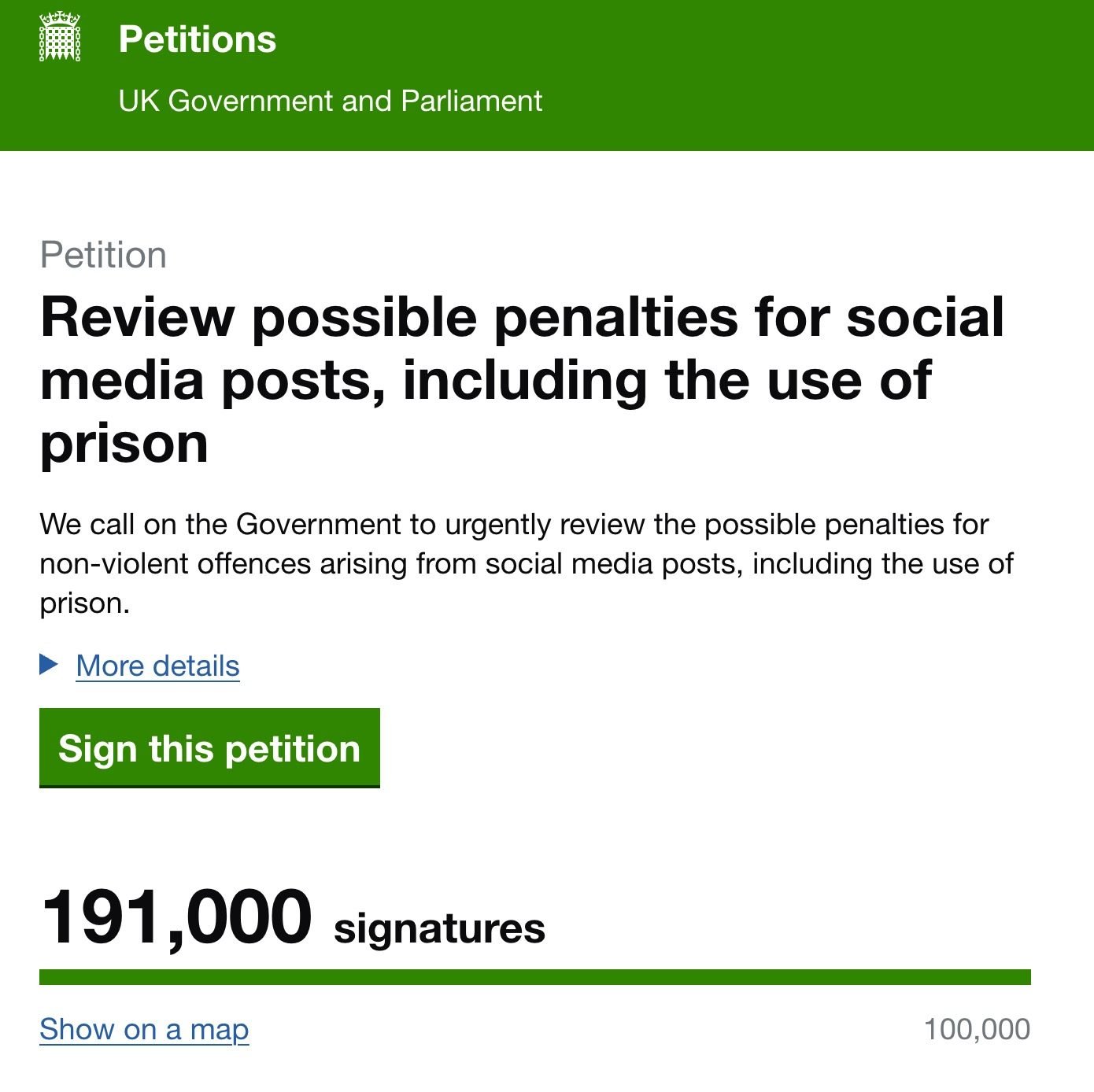
Nearly 200,000 citizens asked, politely, for Parliament to stop locking people up over tweets.
The result was a torrent of pious grandstanding from MPs who seem to believe that sarcasm on X is a more pressing threat to national security than terrorism or a collapsing National Health Service.
Let’s rewind. Rupert Lowe, Independent MP for Great Yarmouth, did something rather unfashionable in today’s Parliament. He listened to the public.
He took up a petition that read, “Imprisoning individuals for posts on social media sets a dangerous precedent.” Clear, sane, and supported by many.
Lowe went further. He brought Lucy Connolly, a British mother who was actually sent to prison for a social media post. She’s now out, but still under restrictions.
Lowe said something most of his colleagues now seem incapable of understanding: “In Britain, nobody should ever be sent to prison for an offensive social media post. Full stop.”
One by one, MPs rose to their feet to let the public know that their quaint little notions about “freedom of speech” were, in fact, dangerous. To these people, your right to open your mouth ends the moment someone else gets the slightest twinge of discomfort.
Jamie Stone, Liberal Democrat MP for Caithness, Sutherland and Easter Ross, made a heroic attempt at logical gymnastics, insisting that the Online Safety Act “does not target content because it is unpopular, offensive or controversial, but whether, crucially, it violates criminal law.”
Section 127 of the Communications Act 2003 criminalizes sending a message that is “grossly offensive.” The Malicious Communications Act 1988 does the same. (Both acts are already an attack on free speech.) And now we’ve got the OSA’s shiny new “false communications” offense, where if your tweet causes someone “non-trivial psychological harm” and you can’t prove a “reasonable excuse,” you’re suddenly bunking with burglars.
Saying the OSA only targets criminal content is circular because the Act creates new criminal content. It invents crimes out of previously legal speech, reclassifies harm as illegality, and then sits back smugly saying, “Well, we’re only punishing what’s criminal.”
Emily Darlington, Labour MP for Milton Keynes Central, made the remarkable claim that the OSA is “ensuring that everybody has a voice.” Presumably, except for people who say things that get them prosecuted.
She then called for UK election laws to be extended to online spaces, said “kids can’t buy a video game that is adult-only rated without ID” but online they can access anything, and warned that ditching the OSA would be dangerous because those critics “are actually putting our free speech at risk.”
Richard Quigley, Labour MP for Isle of Wight West, gave a performance worthy of a BBC drama, declaring that “offensive social media posts can have devastating effects” and that people “demanding the right to speak without restraint” are causing others “to lose their freedom to live without fear.” A stirring line, if you don’t think too hard about what “freedom to live without fear” might end up meaning when enforced by law.
Luke Taylor, Liberal Democrat MP for Sutton and Cheam, gave the most turbocharged rant of the day. He seemed less worried about Lucy Connolly’s jail sentence and more terrified that young people might be getting their news online.
He warned, “Social media posts take seconds to write and publish, and then they are everywhere. They are seen by our parents, grandparents, and kids, with no fact-check and no filter. Terrifyingly, a 2025 Ofcom study found that three-fourths of 18 to 24-year-olds use digital platforms and social media to get their news. The sort of reach once available only to professional journalists, filtered through editors and media owners, is now available to anyone with a phone. We can post with a moment’s thought during our morning coffee break, with the same ease as world leaders with armies of speechwriters, fact checkers and lawyers to craft their statements. One impulsive tap on an app can land in the timelines of tens, thousands, or millions of people.”
He then insisted that “There is free speech, but not without consequences.” A chilling phrase, especially when consequences mean handcuffs.
Oh, and he accused Elon Musk of “treason.”
Jake Richards, Labour MP for Rother Valley and Parliamentary Under-Secretary of State for Justice, chimed in to remind everyone that “freedom of expression is not an absolute right; it carries a responsibility to use that freedom honestly and decently.”
He lavished praise on the OSA and its new “false communications” offense, which criminalizes sending a message that “conveys information that the person knows to be false” with the intent of causing “non-trivial psychological or physical harm to a likely audience” and where there’s “no reasonable excuse for sending the message.” The penalty? Up to 51 weeks in prison and an unlimited fine.
Lowe pushed back. He pointed out something crucial: the British state now punishes “speech crimes” more harshly than some violent offenses. He said: “The British state is now more willing to imprison somebody for a social media post than for a rape.”
He closed with a statement: “We need clearer thresholds in law, a robust statutory requirement that prosecutorial decisions consider freedom of expression, and a prohibition on custodial sentences for pure speech cases.”
You get the impression, watching the current crop of MPs fluff their feathers during these censorship debates, that they genuinely think freedom of speech is a bit outdated. A dusty relic. Something to be politely nodded at in a citizenship class, before being buried beneath 500 pages of regulatory sludge and feelings-based legislation.
And what makes this new generation of politicians truly alarming isn’t just their hunger for control. It’s their complete, jaw-dropping ignorance of the principles they’re dismantling.
The liberty we’re talking about wasn’t handed down by fairy godmothers in wigs. It was wrestled from the jaws of kings, tyrants, censors, and lunatics by people who bled for it. Literally. From the Putney Debates to the Bill of Rights to the trial of John Wilkes, this country built its identity on the idea that people could speak their mind without being thrown in the Tower or dragged off by men in tights and powdered wigs.
Fast forward to today, and you’ve got MPs who think posting a bad joke on Twitter should land you in a holding cell. Politicians now talk about “consequences” for speech with the smirking menace. And they say it with pride. As if locking people up for being offensive makes them moral giants rather than bureaucratic toddlers with power issues.
These people do not understand liberty. They think it’s just one of many “competing values,” right up there with “not being upset,” “feeling safe online,” or “maintaining social cohesion,” whatever the hell that means this week.
They do not grasp that liberty means letting people say what they think, even when it’s wrong, rude, or makes you clutch your pearls so hard they turn to dust.
They are not defenders of liberty. They are its awkward, terrified, clipboard-wielding saboteurs. They don’t understand the danger of letting the state define what’s “harmful,” “false,” or “dangerous.” Because they assume the state will always be people like them.
This article (Britain’s Lawmakers Who Love Censorship and Hate Freedom) was created and published by Reclaim the Net and is republished here under “Fair Use” with attribution to the author Cam Wakefield

••••
The Liberty Beacon Project is now expanding at a near exponential rate, and for this we are grateful and excited! But we must also be practical. For 7 years we have not asked for any donations, and have built this project with our own funds as we grew. We are now experiencing ever increasing growing pains due to the large number of websites and projects we represent. So we have just installed donation buttons on our websites and ask that you consider this when you visit them. Nothing is too small. We thank you for all your support and your considerations … (TLB)
••••
Comment Policy: As a privately owned web site, we reserve the right to remove comments that contain spam, advertising, vulgarity, threats of violence, racism, or personal/abusive attacks on other users. This also applies to trolling, the use of more than one alias, or just intentional mischief. Enforcement of this policy is at the discretion of this websites administrators. Repeat offenders may be blocked or permanently banned without prior warning.
••••
Disclaimer: TLB websites contain copyrighted material the use of which has not always been specifically authorized by the copyright owner. We are making such material available to our readers under the provisions of “fair use” in an effort to advance a better understanding of political, health, economic and social issues. The material on this site is distributed without profit to those who have expressed a prior interest in receiving it for research and educational purposes. If you wish to use copyrighted material for purposes other than “fair use” you must request permission from the copyright owner.
••••
Disclaimer: The information and opinions shared are for informational purposes only including, but not limited to, text, graphics, images and other material are not intended as medical advice or instruction. Nothing mentioned is intended to be a substitute for professional medical advice, diagnosis or treatment.
Disclaimer: The views and opinions expressed in this article are those of the author and do not necessarily reflect the official policy or position of The Liberty Beacon Project.


Leave a Reply