

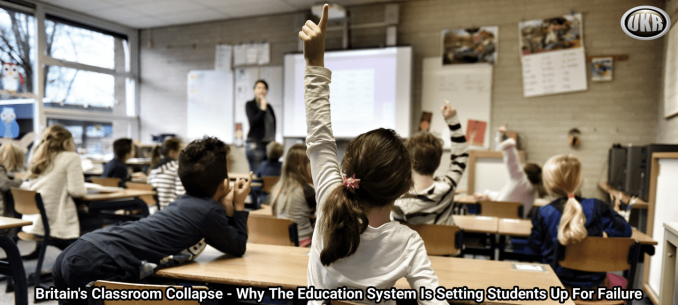
There is a crisis at the heart of Britain’s education system, as decades of underfunding, an obsession with meaningless metrics, and inflated exam results are leaving an entire generation disengaged.
GABRIEL MCKEOWN
The age of British educational pride and academic prowess is over, with decades of underfunding, waste, and wholly uninspired reforms producing a system that treats a child’s education as merely another administrative box to tick. Yet despite £116bn being spent every year to maintain a facade of efficacy, more schools are being financially squeezed as funding fails to keep pace with rising costs. This has created an endless cycle of cuts and closures, leading to teacher recruitment falling to 40% below the Department for Education’s overall target this year, and missing benchmarks by double that amount in core subjects such as physics. Worse still, this failure to attract new teaching staff has been compounded by an inability to retain the existing workforce, as close to 10% leave the state-funded sector every year. This has created a damaging cycle, with more schools now not only critically underfunded, but also understaffed, fuelling further discontent amongst the remaining teachers who are forced to grapple with ever-increasing workloads. For many on the inside, it’s clear that the system has been left in a state of managed decline, where the physical decay of school buildings is matched only by that of the curriculum.
It should therefore come as no surprise that students are disengaging at alarming rates, with absenteeism surging by almost two-thirds since the pandemic, equating to one in five children being persistently out of school. This is especially the case for those with more complex needs, as families now believe that the existing school environment is unsuitable, leading to an explosion in demand for specialist support plans. Close to half a million children now receive some form of classroom assistance, and this is still growing at over 11% a year as more parents turn to specialist plans to combat a system failing to meet its statutory duties. Yet, the knock-on effect of this mass requirement for additional support has been an accelerated decline of the mainstream education system, already at near breaking point due to unmanageable class sizes, dwindling teaching staff, and a wave of post-pandemic pupil unruliness. To pay for this new influx of specialist services, school budgets are hurriedly diverted away from the wider student pool, further exacerbating the underlying issues and forcing more parents to request additional assistance.
Importantly though, these issues are merely surface-level symptoms of the wider failure in modern education, whose curriculum and the assessments designed to measure it have become nothing more than a self-affirming farce, devoid of academic utility. The desire for schools to nurture intellectual curiosity and impart useful subject-agnostic knowledge has instead been replaced by a narrow, metric-driven obsession with ‘teaching to the test’. A school’s reputation, funding, and the careers of its staff now depend entirely on its performance in standardised league tables, with the government exerting the majority of its regulatory might through this simplistic and purely data-driven form of accountability. This has unsurprisingly resulted in a system whose driving motivations are not to produce well-rounded, educated students, but to instead meet the arbitrary targets necessary to continue receiving funding and prevent scrutiny from regulators. It is no longer seen as a priority to provide a balanced education, and subjects that do not fit into the national assessment league table are left underresourced, dramatically shrinking the curriculum. Those core subjects that do remain are studied purely to ensure a mastery of exam questions, through a process of uninspired box-ticking and test-taking, as schools are unable to dedicate the time and effort needed to foster a genuine level of academic interest from students.
This erosion of utility that began in the classroom has now permeated throughout the wider education system, as students are forced to sit pointless exams with inflated grades, for the express purpose of accessing equally useless university courses. By focusing on testing as the sole method of determining ability, grade inflation has been rampant, with a student who would have received a failing grade in 1988 now estimated to be awarded between a B and a C in a modern exam. The pandemic further illustrated this malleability of results when A-level students in 2020 received a 13% jump in the number of top grades awarded, thanks to overly generous teacher-assessed marking. It has therefore become increasingly difficult to identify those students who should actually pursue further educational opportunities, leading to an expansion in university attendance across the board. There is now an endless stream of new degree courses being added each year, designed purely to placate the soaring demand from those who wish to stave off entering employment. It has even been discovered that courses at a number of major universities have offered places to students who ‘achieved’ three E grades in their A-level exams, despite this indicating a total lack of academic aptitude. This has diminished graduate salary premiums, as the market is saturated with ‘overqualified’ labour, leading to a 12.7% unemployment rate for those leaving university, well above the national average. For many, the system has rapidly metastasised into a debt aggregation pipeline, as inflated results in the classroom set naive students up for disappointment in the job market, all while charging a fortune for the privilege.
The recent proliferation of artificial intelligence has brought the failure of the modern system to the forefront, as 88% of students admit to using AI tools specifically for their assessments, so traditional homework has become meaningless as a measure of an individual’s true ability and understanding. For many years, school work has been designed to reward formulaic outputs suitable for standardised exams, and AI now allows students to generate plausible text that is easy to mark consistently, but with the absence of original thought. If the education system had instead fostered genuine subject curiosity and rewarded deeper analysis from students, then it wouldn’t have been as easy, or even in the pupil’s interest, for AI to disrupt the whole process.
To have any hope of reversing the decline in the current system, a renewed appreciation for education as the primary method of advancing society is necessary. This will require a realignment with the classical view that education is a fundamental duty of the state to ensure stability and to cultivate virtue amongst young people. Any attempts at incremental reforms to the current model will be a further waste of resources, as the only viable path forward is a radical new system that is decentralised, free from bureaucracy and importantly, puts holistic education at the forefront. There should be an overarching objective for schools to provide a teaching environment that will go on to raise the general intelligence of all pupils by encouraging integrative thinking. This will give students the ability to understand connections between different disciplines and subjects, more akin to the sort of practical problem-solving needed throughout life. Pupils will be expected to leave the system well-equipped to address the complex issues facing society, rather than being limited to single-subject specialisation without any real application. This new approach could allow the system to move beyond the limited measure of national academic success as quantified by the number of exam passes in specific subjects, and towards a form of learning that genuinely improves complex reasoning and broad understanding. It will also ensure that the system remains highly malleable, requiring schools to innovate and refine their curriculum to prevent a disconnect between the skills taught in class and the skills required in life.
This versatility can be achieved through a remodelled version of the original tripartite education system that existed in Britain up until the 1960s. Despite its many criticisms, which inevitably saw its dismantling, the system correctly identified that children have different aptitudes and abilities, so it provided distinct educational pathways to best address these. Furthermore, those keen to dismiss the system as divisive and as a catalyst for future inequity should appreciate that this is, in large part, due to the failures of that specific application of the system, not the principles that underlie it. For instance, the 11-plus exam ultimately proved to be an unfair and ineffective way of dictating a child’s future, so a modern reinterpretation must address this flawed element of the system. A new tripartite model would have the selection process take place at a later stage, ideally around the age of 14, to allow for early-stage development and for the assessment process to have occurred in the years leading up to selection, rather than via a single arbitrary examination. Additionally, the three pillars of the education system would be treated as equally prestigious and worthy, so one’s placement into a specific pathway should not be considered a success or failure, but a natural alignment with one’s natural aptitude.
Broadly in line with the previous version of the tripartite system, the first selective pathway for students would be into an academic stream, containing around a quarter of the national cohort, and whose explicit goal would be to provide the skills necessary to enter a post-graduate profession. These institutions would offer a rigorous and subject-rich curriculum designed solely to prepare pupils to pursue further areas of study at top research-focused universities. The second pathway would then mirror this approach in the form of a technical stream, absorbing another quarter of the national student cohort in order to provide equally high-prestige technical qualifications. Importantly, this would provide a respected alternative to the purely academic route, acting as a destination of choice for those with a technical aptitude, rather than being considered simply a venue for those who fail the academic selection. In these schools, the curriculum would be akin to a modern apprenticeship, designed to fill industry skills shortages and provide a direct route to technically skilled employment.
The creation of these two specialist education streams would then allow the remaining majority of students to attend a more dynamic general pathway. This would remove the current failing exam-driven curriculum and instead aim to develop transferable cognitive skills through problem-solving and subject-agnostic learning. In this stream, learning is delivered through solving simulated real-world problems, allowing subject-specific knowledge in areas like mathematics or science to be practically applied throughout the learning process, rather than being seen as abstract concepts without any future application. This teaching style would then be combined with a primarily portfolio-based assessment process, consisting of various mediums to suit every student’s strengths, such as written reports and presentations, replacing memorisation-based exams. The schools themselves would then be assessed by how much they have improved the general cognitive ability of students, discarding the current arbitrary national benchmarks and subject league tables.
Without a strong, functioning education system, a nation will simply decay as each new generation enters society totally unequipped to deal with its ever-evolving challenges. In Britain, the system has been broken for many years, and implementing a series of incremental reforms is not a credible solution. By continuing in ignorance, we are doing a disservice to the many teaching staff who want to foster an environment of academic curiosity, and to those children who deserve to leave the classroom better equipped than they began. It’s vital that education isn’t relegated to just another administrative government function, but is instead treated as a true national priority to make the population more cognitively able, more adaptable, and more capable of solving the most complex problems facing society today.

This article (Britain’s Classroom Collapse – Why The Modern Education System Is Setting Students Up For Failure) was created and published by Sad Rabbit Media and is republished here under “Fair Use”
See Related Article Below
White Working-Class Failure
FRANK HAVILAND
I think of this incident whenever stories appear about white working-class children failing educationally. So dire have things become (66% of white British boys eligible for free school meals failed both English and maths GCSEs and only 13% progress to university) that the Education Secretary has commissioned a White Paper to be published in the autumn. When writing about the issue ahead of A Level results, Bridget Phillipson suggested that more parents need to be like her “Mam” and understand “the value of education”. She wants schools to be “warm and welcoming” and government to provide “support and accountability”.
I work with, and like, the demographic that has failed educationally so catastrophically but, as Spiderman demonstrated, I do not blame their lack of aspiration. I do blame the rotten ideologies that have permeated the education system and society at large. As former schools minister Nick Gibb wrote recently: “An ideology of progressive education was the fundamental problem in English schools.”Phillipson suggests the White Paper will include: expanded “mental health provision” and “behaviour hubs” in schools, “AI-powered reports” to detect where early help is needed and the “provision of whole-family support”. These are only sticking plasters; the blood will continue to seep out, draining individuals and society of its ability to flourish.
What then is going on?
When children struggle at school or at home – as all children will at some stage – all parents and teachers will try their best to help. All of them. However, some parents and teachers will reach for useful solutions (see below), tried and tested over generations, others will reach for progressive solutions that will hinder the child’s ability to function well. It is my contention that certain segments of society are more susceptible to these harmful social and political ideologies that have been relentlessly propagandised to an undeserving population. People who come from families that have endured generational fracturing and worklessness do not love their children any less than the middle classes or Bridget Phillipson’s Mam and, in fact, love them so much that they – without solid family support – reach for the current prevailing ideology in the mistaken belief they are doing the very best for their children. Sadly for them, the current prevailing ideologies around parenting and education are absolutely catastrophic to the welfare of children. It is these “solutions” that drive a falling out of the education system.
The ideology of our time concerning families and education is dark, insistent and wildly damaging. Some of the lies told by experts and then broadcast by politicians and media stars are broad: self-actualisation over family commitment, self-care over hard work, the default setting that the state rather than families should help first, that family breakdown doesn’t matter. Others are narrow and pernicious: the relaxing harmlessness of weed, the benefits of nurseries over mothering, that classroom discipline is Right-wing, that the western canon is racist. The worst are draped in the cold lies of science: the educational benefits of digital devices, that ordinary childhood challenges are explained by faulty brains that require lifelong medication. It should be obvious by now, with one in five children and young people reporting mental illness and 20% of children persistently absent from school, that these useless ideologies are not conducive to human happiness or educational prospects.
Meet Tyler (not his real name), a white working-class 15 year-old educational failure whom I am trying to teach. He was in bed (2pm) and I waited downstairs with his mother, a woman in her thirties and her baby son. She sat on the sofa with her baby cradled in the folds of her skirt. The baby curled his balled fists into his mother’s hair and she nuzzled her kisses to his neck. It was a Madonna and Child scene worthy of Raphael: Bridget Phillipson’s Mam would approve. We began to chat, she explaining everything that had gone wrong with her older son’s schooling and all of the things that she had done to try to help him. The list was long but worth recording in full: from a young age they had made sure he had all the latest tech from his first iPad at five, smartphone at seven to his Xbox at eight. When he wasn’t enjoying school, she had him assessed for ADHD, autism and ODD (oppositional defiance disorder) and was relieved with the ADHD diagnosis. They’d invested in wobbly sensory cushions for home and school, fidget toys and played white noise to help him sleep. He was also dyslexic. She’d put him on the waiting list for CAMHS and he’d had one appointment with a specialist who thought he was suffering PTSD after a fight at school. He was prescribed ADHD medication, an antipsychotic and melatonin to help him sleep. He’s on a waiting list to see a therapist but in the meantime she’s signed him up to an online therapy website but he’s not keen on taking part. He’s got his next CAMHS appointment in six weeks and she’s hoping that afterwards his behaviour will stabilise. I learned that the boy’s father had separated when he was young and her new boyfriend, the father of the baby, and Tyler don’t get on. Tyler has started smoking weed to help him relax. Within this rotten paradigm, educational attainment is impossible. Bridget Phillipson’s “behavioural hubs” may contain the problem but not solve anything.
In the end Tyler did not get up and we did not have our tutoring session (I’m sent by the second school that expelled him). What is particularly poignant in this situation and hundreds of thousands of others like it is the dedication of the mother and her innocent trust in the experts to help. Everything, from the digital zombification, the medication, the family breakdown, the county council accommodating his absence from school, the various special-needs diagnoses to the hope of therapy to solve the situation, are completely inimical to her or her son’s ability to live a good life. Yet all of it forms the current prevailing wisdom about how best to educate children and help those struggling. In trying to deploy the very latest medical and therapeutic expertise to support her son, she unwittingly harmed him.
How different would the outcome have been if the prevailing elite ideology had recommended exercise over medication, socialising over digital isolation, volunteering or part-time work over online therapy?
In another world, Bridget Phillipson, teachers and doctors, television personalities and politicians, Hollywood stars and mayors of London, TikTok personalities and CAMHS specialists would instead eulogise over digital detoxes, the joy of reading books, the necessity to spend time in nature, to volunteer in the community, to help others, to prioritise hard work, to socialise. The London Underground would be plastered with signs forbidding children and babies to use phones and take off headphones. The Keep Calm and Carry On signs would be reissued. New signs would appear: Work Hard, Play Hard. The Education Secretary would announce the rapid recruitment of thousands of male teachers, with intensive academic lessons in the morning and afternoons spent outside exploring and making things. Village halls and community centres would host dances every week so young people could socialise in person. A massive campaign akin to the drink-driving ads will appear on TV, on billboards, in schools, encouraging everyone to come off their mind-altering drugs – whether legal or illegal. Allowing children to play Roblox would become as socially unacceptable as giving children crack.
Bridget Phillipson’s Mam doesn’t strike me as the sort of woman who would have fallen for this progressive nonsense; let’s hope her daughter can shake herself out of it and give an honest assessment about how to improve the education of the white working class.
*****
Mary Gilleece is an education support worker and her name is a pseudonym.
This piece was first published in The Daily Sceptic, and is reproduced by kind permission.
If you enjoy The New Conservative and would like to support our work, please consider buying us a coffee or sharing this piece with your friends – it would really help to keep us going. Thank you!
Featured image: Pexels

••••
The Liberty Beacon Project is now expanding at a near exponential rate, and for this we are grateful and excited! But we must also be practical. For 7 years we have not asked for any donations, and have built this project with our own funds as we grew. We are now experiencing ever increasing growing pains due to the large number of websites and projects we represent. So we have just installed donation buttons on our websites and ask that you consider this when you visit them. Nothing is too small. We thank you for all your support and your considerations … (TLB)
••••
Comment Policy: As a privately owned web site, we reserve the right to remove comments that contain spam, advertising, vulgarity, threats of violence, racism, or personal/abusive attacks on other users. This also applies to trolling, the use of more than one alias, or just intentional mischief. Enforcement of this policy is at the discretion of this websites administrators. Repeat offenders may be blocked or permanently banned without prior warning.
••••
Disclaimer: TLB websites contain copyrighted material the use of which has not always been specifically authorized by the copyright owner. We are making such material available to our readers under the provisions of “fair use” in an effort to advance a better understanding of political, health, economic and social issues. The material on this site is distributed without profit to those who have expressed a prior interest in receiving it for research and educational purposes. If you wish to use copyrighted material for purposes other than “fair use” you must request permission from the copyright owner.
••••
Disclaimer: The information and opinions shared are for informational purposes only including, but not limited to, text, graphics, images and other material are not intended as medical advice or instruction. Nothing mentioned is intended to be a substitute for professional medical advice, diagnosis or treatment.
Disclaimer: The views and opinions expressed in this article are those of the author and do not necessarily reflect the official policy or position of The Liberty Beacon Project.


Leave a Reply