

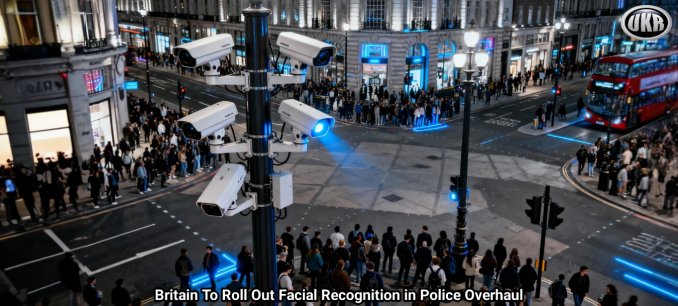
Britain To Roll Out Facial Recognition in Police Overhaul

The government’s AI overhaul recasts policing as data extraction, turning public life into a surveillance lab.

Stylized split human face of blue circuitry left and red hexagonal patterns right on a black digital background.
.

CAM WAKEFIELD

Britain’s policing system, we are told, is broken. And on Monday, the home secretary, Shabana Mahmood, announced that the fix would arrive in the form of algorithms, facial recognition vans, and a large check made out to the future.

The government plans to spend £140m ($191M) on artificial intelligence and related technology, with the promise that it will free up six million police hours a year, the equivalent of 3,000 officers.

It is being billed as the biggest overhaul of policing in England and Wales in 200 years, aimed at dragging a creaking system into the modern world.

The ambition is serious. The implications are too.

The plan is for AI software that will analyze CCTV, doorbell, and mobile phone footage, detect deepfakes, carry out digital forensics, and handle administrative tasks such as form filling, redaction, and transcription. Mahmood’s argument is that criminals are getting smarter, while parts of the police service are stuck with tools that belong to another era.

She put it plainly: “Criminals are operating in increasingly sophisticated ways. However, some police forces are still fighting crime with analogue methods.”

And she promised results: “We will roll out state-of-the-art tech to get more officers on the streets and put rapists and murderers behind bars.”

There is logic here. Few people would argue that trained officers should be buried in paperwork. Technology can help with that. The concern is what else comes with it.

Live facial recognition is being expanded aggressively. The number of police vans equipped with the technology will increase fivefold, from ten to fifty, operating across the country. These systems scan faces in public spaces and compare them to watch lists of wanted individuals.

This is a form of mass surveillance and when automated systems get things wrong, the consequences fall on real people.

That is true for Shaun Thompson, an anti-knife crime campaigner, who was wrongly caught in the Metropolitan Police’s facial recognition tech.

Earlier this month, Mahmood took a tone explicitly embracing the logic of the panopticon rather than warning against it.

She argued that the knowledge of being observed can itself deter crime, describing visibility and certainty as powerful tools in modern policing.

In her account, technology that makes offenders feel watched is not a threat to public life but a feature of a safer one, provided it is deployed by the state rather than left to chance or private actors.

Mahmood said: “When the future arrives, there are always doubters. 100 years ago, fingerprinting was decried as curtailing our civil liberties. But today, we could not imagine policing without it.

“I have no doubt the same will prove true of facial recognition technology in the years to come.”

Facial recognition is not the same as fingerprinting because it operates at a distance and without active participation. Fingerprints are taken after arrest or with consent, in controlled settings, and they sit quietly in databases until a specific investigative need arises.

Facial recognition works in public spaces, scanning faces automatically as people go about their lives, many of whom are not suspected of any wrongdoing, and checking them against databases.


This article (Britain To Roll Out Facial Recognition in Police Overhaul) was created and published by Reclaim the Net and is republished here under “Fair Use” with attribution to the author Cam Wakefield

See Related Article Below

The Starmer regime has announced a roll-out of AI digital facial recognition technology for police surveillance in our towns and cities. This is repugnant to our fundamental freedoms and right to privacy. Panopticons are for prisons, not the general public.

DAVID KURTEN

WATCH:

••••

The Liberty Beacon Project is now expanding at a near exponential rate, and for this we are grateful and excited! But we must also be practical. For 7 years we have not asked for any donations, and have built this project with our own funds as we grew. We are now experiencing ever increasing growing pains due to the large number of websites and projects we represent. So we have just installed donation buttons on our websites and ask that you consider this when you visit them. Nothing is too small. We thank you for all your support and your considerations … (TLB)

••••

Comment Policy: As a privately owned web site, we reserve the right to remove comments that contain spam, advertising, vulgarity, threats of violence, racism, or personal/abusive attacks on other users. This also applies to trolling, the use of more than one alias, or just intentional mischief. Enforcement of this policy is at the discretion of this websites administrators. Repeat offenders may be blocked or permanently banned without prior warning.

••••

Disclaimer: TLB websites contain copyrighted material the use of which has not always been specifically authorized by the copyright owner. We are making such material available to our readers under the provisions of “fair use” in an effort to advance a better understanding of political, health, economic and social issues. The material on this site is distributed without profit to those who have expressed a prior interest in receiving it for research and educational purposes. If you wish to use copyrighted material for purposes other than “fair use” you must request permission from the copyright owner.

••••

Disclaimer: The information and opinions shared are for informational purposes only including, but not limited to, text, graphics, images and other material are not intended as medical advice or instruction. Nothing mentioned is intended to be a substitute for professional medical advice, diagnosis or treatment.

Disclaimer: The views and opinions expressed in this article are those of the author and do not necessarily reflect the official policy or position of The Liberty Beacon Project.

Be the first to comment

Leave a Reply

Your email address will not be published.


*
