

CLIVE PINDER
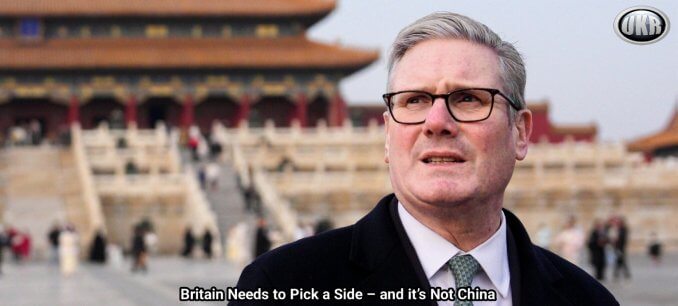
While Britain teeters on the edge of economic exhaustion and strategic irrelevance, its Prime Minister has just returned from a trip to China.
Let that sink in.
At the very moment when the world is splitting into rival civilisational blocs, when supply chains are weaponised, when technology, energy and intelligence determine national survival, Britain’s answer appears to be a polite handshake with a one-party surveillance state whose interests are fundamentally hostile to our own.
This is not diplomacy. It is delusion.
China is not a misunderstood partner waiting to be charmed into good behaviour. It is a rival power with a radically different culture, values system and political philosophy. It is a country that blends state capitalism with authoritarian control. Exports dependency. Steals intellectual property at scale and runs mass detention camps to combat ‘extremism’.
Not content with inviting such a power into the centre of our economic life, along with a begging trip to Beijing, our Prime minister is apparently relaxed about allowing a vast Chinese state outpost to rise in the heart of London: the nerve centre of our history, politics and finance. Which is rather like permitting a foreign garrison to set up camp inside the city walls and then calling it hospitality. History is rarely kind to such acts of complacency.
That is the naïvety tax of flirting with authoritarian powers. You gain neither their loyalty nor your allies’ trust. Britain cannot afford to keep paying it.
Empire is Over. Drift is the Enemy
The old-world order is over. The post-war settlement has collapsed. Globalisation has fractured. Power has returned to hard economics, hard security and hard choices. Even Europe has begun to mutter the unsayable. At Davos this year, the German Chancellor openly conceded that the European project had “wasted its opportunities” and is no longer “fit for purpose”. When Germany finally says that out loud, the age of comforting illusion has ended.
Britain now stands at a strategic inflection point. To become a footnote in the history of great empires like Greece and the Ottomans, or to leverage our history and pedigree to become the Singapore of Europe.
We are no longer the leader of an empire. That chapter is closed. But nor are we condemned to be a second-rate European appendage or a supplicant wandering the world clutching a trade brochure. The danger we face is drift, the most lethal condition for any nation with a proud history and potentially promising future.
The economic facts are no longer debatable. They are disastrous. Public debt sits at levels last seen after the Second World War. Interest payments exceed our defence budget. Productivity has flatlined for over a decade. Real wages have stalled. Energy costs are punitive. The tax burden is crushing. The state grows larger as the economy weakens, the unmistakable symptom of a welfare system feeding on a shrinking host. Confidence in every critical agent of our socio-economic well-being is rock bottom: politics, civil service, health service, armed forces, police – you name it, ordinary men and women don’t trust it.
A proud nation can endure hardship. What it cannot endure indefinitely is stagnation combined with humiliation.
The Atlantic Umbilical Cords
Britain’s future will not be secured by flirting with authoritarian regimes that neither share our values nor wish us well. It will be secured by choosing, deliberately and without apology, to anchor ourselves to the civilisation that does. That civilisation is the liberal democratic West. Its enduring centre of gravity remains the United States: not because of or even in spite of any one president, but because its institutions endure, its constitution anchors authority and its power still moves the world.
This is not an ideological leap. It is the formal recognition of an existing reality.
Britain and America are already bound by multiple umbilical cords.
Britain sits between the United States and Russia, commanding the eastern Atlantic and anchoring NATO’s northern flank. In any serious confrontation with Russia, the North Atlantic is decisive, and Britain sits at its centre.
Britain is not a passenger in American intelligence. It is a producer, a trusted set of eyes and ears with intelligence cooperation that goes further than with any other ally.
Culturally, Britain does not orbit Europe. It orbits America. Our entertainment industries, media and creative talent integrate effortlessly with America and struggle far more on the continent.
Language matters more than policymakers like to admit. A shared language is not a courtesy, it is a strategic asset. It accelerates commerce, deepens trust, reduces friction and allows ideas to move at speed. Britain and America speak the same language legally, commercially, culturally and instinctively.
Then there is education and innovation.
Britain’s top universities already match America’s best, with research and talent moving easily between them. What Britain lacks is scale, capital and urgency, which America has in abundance.
Energy, trade and critical minerals complete the picture. Britain’s energy costs are economic self-harm. We are not energy-poor yet behave as if we are. The North Sea still holds vast gas potential. We retain nuclear expertise and our geography suits next-generation energy. Yet investment stalls and industry pays the price. What Britain lacks is not resources but scale, capital and certainty.
A deep Atlantic partnership supplies all three. American capital, technology and markets would unlock North Sea gas, stabilise energy costs and anchor industrial revival, while opening access to Central and South America’s fossil fuels and rare earths. No modern economy survives without cheap, reliable power.
Trade then locks the strategy in place. Britain’s natural role is not as a closed island but as an entrepôt. The Atlantic gateway for American capital, energy and critical minerals into Europe and the Middle East. A formal partnership gives Britain privileged access to the American continent’s resources, while offering the United States trusted markets, deep finance and a rules-based legal system. Where the continent hesitates and regulates, Britain can move and act.
The foundation of such a partnership must be explicit: shared Judeo-Christian cultural roots, liberal democratic values., rule of law, free enterprise, open commerce. This does not mean open borders without control. It means managed immigration schemes that serve national interest, student mobility, skilled labour pipelines and reciprocal access that strengthens rather than erodes social cohesion.
Why this Partnership Works
There is an uncomfortable truth that must also be acknowledged.
Britain has become, in large part, a welfare nation. America largely has not. Roughly one in five Britons now depends on some form of means-tested support. In the United States, the figure is significantly lower, and labour participation remains higher. That difference matters. It shapes culture, ambition and economic dynamism. A deeper partnership with America is not about importing cruelty: it is about rediscovering agency.
Put all this together and the conclusion becomes unavoidable.
Britain and America are not potential partners: they are natural ones.
The model for this partnership is not empire and it is not subordination. It is Singapore. Singapore did not prosper by dominating its region. It prospered by making itself indispensable to those who do. Fiercely sovereign, unapologetically patriotic, ruthlessly pragmatic, it aligned itself with American power while remaining unmistakably itself.
Britain must now do the same on the Atlantic.
This would mean a formalised Anglo-American partnership across defence, intelligence, energy, technology, trade, capital markets and education. Britain would become the front-line Atlantic platform through which Western economic and strategic power flows into Europe and the Middle East. Not a follower: a force multiplier.
The Transatlantic Generation
How do we sell it?
First, as a jobs and wages pact: cheaper energy, faster investment, higher productivity.
Second, we make the partnership real through a Trans-Atlantic Education and Work Pact. Any British or American citizen aged 18 to 25, legally resident in their home country, would have the automatic right to study and work for up to 10 years in the other, across any field. From universities and laboratories to agriculture, engineering, construction, healthcare and high technology.
This is not open-ended migration but managed, time-limited mobility in the national interest. If Erasmus was Europe’s soft power, this is a serious upgrade.
For the United States, the case is not emotional. It is strategic. Britain is the low-friction ally that multiplies American power with geographic reach spanning Europe, the Middle East and the Atlantic. This partnership once gave America the platform to win a world war and shape a new order. It can do so again, with Britain as its Atlantic hinterland and entrepôt, free of continental drag.
In an era of Chinese economic coercion and a European Union paralysed by regulation, demographics and indecision, a sovereign Britain offers the United States the one thing it cannot get from the continent: a proven, trusted, value-aligned partner capable of acting rather than convening.
The Hour of Decision
The idea that sovereign nations cannot be closely entwined with a larger democratic power is a fantasy indulged by those who mistake morals for strategy. Australia and New Zealand share defence, labour markets and culture without losing themselves. Canada and the United States run deeply integrated trade, intelligence and supply chains while remaining fiercely independent.
None of this is weakness: it is adulthood. Britain would remain independent yet interdependent, which is how serious nations survive in a dangerous world.
The alternative is the spectacle we have just endured: our Prime Minister genuflecting in Beijing, seeking relevance from a regime that regards Britain as a tired former power, useful for ceremony but not for respect. That is not diplomacy: it is strategic self-harm.
If we have the courage to choose our friends wisely, to anchor ourselves to our natural allies, to act with confidence rather than apology, Britain can yet play a great and honourable role.
Yet history is unkind to nations that hesitate when clarity is required.
This is the hour to choose strength over sentiment. Partnership over pride. To place Britain, firmly and confidently on the Atlantic side of history.
Clive Pinder is a recovering global executive, former elected ornament and reluctant chronicler of institutional decay. Subscribe to his Substack.
This article (Britain Needs to Pick a Side – and it’s Not China) was created and published by The Daily Sceptic and is republished here under “Fair Use” with attribution to the author Clive Pinder

••••
The Liberty Beacon Project is now expanding at a near exponential rate, and for this we are grateful and excited! But we must also be practical. For 7 years we have not asked for any donations, and have built this project with our own funds as we grew. We are now experiencing ever increasing growing pains due to the large number of websites and projects we represent. So we have just installed donation buttons on our websites and ask that you consider this when you visit them. Nothing is too small. We thank you for all your support and your considerations … (TLB)
••••
Comment Policy: As a privately owned web site, we reserve the right to remove comments that contain spam, advertising, vulgarity, threats of violence, racism, or personal/abusive attacks on other users. This also applies to trolling, the use of more than one alias, or just intentional mischief. Enforcement of this policy is at the discretion of this websites administrators. Repeat offenders may be blocked or permanently banned without prior warning.
••••
Disclaimer: TLB websites contain copyrighted material the use of which has not always been specifically authorized by the copyright owner. We are making such material available to our readers under the provisions of “fair use” in an effort to advance a better understanding of political, health, economic and social issues. The material on this site is distributed without profit to those who have expressed a prior interest in receiving it for research and educational purposes. If you wish to use copyrighted material for purposes other than “fair use” you must request permission from the copyright owner.
••••
Disclaimer: The information and opinions shared are for informational purposes only including, but not limited to, text, graphics, images and other material are not intended as medical advice or instruction. Nothing mentioned is intended to be a substitute for professional medical advice, diagnosis or treatment.
Disclaimer: The views and opinions expressed in this article are those of the author and do not necessarily reflect the official policy or position of The Liberty Beacon Project.


Leave a Reply