

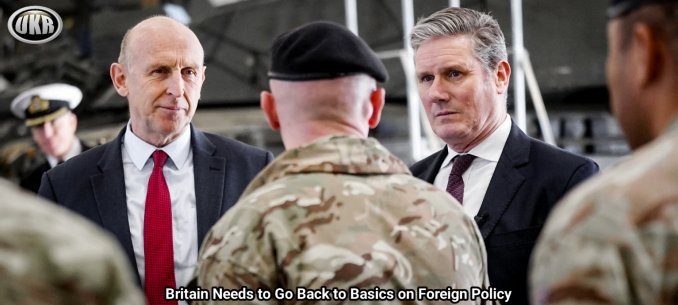
Britain needs to go back to basics on foreign policy
Britain cannot be subordinated to Europe or America but must make itself powerful again
SEBASTIAN MILBANK
Britain seems to drift through the buffeting ocean of geopolitics, driven this way and that by the tides and the winds of events, our rudderless ship of state unable to exert any influence as we’re steadily blown towards catastrophe. Anyone who closely follows British politics must have at some point asked themselves the question, “why are we so bloody useless as a country?”
A large part of the answer is that we have an establishment that believes its job is to react, rather than decisively act, and is committed to process and management rather than politics and governance.
This has become especially obvious in the field of geopolitics, where our foreign policy problems can be summed up quite simply as the fact that we haven’t got one. We have any number of noble commitments — to our treaties, alliances, norms, ideals and so on — but not a single notion of what we are seeking to achieve or pursue. The post-imperial demoralisation following Suez saw British foreign policy outsourced to America and the emerging European Community. Now that we are out of the EU, and America is pursuing an “America First” foreign policy, Britain is suddenly waking up to the fact that it has no policy or purpose of its own.
We have shaped our economy and institutions around the assumptions of a relatively benign America, global free trade, and open markets. We bet big on the idea that we could be a finance, services, and consumption based economy that could continue to suck in enough foreign labour and capital to keep our generous welfare system going. We are reliant on foreign imports for almost everything, including energy, and we have built a military on the assumption that it would only be deployed as part of a larger NATO mission, rather than having to operate autonomously, at scale, or for a prolonged period.
This triumph of process over policy was at its most glaringly visible in the insane handover of the Chagos Islands to Mauritius. It wasn’t just the failing of our clench-jawed Prime Minister, but was rather the outcome of years of civil service drift and dogma, which had gone unchallenged by multiple Conservative governments in the years leading up to the signing of the deal.
But reality has come knocking. Trump’s cynical 180 on the Chagos deal was predictable, and it has given him further ammunition in his dismissal of Europe as a complacent continent unable and unwilling to defend its territory and interests.
Yet that is changing, and it risks leaving Britain behind in the most dangerous way. America has never responded with especial enthusiasm to the so-called “special relationship”, and now Europe looks set to integrate on defence as well economic policy. With growing protectionism and competition over resources and energy worldwide, the EU may well be on a trajectory to becoming a mercantilist bloc — one from which Britain could end up excluded.
A pivot to global trading partners or to an alliance with India or China has not paid off, despite years of trying — they rightly calculate that we need their cheap goods, and they can in turn buy up British assets, all without having to give us particularly preferential terms. Pivoting to “CANZUK” (Canada, Australian, New Zealand and the United Kingdom), sounds good, but our former dominions are now integrated into new economic spheres, and are unlikely to be attracted by what Britain can offer on its own.
The current tensions with America, and our stuttering economy, has seen a growing push for Britain to rejoin the EU, and even if we stop short of that, there is already movement from Labour for a re-entry to the customs union, as well as the olive branch of restarting the Erasmus scheme.
There is a path for Britain to steer between Scylla and Charybdis, but it involves learning the lessons of history and geography
This looks like a solution to some, but subordination to either the American or European spheres both now carry increased costs. A half way house, like the customs union, may be more politically palatable but it is by far the worst option, leaving us as ruletakers but not rulemakers, with EU countries free to impose disfavourable terms on Britain. Even if full re-entry could be achieved, the neoliberal framework of EU competition rules would effectively block Britain from the aggressive reindustrialisation, and interventionist fiscal and industrial policies it almost certainly needs if it is to adapt to a newly hostile and protectionist world order. Even if admittance to a reformed European defence and economic union is on the cards, this would be by far a better prospect if it waits till Britain takes full advantage of a free hand in its economy.
There is a path for Britain to steer between Scylla and Charybdis, but it involves learning the lessons of history and geography, and going back to our “natural” foreign policy stance. Historically, Britain created a powerful navy which served both to protect the Home Islands, and to open the seas to British trade. This same tool allowed us to project power quickly and at the point of maximum impact. Rather than going it alone, Britain was able to assemble a powerful alliance system by offering to tip the scales in major European conflicts, gradually assembling a strong coalition of allies who also offered a market for British goods.
Britain made a critical error post-war. It believed that it could simply hand over its imperial project to America, becoming the junior partner, but still having a crucial convening role. The problem with this idea was that the US simply wasn’t interested. A continental sized economy, it didn’t need a sprawling alliance system to project power, and could simply dictate the terms of a world order that best served the interests of its hundreds of millions of citizens.
Instead, we should do now what we should have done then, and look to another post-imperial moment. In 1783, the British Empire looked much reduced. Britain had lost most of its American colonies. Canada was an obvious target for US expansion, and France was still eager to contest British rule in India, where powerful local rulers, like Tipu Sultan, looked fully capable of pushing the East India Company out of the subcontinent with French help, just as Washington had done in North America. Britain had scored one major victory against the French-Spanish alliance however — the siege of Gibraltar.
Unlikely though it seems, this would prove crucial. Gibraltar opened the Mediterranean to British naval power, allowing us to counter Napoleon’s ambitions in Egypt, stage the battle of Trafalgar, and blockade France. Britain became the hegemonic power of the 19th century not because it had a large empire, but because it industrialised, built an unstoppable navy, seized control of global trade and finance, and created a powerful alliance system that kept potential rivals isolated and off-balance.
We need not be aiming at superpower status to learn from the strategic fundamentals at play. Britain has fared poorly in past EU negotiations because we are one country against many, and turn up empty handed expecting to be given good terms. Rather than acceding to EU interests, or becoming a still more craven vassal of another great power, Britain has to return to the basics, and think about what it has to offer.
The answer is the same as it was 200 years ago: a professional army and a powerful navy. Whilst Britain has little to gain right now in plunging back into the EU in its current form, it has huge amounts to gain through membership of a European security and defence alliance. Britain should make itself indispensable and integral to European defence. This one policy unlocks a number of vital doors for British interests.
In the first instance we are already aligned with Europe on security and defence, and our interests are naturally served by excluding Russian, Chinese and, yes, American influence from Europe. What we need to do now is go much further. Britain has to develop fully independent and autonomous capabilities in arms production, energy and military action along French lines, thus becoming a much more useful ally, at the same time as being able to fully protect our own interests. Just as importantly we have to develop defence policy in concert with European allies, and be willing to proactively use our military in our shared interest.
If we become not simply useful, but integral to European defence, this gives us vital leverage and bargaining power that extends into every level of our relationships, and most importantly in trade negotiations. If Britain is patrolling the walls of Fortress Europe, we can command favourable terms and take a direct hand in securing our economic interests. Importantly, we can pursue this policy directly and without going through the EU. We already have strong bilateral relationships with countries like France on defence, and by making individual deals, we can ensure that we have key allies invested in our interests when we have to deal with the EU.
To give a practical example of how this might work, we are currently facing a channel migration crisis in which France is failing to act to stop migrants from crossing to Britain, or allowing us to return them to France. But think about it from the French perspective — they’re facing a much larger crisis in the Mediterranean, and every migrant that goes to Britain is one less burden on the French state. How do we get our interests to align? Britain and France could agree on a shared strategy to address illegal migration in the channel and Mediterranean, with our navies and coastguards working directly together to fight drug and people smuggling as well as terrorist threats, in both seas. The costs of immigration processing centres could be shared, and offshore processing could be employed using the two nation’s numerous overseas territories, or by working to set up and fund refugee camps in Northern Africa and the Middle East.
This defence and security led European policy leverages our still potent advantages in intelligence, defence and naval power projection into economic advantages and strategic partnerships that act as force multipliers. At present the EU is moving slowly on defence, and its structures are poorly adapted to such policies — indeed, in many respects it historically exists to disarm and defang Europe, even as NATO dominates defence policy. Britain has an opportunity to put itself at the heart of European defence rather than letting it falter in the mud of EU bureaucracy.
By the same token, a defence-led foreign policy in Europe is likely to spark a shift in economic policy — with more emphasis on reshoring industry, producing energy security, and securing natural resources. Britain has much to offer here, from its still significant hydrocarbon reserves, potential tungsten mining operations, and our civil nuclear industry. Putting more investment into these sectors, and especially catching up with the French on nuclear energy, would greatly increase the strength of our hand.
Whilst autarky is not a reasonable economic policy for any but continental scale economies, greater economic autonomy and diversity makes us more adapted and makes us more attractive partners. Crucially, rather than joining outsize trade blocs, we should focus on deepening bilateral relationships that include defence, intelligence and security, effectively “raising the stakes” of economic partnerships and shielding them from transactional logic and competition from other powers.
Such partnerships should begin with Europe, as our most accessible market with the most peer nations in terms of small to medium sized advanced economies, but it need not end there. In the past 20 years we have tried and failed to secure economic relationships purely through glorified trade missions and (poorly employed) soft power. Britain should instead start by offering military, policing, security and intelligence expertise, then expand that into a wider strategic partnership that includes preferential economic terms. Not only should we invest in and secure our overseas bases, but we should actively work to secure more allies and bases from which we can project power and influence.
The fact that Britain is a highly advanced medium-sized nation rather than a giant like Russia, China or America has its advantages. Britain is a less menacing trade and security partner than the likes of the big three, and we can convene wider alliances and coalitions based on mutual interest. China’s growing influence in Africa and Latin America is something that Britain, and European allies, could seek to counter.
Building influence in this way is a virtuous circle. The more that Britain has influence in Europe, the more it can parlay that into influence further afield. If we can secure preferential terms with Europe through an expanded investment in European defence, this also offers us the strongest terms for creating a closer partnership with the CANZUK countries. Here as well, defence and security based around the defence of a shared civilisational order offer the best possible foundation, from which economic integration and partnership can naturally flow.
One of the chief advantages of reinvesting in industry and defence is to raise the morale of a depressed and apathetic country
A path is still visible to Britain, with our historic strengths and institutions, to being a serious world power, not through delusions of grandeur, but rather by building up a few key capabilities and leveraging its relationships with Europe and the former Commonwealth to create new alliance systems. Even the simple move of closely aligning Britain and France, doubles our strength overnight in shared endeavours. Nor is rebuilding global influence about empire building, neoconservative or otherwise, but rather about securing our interests in a globalised but increasingly competitive world.
But as with many things, these realistic and pragmatic concerns won’t be addressed by a country wedded only to pragmatism and process. Britain’s greatest strengths and strategy remains in shining ideals, the beauty of our culture and the strength of the national character. One of the chief advantages of reinvesting in industry and defence is to raise the morale of a depressed and apathetic country, and to bring us back into a sense of urgency and action.


Leave a Reply