

TIM BRIGGS
There are many ways for a modern welfare state to lose control of its finances. Some are spectacular. Others are incremental, technocratic and almost invisible — until the bill becomes impossible to ignore.
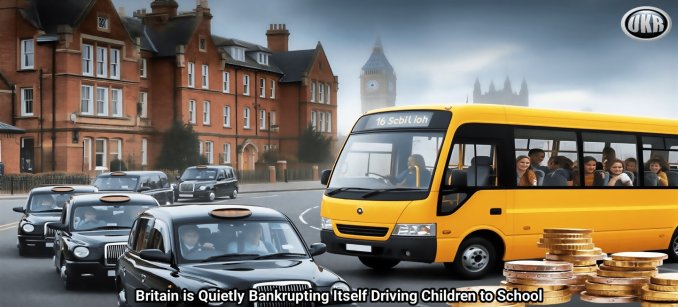
One such disaster is unfolding right now inside local authority budgets: the cost of transporting children with Special Educational Needs and Disabilities (SEND) to school. SEND transport is obscure, politically sensitive and ruinously expensive. And despite the Labour Government deciding to ‘do something’ by announcing a consultation, almost nobody in Westminster really wants to talk about it.
The figures alone should set alarm bells ringing. Councils in England now spend £2.3 billion a year on SEND transport — a 70% increase since 2015-16. Around 520,000 children qualify for free transport. Children are eligible if their nearest suitable school is beyond two miles for under-eights and three miles for over-eights, if there’s no “safe walking route” or if they cannot walk there due to SEND or a mobility problem. The average annual cost per SEND child is £8,116. For other pupils, it is £1,526.
These huge differences in cost belie a systemic failure.
Local authorities presently stagger under four pressures: temporary accommodation, adult social care, staff costs — and now SEND transport. This last category is growing faster than almost anything else, driven by a toxic mix of legal absolutism, opaque procurement and bureaucratic inertia.
I saw this up close during eight years on Lambeth Council as an opposition leader, scrutinising ruinous Labour budgets. Each year, finance officers warned that SEND transport costs were spiralling out of control. Each year, nothing meaningful changed.
The rot accelerated during Covid. During lockdowns, Councils abandoned shared minibuses and moved SEND children into individual taxis to comply with mandatory legal duties to make sure children got to school. It was billed as temporary. It became permanent.
Once introduced, those arrangements proved politically and legally difficult to unwind. At the same time, smaller transport operators exited the market, tightening supply and pushing prices up.
By 2025, matters had worsened further. Fuel costs climbed. Wages rose. National Insurance increases pushed up employment costs. Transport firms, facing higher risks and tighter margins, had little incentive to expand services. Councils, legally obliged to provide transport regardless of cost, paid whatever was demanded.
Corruption thrives in the dark
Then there is procurement — the great unspoken scandal of local government. Contracts and bidders are hidden. ‘Commercial confidentiality’ is deployed as a shield against proper scrutiny. In this environment, competition withers and suspicion flourishes.
During my time in local government, allegations of cartel-like behaviour among suppliers and favoured contractors run by family members of council officers were common — and strikingly rarely challenged. When spending is mandatory, oversight is weak and transparency absent, costs rise inexorably. This is institutional failure and it requires institutional change.
Overlaying all this is a legal framework that treats SEND transport as an absolute right, detached from affordability. Judges have increasingly interpreted education, human rights and equality legislation as imposing duties without reference to cost or proportionality. This may feel compassionate. In practice, it means councils must provide whatever transport is demanded, even if it is wildly expensive.
At the same time, demand has surged. The number of children with Education, Health and Care Plans has risen by 166% (i.e., more than doubled, heading towards tripled) in a decade, from 240,000 in 2015 to 639,000 today. Mental health needs, genuine and otherwise, have multiplied. The system of helping SEND children get to school was not designed for these numbers.
The official response has been depressingly familiar. Reports from the National Audit Office emphasise improved data collection, better monitoring and greater inclusion of SEND children in mainstream education. All sensible. All insufficient.
None of this confronts the core issue: an open-ended legal duty delivered through the most expensive possible model, with no meaningful price discipline. More money will not solve this. It will only postpone the reckoning.
What a serious government would do
A majority Reform or Conservative government that was serious about public finances would need to act quickly — and unapologetically.
First, personal transport budgets would become the default wherever possible. Families who can transport their children themselves should be supported to do so, using public transport where needs allow.
Second, total transparency in procurement. All councils should be required to publish every costed bid from transport providers on Gov.UK as a condition of bidding, successful or not. No more secrecy. No more cosy arrangements. Competition and lower prices would return overnight.
Third, the assessment of need must reconnect with reality. The duty to provide transport should be balanced explicitly against average local transport costs, not treated as an open-ended liability divorced from economics. Right cannot be allowed to float free of economic reality.
Fourth, introduce a digital voucher system for SEND transport. Allocate each child a fixed amount of credit for required journeys. Log every trip digitally. Monitor usage in real time. Cap costs while preserving safeguarding. This is not radical — it is basic modern administration, and avoids the kind of open-ended fraud that appears to have taken place in Minnesota.
Extra flexibility — for medical appointments, for example — can be built in using Uber-style per-mile payments across a range of vehicles, instead of gold-plated retainer contracts for particular taxi firms.
Finally, the law itself must change. Parliament should make clear that shared transport such as minibuses fulfils the state’s duty, and that obligations are met when the majority of journeys are provided. That will require amendments to education law, equality legislation and human-rights provisions, amendments which are also required to tackle state overreach in other areas of public life and the resulting Rule of Lawyers.
SEND transport is not a fringe issue. It is a warning of greater failings to come if we do nothing. A state that refuses to price its promises will eventually fail to keep them. Sustainability is not cruelty. It is the only way to protect the services that matter most. Britain can reform now — calmly, rationally and fairly — or wait until the money runs out and chaos forces change upon it. The uncomfortable truth is that sustainability is itself a moral choice. Britain is running out of time to pretend otherwise.
Tim Briggs is a solicitor and ex-Para, and the former Conservative Leader of the Opposition at Lambeth Council. Follow him on X here.
This article (Britain is Quietly Bankrupting Itself Driving Children to School) was created and published by The Daily Sceptic and is republished here under “Fair Use” with attribution to the author Tim Briggs

••••
The Liberty Beacon Project is now expanding at a near exponential rate, and for this we are grateful and excited! But we must also be practical. For 7 years we have not asked for any donations, and have built this project with our own funds as we grew. We are now experiencing ever increasing growing pains due to the large number of websites and projects we represent. So we have just installed donation buttons on our websites and ask that you consider this when you visit them. Nothing is too small. We thank you for all your support and your considerations … (TLB)
••••
Comment Policy: As a privately owned web site, we reserve the right to remove comments that contain spam, advertising, vulgarity, threats of violence, racism, or personal/abusive attacks on other users. This also applies to trolling, the use of more than one alias, or just intentional mischief. Enforcement of this policy is at the discretion of this websites administrators. Repeat offenders may be blocked or permanently banned without prior warning.
••••
Disclaimer: TLB websites contain copyrighted material the use of which has not always been specifically authorized by the copyright owner. We are making such material available to our readers under the provisions of “fair use” in an effort to advance a better understanding of political, health, economic and social issues. The material on this site is distributed without profit to those who have expressed a prior interest in receiving it for research and educational purposes. If you wish to use copyrighted material for purposes other than “fair use” you must request permission from the copyright owner.
••••
Disclaimer: The information and opinions shared are for informational purposes only including, but not limited to, text, graphics, images and other material are not intended as medical advice or instruction. Nothing mentioned is intended to be a substitute for professional medical advice, diagnosis or treatment.
Disclaimer: The views and opinions expressed in this article are those of the author and do not necessarily reflect the official policy or position of The Liberty Beacon Project.


Leave a Reply