

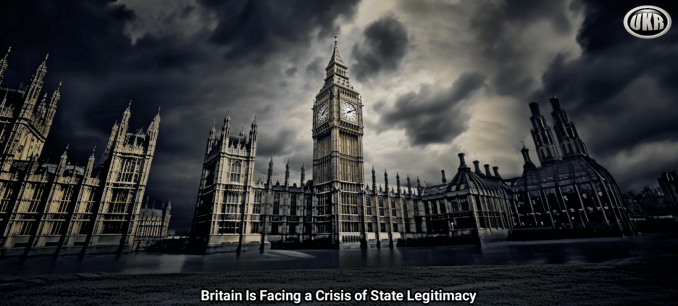
Britain is facing a crisis of state legitimacy
An unpopular government is relying on damaged and impermanent tradition
CHRIS BAYLISS
When he defeated Neil Hamilton at Tatton in the 1997 general election, Martin Bell famously marked his victory with a dramatic flourish, reciting the final lines of G.K Chesterton’s “The Secret People”. It was well received, but with hindsight that election now seems to have been a continuation of Chesterton’s theme from the earlier stanzas of that poem — that the English people continually duck the chance of rebellion.
As it happened, the 1997 election ushered in the most blandly conformist era of British politics in modern times; a period in which decision-making was pushed ever farther away from the reach of the people to influence it through democratic mechanisms. But there was a genuine charge in the air in the room that night, as people turned out to watch an MP and former minister be publicly humbled by their own votes. On the same night, David Mellor was chanted off the stage at his count, having lost his own seat of Putney. Election counts in Britain still retain a visceral element that is absent in almost every other European democracy, with backbenchers and prime ministers alike facing a jeering mob while standing on a stage wearing a big ribbon.
For some, especially those on the centre left, this is pure anachronism. As far as they are concerned, European-style democracies are clearly the sensible way to run a country. With legislators elected from party lists, and governments formed after weeks or months of wrangling; accountable in a roundabout sort of way to assemblies seated in semi-circular arrays at pine tables, in glass and steel buildings, voting via buttons on their desks. This was the vision when the Scottish and Welsh assemblies were built during the New Labour era, heralding the way forward for Westminster itself. All that was left to do was wait for the Palace of Westminster to become so dilapidated that it was too unsafe to work in, and too expensive to repair.
Yet for all of Blair’s constitutional innovation, the United Kingdom as it is currently conceived is not, and cannot be, a modern European democracy like all the others. It is not the successor of a revolutionary republic like France, or even Portugal or Greece, nor a result of the wave of constitutional monarchical settlements across Europe in 1848, such as the Netherlands. It was not laid down by magnanimous foreign occupiers on a constitutional blank slate like Germany’s Federal Republic, nor was it the result of elite consensus to fill a vacuum left by malignant foreign occupiers, as in the case of the former communist countries. With the possible exception of Sweden, the British state is the only ancien regime left in Europe greater than the size of a microstate. It is, essentially, a pre-revolutionary polity.
We only get a real sense of this from the Monarchy, and the way that it guards its reputation and its aura of prestige and legitimacy. It is never especially clear what it is that they are supposed to be doing, or against what standard they’re supposed to be measured — but we instinctively know when the Royal Family are having a bad year of it.
Though it is never spoken of, they know all too well the threat that lurks just below the surface. They can see enough evidence of it in their own extended family, who drift in unhappy dispossession around Europe, or even in the branches of it that were extinguished. Tyrannical governments have more to fear from the mob than elected ones, and those that endure learn to hear the changing of the whispers on the wind. In much the same way, a monarchy must be ever sensitive to signs that it is losing the mandate of heaven.
So much of the legitimacy of the British state rests on its sheer longevity. Any sovereign entity that could survive the eighteenth, nineteenth and twentieth centuries largely unscathed, with its constitutional character reformed but essentially recognisable, is a polity with staying power to be reckoned with by friend and foe alike. And the modern British state can claim direct succession to a legacy that goes far further back than that. Anything that has kept itself together for that long stands a chance of being around a while longer still; barring any catastrophic change of fortune.
More than any other, ours is a state that relies on the sense of solidity that it has accrued over many centuries. It is not upheld by any sacred foundational text with universal commitment, as with the United States. There is certainly no apparatus for the regime to uphold itself by force in the case of a serious challenge, as there is in Russia or China. There is not even the sort of militia or gendarmerie typical of a modern European State. Instead, there is an aura borrowed from history. There is a sense that things are done because they have always been done, and the things that have always been done have not killed us or caused catastrophe so far, so we maintain fidelity. Individuals are bound into this by the sense that they live under forms of authority that would be recognisable to their forefathers over countless generations; to go against it would be a rupture with tradition that nobody would take lightly.
Quite clearly, all of this is only held in place as long as the state itself exudes this solidity and historical weight, and so long as adherence to tradition does not become self-contradictory. The most obvious way it can become contradictory is if the monarch, bound by the tradition that he appoints a Government that commands a majority in the House of Commons, is forced by the electorate to invest his confidence in an administration that is desperate to tear up convention.
Readers may see now where I’m going with all of this.
Britain’s constitutional settlement and legal norms have of course evolved steadily over the centuries. That it has been flexible is a huge part of why it has avoided the sort of upheavals that end up in a nation having to number its republics. Indeed, we have had governments in the past who have played fast and loose with constitutional tradition. The Blair governments are the most recent and obvious case. The exclusion of most hereditary peers and the creation of the Supreme Court were innovations inspired by a desire to make Britain resemble other countries; usually both the United States and a hypothetical idealised European democracy simultaneously. Driving this was an aesthetically motivated flattening impulse that sought to tamp down any specificity that differentiated Britain from anywhere else, usually justified on the grounds of modernisation.
Yet this was always tempered by an understanding that if taken to its logical conclusion, modernisation would justify the abolition of Britain’s entire pre-revolutionary state, and the building of a new political settlement. Whilst some around Blair’s milieu may have found that appealing, Blair himself was never that ambitious or that daring. The governments he led were out to chalk up some victories over their demoralised conservative contemporaries, to fashion a zeitgeist in their own image, and to leave on the historical record the stamp of their own fleeting authority. They were not revolutionaries, less still state builders. Fundamentally, they seemed to understand that their tryst with the electorate’s affection was a temporary affair, and that they were better off creating inbuilt mechanisms to make the political system continue to do their bidding even after their opponents had regained power.
Margaret Thatcher’s governments had begun the process of setting up arms-length bodies, in a misguided attempt to introduce competition to the public sector and remove political interference over critical decision-making. But it was New Labour that made the Quango its own — hiving off huge swathes of government to nominally independent institutions overseeing everything from sector-specific standards, the rights of minorities and the disabled, regional development, to education and grant-making. Within their terms of reference, strengthened by a new pattern of quasi-constitutional lawmaking begun by New Labour but then taken on by the Tories, was encoded the DNA of a neo-Blairite permanent state that grew around the Westminster system.
This represented a different kind of government, in which process was separated from politics, and in which decision-making was withdrawn by degrees out of the democratic arena. True civil servants may take a patrician attitude toward voters and their concerns, but they are at least forced to deal with Ministers who are accountable to the electorate, and who once every few years have to stand on a stage wearing big ribbons. The Quangos were often deliberately situated in locations that were far from Westminster, to represent their independence, and to put them closer to the public they nominally served. But critically, without any mechanism for the public to hold them accountable, other than via formalised terms of reference which set out their relationship with ministers, and the performance indicators they were to be measured against.
Britain’s expanded governing class has developed a culture in which constitutional questions are seen as obscure and abstract
The result has been that, in the years since 1997, Britain’s expanded governing class has developed a culture in which constitutional questions are seen as obscure and abstract. This became apparent during the 2016 EU referendum, in which elite commentators seemed to regard the very notion of “sovereignty” as inherently fatuous. Instead, the new governing class prioritises competence, which they perceive as a mixture of advanced forms of office etiquette and secretarial skills. Individuals can protect themselves and their colleagues by ensuring that process has been followed to the letter, but nobody thinks about the actual basis of political power. The loyalty of the public and the right of the governing class to govern isn’t merely assumed; it isn’t considered at all. We often hear discourse about the disengagement of the public from politics, but in today’s Britain, it is the political class itself that has disengaged from politics, in the proper sense of the word.
In 2024, Starmer’s Labour became the first party in fifty years to win a majority (and a very large one at that) with fewer than ten million votes. It was essentially a victory by default, as a result of more than half of the Conservative vote from the previous election not turning out; indeed, a substantial proportion of the 2019 Labour vote didn’t turn up either.
One frequently hears that Starmer is process-driven and lawyerly in his style, but his premiership so far has demonstrated that he is willing to be absolutely ruthless in using the powers that are formally at his disposal. His attempt to present the White House, the British public and the Chagos Islanders with a fait accompli over the transfer of sovereignty of the British Indian Ocean Territory to Mauritius was, purely in terms of process, one of the most high handed acts of diplomacy by any British government in many decades. Selecting a backbench MP with a sympathetic personal story to sponsor the most morally significant government legislation through parliament as if it were a private member’s bill is a strategy that must be admired for its sheer audacity if nothing else.
Just in the last couple of weeks, the Government has announced that it is suspending trial by jury for most criminal offences, and that it is suspending, for years, regional elections that Labour is likely to lose. All of this is technically well within the rightful authority of a prime minister with a commanding majority in the Commons. And of course, neither the number of votes from the electorate that was required to win that majority, nor the government’s current position in the opinion polls, is relevant at all; at least not in a strictly technical sense. In fact, to some extent, the government appears to be liberated by its own unpopularity; the fact that winning the next election or indeed ever governing again seems to be off the cards, they may exercise power while they still have it.
But politics is not a matter of mere technicality, and adherence to process is only a protection providing that fundamental political questions are settled. Jury trials and elections are fundamental to the understanding of the British public about their relationship with the state; a prime minister may have the legal power to alter them, but it’s the sort of question that a proper politician would consider very carefully in terms of their own personal authority and relationship with the public, before they interfered with it. Yet this prime minister, and the people around him, are part of a cohort and a class that has never approached politics in that manner, and has taken no time to dwell on the nature of political legitimacy.
People may draw parallels to Boris Johnson’s decision to prorogue parliament in 2019. But whatever one may accuse Johnson of, he had a far more serious grasp and approach to the nature of visceral constitutional politics. It was a step that he took knowing that he had a sufficient mass of the public firmly behind him, and that the parliament he was proroguing was comprehensively loathed and incapable of discharging its duties. Voters subsequently rewarded him at the ballot box.
This Government is taking a gamble, consciously or unconsciously, that the British people will maintain the tradition of inertia and weary resignation summarised in Chesterton’s Secret People. Yet Britain’s lack of a revolutionary tradition is just as much a factor of successive monarchs and parliaments and prime ministers only pushing the people so far. It is also the result of Britain’s geography meaning that there have been limited opportunities for serious challenges to state authority and legitimacy.
Still, the prime minister is taking this gamble at precisely the moment that the British state is facing the greatest threat to its legitimacy in generations. This comes in the form of a campaign of sexual violence against underage English girls, largely perpetrated by members of an ethnic minority whose arrival and settlement in Britain remains closely associated with the current political establishment, which has taken place on the scale of a wartime atrocity, for years. There is almost no pillar of the British state that does not seem to be implicated in the denial, covering up and suppression of what was going on — the police, the judiciary, countless local authorities, the press, many state agencies and successive governments and ministers; all have been corrupted.
As far as they are concerned, the British people obey laws and respect authority as automatons
The governing class and the media seem vaguely aware that the matter is a potential Pandora’s Box. But their inability to think deeply about the nature of state legitimacy and the sources of political power means that they can’t really figure out why. The rape gangs issue is the sort of thing that wars get started over; in a normal country, just one of the countless thousands of stories would have triggered rioting and intercommunal strife. It is only down to the residual trust that the British people placed in their state that so far, they have inched forward on some sort of assumption that it will be dealt with properly, at some point. But even this has rested on the fact that so many of the truly gory details have been kept out of common currency among much of the public.
The rape gang phenomenon beginning to emerge into public consciousness at the same time as a government experimenting with how far it can strain popular faith in democracy is a perfect storm. And the situation is made vastly more dangerous by the fact that the class of people who run our government and our institutions are unable to perceive the risk to their own legitimacy. As far as they are concerned, the British people obey laws and respect authority as automatons, rather than because we have been on one side of a hitherto worthwhile and functioning social and political contract. Perhaps they will somehow be able to limp on and avoid disaster for the next three and a half years until authority can be handed over to someone else, but God help them if they can’t.
This article (Britain is facing a crisis of state legitimacy) was created and published by The Critic and is republished here under “Fair Use” with attribution to the author Chris Bayliss

••••
The Liberty Beacon Project is now expanding at a near exponential rate, and for this we are grateful and excited! But we must also be practical. For 7 years we have not asked for any donations, and have built this project with our own funds as we grew. We are now experiencing ever increasing growing pains due to the large number of websites and projects we represent. So we have just installed donation buttons on our websites and ask that you consider this when you visit them. Nothing is too small. We thank you for all your support and your considerations … (TLB)
••••
Comment Policy: As a privately owned web site, we reserve the right to remove comments that contain spam, advertising, vulgarity, threats of violence, racism, or personal/abusive attacks on other users. This also applies to trolling, the use of more than one alias, or just intentional mischief. Enforcement of this policy is at the discretion of this websites administrators. Repeat offenders may be blocked or permanently banned without prior warning.
••••
Disclaimer: TLB websites contain copyrighted material the use of which has not always been specifically authorized by the copyright owner. We are making such material available to our readers under the provisions of “fair use” in an effort to advance a better understanding of political, health, economic and social issues. The material on this site is distributed without profit to those who have expressed a prior interest in receiving it for research and educational purposes. If you wish to use copyrighted material for purposes other than “fair use” you must request permission from the copyright owner.
••••
Disclaimer: The information and opinions shared are for informational purposes only including, but not limited to, text, graphics, images and other material are not intended as medical advice or instruction. Nothing mentioned is intended to be a substitute for professional medical advice, diagnosis or treatment.
Disclaimer: The views and opinions expressed in this article are those of the author and do not necessarily reflect the official policy or position of The Liberty Beacon Project.


Leave a Reply