Matthew Jeffery is a global talent and business adviser who has built and led large-scale recruitment and workforce strategies for international companies including Electronic Arts, Autodesk, SAP and EY.
The economy is shrinking. Recession is looming. Taxes are punitive. Business confidence is collapsing. Investment is stalling. Productivity is stagnating. Public services are failing. Inflation is entrenched. Unemployment is rising. Public debt is unsustainable. Our defences are threadbare. Our international influence is fading. Education is failing to prepare the next generation. Talent is leaving Britain.
No serious country can ignore this combination indefinitely, especially with the return of the politics of envy.
Every nation reaches a moment when it must decide whether it still believes in itself. Britain is at that moment now. If we choose wrongly, the consequences will be irreversible. We are punishing the very people who fund the state, create the jobs and build the prosperity that everyone else relies on. We have created a political climate where aspiration is suspect, ambition is frowned upon and success is treated as something to be plundered.
The economic damage is already visible. The moral rot is worse. A destructive cultural idea has taken hold in Britain. The idea that wealth should be redistributed rather than created. The idea that success is something to resent rather than something to learn from. The idea that the country is better off slicing the pie thinner instead of baking a bigger one.
In the process, Britain has lost sight of a far more powerful idea. The idea of an opportunity society. One where people are encouraged to work hard, take risks, build businesses and generate wealth. Not for the benefit of a few, but because growth expands the tax base, funds public services and raises living standards for everyone.
Prosperity does not come from pulling the successful down. It comes from enabling more people to succeed. The broader the base of people earning, investing and paying tax, the stronger the country becomes. More taxpayers mean more revenue. More growth means more opportunity. More success means more to share.
It is time to say the obvious truth.
Britain cannot tax and spend its way out of decline. It can only grow its way out by restoring a culture that rewards effort, enterprise and ambition, and by remembering that a society built on opportunity will always outperform one built on resentment.
This Is no longer theoretical and this debate is no longer academic. We see already what it looks like when stagnation turns into contraction.
The Office for National Statistics has confirmed that the British economy has begun to contract. Output has fallen again in the latest monthly data, marking a second consecutive decline. Services and construction, the engines of everyday economic activity, are weakening.
At the same time, confidence is evaporating. The prolonged lead up to the Budget, combined with selective briefing from the Chancellor, undermined business confidence and injected uncertainty at precisely the wrong moment. As a result, companies are delaying investment. Consumers are pulling back spending. Capital is becoming cautious, and high earners and entrepreneurs are actively assessing relocation to lower tax regimes.
This is the predictable outcome when a country sends a sustained signal that success will be punished rather than rewarded.
The consequences of driving out wealth creators are not something Britain will face one day. They are arriving now. This is not a cycle but a trajectory, and the numbers that should terrify Westminster.
The top one per cent of earners pay around 30 per cent of all income tax. The top ten per cent pay around 60 per cent. This is the structural reality of the British state: the entire system rests on a very small number of highly productive people.
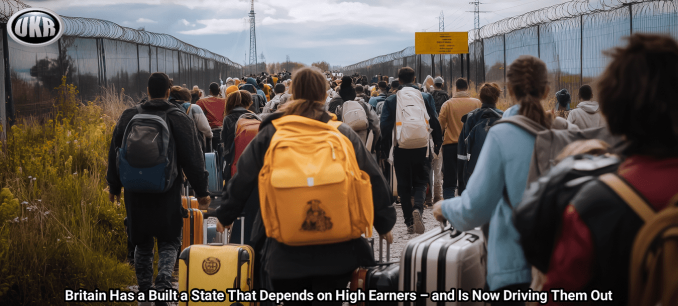
Yet these are the very people Britain is driving away. According to global wealth migration data, Britain will lose around 9,500 millionaires this year. Next year that figure could rise to 16,500, the highest outflow of wealth creators of any country in the world.
More than 240,000 British citizens now live in Dubai. And the list is growing.
The broader picture is even more troubling. ONS figures show 693,000 people emigrated long term from the UK in the year to June 2025, with a net outflow of 109,000 UK citizens. Almost eight in ten of those leaving are under 35. These are the future taxpayers, innovators and entrepreneurs. They are exactly the people Britain needs most.
They are leaving because Britain has become a place where the price of success is punishment. And what happens if the one per cent leave? Britain loses almost a third of its income tax overnight. Not gradually. Not over a decade. Overnight.
That revenue is not abstract. It funds hospitals, schools, policing, defence and local government. Remove it and the consequences are immediate. Waiting lists lengthen. Class sizes grow. Police numbers fall. Councils collapse. Infrastructure projects are cancelled halfway through delivery. Welfare support is cut for those who rely on it most.
This is not a spreadsheet problem. It is a real world breakdown in the basic functions of the state.
If the top 10 percent leave, the system snaps. Sixty percent of the income tax base disappears. No wealth tax replaces it; no corporate levy fills the gap; no political slogan rescues the situation. Britain does not end up with fewer public services. It ends up without a functioning public realm.
Now consider the dependency this creates. Ninety percent of earners together contribute just 40 percent of total income tax receipts. The remaining 60 percent comes from the top 10 percent alone.
Britain has built a state that depends overwhelmingly on a small group of high earners to fund almost everything it does. A country built on that foundation cannot afford to vilify the people holding it up. Yet Britain does so daily. We demand more. We offer less. And then we act surprised when they decide they have had enough and leave.
Today economic mismanagement has become economic self-harm. Britain’s decline is no longer the result of bad luck or global headwinds, but of conscious policy choices – decisions that prioritise short term political optics over long term economic strength.
Corporation tax has been raised in a world where capital is more mobile than ever. At the same time, the incentives to invest, innovate and expand have been weakened or removed. The signal to business is unmistakable. Britain is no longer a place that actively wants growth.
This is why investment is not just slowing, but diverting elsewhere. Global firms are not abandoning Britain entirely. They are simply choosing to place their headquarters, innovation hubs, and future growth in jurisdictions that reward enterprise rather than resent it. Dublin, Amsterdam and Dubai are not winning by accident. They are winning by design.
The latest budget confirmed the direction of travel. There was no serious supply side reform, no credible plan to raise productivity, no attempt to compete for global talent and capital. Instead, there was an acceptance that higher taxes and lower growth are the price to be paid for political convenience.
And the message it sends to wealth creators is devastatingly clear: Build, invest and grow, elsewhere.
No serious country chooses to export its most productive citizens and then pretends it can still prosper. Britain must decide: we can be a nation that celebrates ambition or a nation that flees from it; we can be a magnet for global talent or a warning to the world about what happens when envy triumphs over effort; we can be an economy where enterprise is rewarded or a slow moving museum of past greatness.
The path to renewal is clear. Lower, simpler taxes; a competitive corporation tax regime; a regulatory environment that unlocks innovation; and a national story that encourages people to stay, invest, build, hire and grow. Decline is a choice. Britain has chosen decline for too long.
We are almost out of time. The people who fund the country have already begun choosing for themselves. If Britain does not change course, it will discover too late that once wealth creators leave, they rarely come back.




Matthew Jeffery is a global talent and business adviser who has built and led large-scale recruitment and workforce strategies for international companies including Electronic Arts, Autodesk, SAP and EY.
The economy is shrinking. Recession is looming. Taxes are punitive. Business confidence is collapsing. Investment is stalling. Productivity is stagnating. Public services are failing. Inflation is entrenched. Unemployment is rising. Public debt is unsustainable. Our defences are threadbare. Our international influence is fading. Education is failing to prepare the next generation. Talent is leaving Britain.
No serious country can ignore this combination indefinitely, especially with the return of the politics of envy.
Every nation reaches a moment when it must decide whether it still believes in itself. Britain is at that moment now. If we choose wrongly, the consequences will be irreversible. We are punishing the very people who fund the state, create the jobs and build the prosperity that everyone else relies on. We have created a political climate where aspiration is suspect, ambition is frowned upon and success is treated as something to be plundered.
The economic damage is already visible. The moral rot is worse. A destructive cultural idea has taken hold in Britain. The idea that wealth should be redistributed rather than created. The idea that success is something to resent rather than something to learn from. The idea that the country is better off slicing the pie thinner instead of baking a bigger one.
In the process, Britain has lost sight of a far more powerful idea. The idea of an opportunity society. One where people are encouraged to work hard, take risks, build businesses and generate wealth. Not for the benefit of a few, but because growth expands the tax base, funds public services and raises living standards for everyone.
Prosperity does not come from pulling the successful down. It comes from enabling more people to succeed. The broader the base of people earning, investing and paying tax, the stronger the country becomes. More taxpayers mean more revenue. More growth means more opportunity. More success means more to share.
It is time to say the obvious truth.
Britain cannot tax and spend its way out of decline. It can only grow its way out by restoring a culture that rewards effort, enterprise and ambition, and by remembering that a society built on opportunity will always outperform one built on resentment.
This Is no longer theoretical and this debate is no longer academic. We see already what it looks like when stagnation turns into contraction.
The Office for National Statistics has confirmed that the British economy has begun to contract. Output has fallen again in the latest monthly data, marking a second consecutive decline. Services and construction, the engines of everyday economic activity, are weakening.
At the same time, confidence is evaporating. The prolonged lead up to the Budget, combined with selective briefing from the Chancellor, undermined business confidence and injected uncertainty at precisely the wrong moment. As a result, companies are delaying investment. Consumers are pulling back spending. Capital is becoming cautious, and high earners and entrepreneurs are actively assessing relocation to lower tax regimes.
This is the predictable outcome when a country sends a sustained signal that success will be punished rather than rewarded.
The consequences of driving out wealth creators are not something Britain will face one day. They are arriving now. This is not a cycle but a trajectory, and the numbers that should terrify Westminster.
The top one per cent of earners pay around 30 per cent of all income tax. The top ten per cent pay around 60 per cent. This is the structural reality of the British state: the entire system rests on a very small number of highly productive people.
Yet these are the very people Britain is driving away. According to global wealth migration data, Britain will lose around 9,500 millionaires this year. Next year that figure could rise to 16,500, the highest outflow of wealth creators of any country in the world.
More than 240,000 British citizens now live in Dubai. And the list is growing.
The broader picture is even more troubling. ONS figures show 693,000 people emigrated long term from the UK in the year to June 2025, with a net outflow of 109,000 UK citizens. Almost eight in ten of those leaving are under 35. These are the future taxpayers, innovators and entrepreneurs. They are exactly the people Britain needs most.
They are leaving because Britain has become a place where the price of success is punishment. And what happens if the one per cent leave? Britain loses almost a third of its income tax overnight. Not gradually. Not over a decade. Overnight.
That revenue is not abstract. It funds hospitals, schools, policing, defence and local government. Remove it and the consequences are immediate. Waiting lists lengthen. Class sizes grow. Police numbers fall. Councils collapse. Infrastructure projects are cancelled halfway through delivery. Welfare support is cut for those who rely on it most.
This is not a spreadsheet problem. It is a real world breakdown in the basic functions of the state.
If the top 10 percent leave, the system snaps. Sixty percent of the income tax base disappears. No wealth tax replaces it; no corporate levy fills the gap; no political slogan rescues the situation. Britain does not end up with fewer public services. It ends up without a functioning public realm.
Now consider the dependency this creates. Ninety percent of earners together contribute just 40 percent of total income tax receipts. The remaining 60 percent comes from the top 10 percent alone.
Britain has built a state that depends overwhelmingly on a small group of high earners to fund almost everything it does. A country built on that foundation cannot afford to vilify the people holding it up. Yet Britain does so daily. We demand more. We offer less. And then we act surprised when they decide they have had enough and leave.
Today economic mismanagement has become economic self-harm. Britain’s decline is no longer the result of bad luck or global headwinds, but of conscious policy choices – decisions that prioritise short term political optics over long term economic strength.
Corporation tax has been raised in a world where capital is more mobile than ever. At the same time, the incentives to invest, innovate and expand have been weakened or removed. The signal to business is unmistakable. Britain is no longer a place that actively wants growth.
This is why investment is not just slowing, but diverting elsewhere. Global firms are not abandoning Britain entirely. They are simply choosing to place their headquarters, innovation hubs, and future growth in jurisdictions that reward enterprise rather than resent it. Dublin, Amsterdam and Dubai are not winning by accident. They are winning by design.
The latest budget confirmed the direction of travel. There was no serious supply side reform, no credible plan to raise productivity, no attempt to compete for global talent and capital. Instead, there was an acceptance that higher taxes and lower growth are the price to be paid for political convenience.
And the message it sends to wealth creators is devastatingly clear: Build, invest and grow, elsewhere.
No serious country chooses to export its most productive citizens and then pretends it can still prosper. Britain must decide: we can be a nation that celebrates ambition or a nation that flees from it; we can be a magnet for global talent or a warning to the world about what happens when envy triumphs over effort; we can be an economy where enterprise is rewarded or a slow moving museum of past greatness.
The path to renewal is clear. Lower, simpler taxes; a competitive corporation tax regime; a regulatory environment that unlocks innovation; and a national story that encourages people to stay, invest, build, hire and grow. Decline is a choice. Britain has chosen decline for too long.
We are almost out of time. The people who fund the country have already begun choosing for themselves. If Britain does not change course, it will discover too late that once wealth creators leave, they rarely come back.