

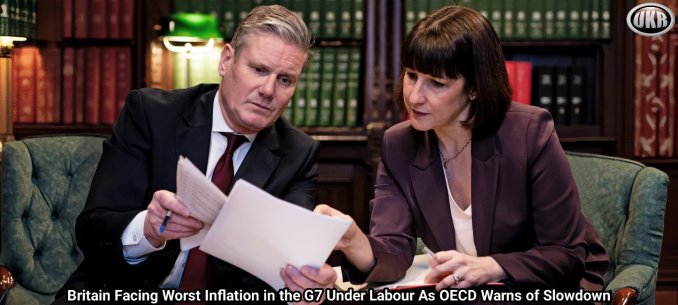
Britain facing worst inflation in the G7 under Labour as OECD warns of slowdown
CP
“Under Labour, Britain is in a high-tax, high-inflation, low-growth doom loop.”
Britain is heading for the highest inflation in the G7 this year, according to a stark warning from the Organisation for Economic Cooperation and Development (OECD).
The Paris-based body raised its forecast for UK inflation in 2025 to 3.5 per cent, up from 3.1 per cent just three months ago, and well above the 2.5 per cent recorded last year.
That leaves Britain at the top of the inflation table among the world’s most advanced economies. Prices are expected to rise by only 1.1 per cent in France, 1.9 per cent in Italy, 2.7 per cent in the US and 3.1 per cent in Japan.
The OECD also predicted slower growth for the UK. “In the UK, a tighter fiscal stance, higher trade costs and uncertainty are also anticipated to drag on external and domestic demand, with growth projected to ease from 1.4pc in 2025 to 1pc in 2026,” it said.
The warning comes alongside fresh signs of weakness at home. Data from S&P Global showed growth in public sector output slipping to its slowest pace in four months. Its Flash UK Purchasing Managers’ Index suggested some 50,000 job losses in the three months to September as firms struggled with rising wage bills and other costs.
Chris Williamson of S&P Global said: “September’s flash UK PMI survey brought a litany of worrying news including weakening growth, slumping overseas trade, worsening business confidence and further steep job losses. Alarm bells should be ringing that the economy is faltering.”
Despite claiming to have inherited “the fastest growing economy in the G7” earlier this year, Labour now finds itself presiding over an inflation crisis that is deepening rather than easing. Rachel Reeves, the Chancellor, is expected to announce further tax rises in November’s Budget as she tries to plug a hole in the public finances estimated at £20 billion or more.
Sir Mel Stride, the shadow chancellor, said: “The OECD confirms what hard-working families already feel – under Labour, Britain is in a high-tax, high-inflation, low-growth doom loop. Rachel Reeves seems to think the solution is yet more tax rises. The UK is now teetering on the edge of stagflation, all driven by Labour’s economic mismanagement. This should be a wake-up call to the Chancellor: you can’t tax your way to growth.”
The OECD’s assessment highlights how Britain is struggling with the rising cost of basics such as food, while other rich nations see inflation fall. Its figures show that only Brazil, South Africa and Japan have endured faster rises in food prices over the past year. Across the G20, only Argentina, Turkey and Mexico saw bigger upward revisions to inflation forecasts than Britain.
The British Retail Consortium expects food inflation to hit 6 per cent later this year, blaming the rise on Labour’s new costs for employers, including higher minimum wages, a £25bn increase in National Insurance contributions, and new packaging taxes.
The OECD also pointed to wage growth running above levels “consistent with inflation targets” while labour productivity remains weak. It warned that unemployment could creep up as employers rein in hiring. “Signs of weaker labour demand are also apparent in continued gradual falls in the ratio of job vacancies to the number of unemployed in the US, Germany, Australia, the UK and Canada,” the OECD said.
Critics argue that after just a year in government, Labour has squandered economic momentum and dragged Britain into a cycle of high prices, weak growth and higher taxes. “They inherited the fastest growing economy in the G7,” a former Tory MP told the Post. “The OECD’s findings offer little comfort to households already under strain and provide fresh ammunition to those who say Labour is repeating the familiar pattern of economic mismanagement.”
This article (Britain facing worst inflation in the G7 under Labour as OECD warns of slowdown) was created and published by Conservative Post and is republished here under “Fair Use” with attribution to the author CP

••••
The Liberty Beacon Project is now expanding at a near exponential rate, and for this we are grateful and excited! But we must also be practical. For 7 years we have not asked for any donations, and have built this project with our own funds as we grew. We are now experiencing ever increasing growing pains due to the large number of websites and projects we represent. So we have just installed donation buttons on our websites and ask that you consider this when you visit them. Nothing is too small. We thank you for all your support and your considerations … (TLB)
••••
Comment Policy: As a privately owned web site, we reserve the right to remove comments that contain spam, advertising, vulgarity, threats of violence, racism, or personal/abusive attacks on other users. This also applies to trolling, the use of more than one alias, or just intentional mischief. Enforcement of this policy is at the discretion of this websites administrators. Repeat offenders may be blocked or permanently banned without prior warning.
••••
Disclaimer: TLB websites contain copyrighted material the use of which has not always been specifically authorized by the copyright owner. We are making such material available to our readers under the provisions of “fair use” in an effort to advance a better understanding of political, health, economic and social issues. The material on this site is distributed without profit to those who have expressed a prior interest in receiving it for research and educational purposes. If you wish to use copyrighted material for purposes other than “fair use” you must request permission from the copyright owner.
••••
Disclaimer: The information and opinions shared are for informational purposes only including, but not limited to, text, graphics, images and other material are not intended as medical advice or instruction. Nothing mentioned is intended to be a substitute for professional medical advice, diagnosis or treatment.
Disclaimer: The views and opinions expressed in this article are those of the author and do not necessarily reflect the official policy or position of The Liberty Beacon Project.


Leave a Reply