

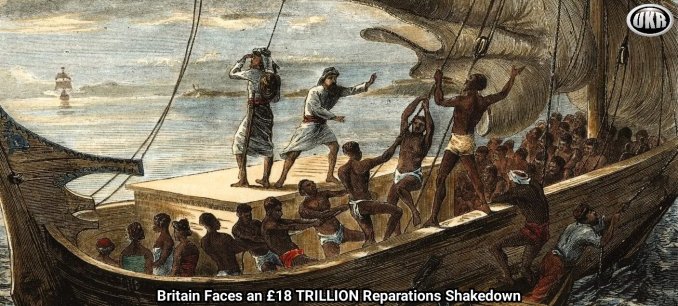
Britain faces an £18 trillion reparations shakedown
NIGEL BIGGAR
‘Decolonisation’ threatens to become expensive. Earlier this month the African Union joined the Caribbean Community (‘Caricom’) in demanding reparations from Britain for its ‘colonial crimes’, especially slavery. Caricom has already submitted its bill of £18 trillion. The African continent’s claim is bound to be higher.
Indeed, ‘decolonisation’ has already become expensive for members of the Church of England. In November 2023 the Church Commissioners of England, responsible for the church’s property assets, committed itself to deploy an initial £100 million to establish an investment fund to support communities ‘affected by historic slavery’. As they explained, ‘The immense wealth accrued by the Church Commissioners has always been interwoven with the history of African chattel enslavement… [which] was central to the growth of the British economy of the 18th and 19th centuries and the nation’s wealth thereafter’. The commissioners confessed a ‘strand of complicity in an abominable trade that still scars the lives of billions… [T]he cruelty of a multinational white establishment that deprived tens of millions of Africans of life and liberty… has continuing toxic consequences…’. Hence, the need for the Church to make reparations.
The ‘strand of complicity’ concerns the Queen Anne’s Bounty, an 18th-century forerunner of the Commissioners’ endowment devoted to supporting poorer clergy, which, through its investment in the South Sea Company, acquired ‘links’ with African enslavement.
Except that it didn’t. As Richard Dale, retired professor of international banking and author of The First Crash: Lessons from the South Sea Bubble (2004), has written:
First, no investor in the South Sea Company benefited financially from the slave trade, since it was consistently loss-making. Second, the Church Bounty did not even stand to benefit from the trade, because it declined to buy shares in the Company. Third, the investments that it did make, in South Sea annuities, represented, at one remove, claims on the Government which had no connection with the trade in slaves. Finally, it is grossly misleading to suggest, as the [Commissioners do], that all South Sea investors were consciously investing in slave-trading voyages.
What’s more, the cartoonish – even racist – tale of a ‘white establishment’ exploiting innocent African victims is a caricature of the truth. The ‘black establishment’ was even more to blame. Africans had been enslaving other Africans for centuries. Those they didn’t consume in human sacrifices, they sold first to the Romans and then to the Arabs. A few years before the first British slave-ship arrived on the West African coast in 1563, a Portuguese witness had reported that the African kingdom of Kongo was exporting overseas between four and eight thousand ‘pieces’ (slaves) annually.
Three hundred years later, Omani Arabs were running slave plantations on the East African coast, and Fulani Africans were running them in the Sokoto Caliphate in what’s now northern Nigeria. Indeed, according to the historian Mohammed Bashir Salau, the Caliphate became ‘one of the largest slave societies in modern history’, equaling the United States in the number of slaves (four million).
Meanwhile, unlike Africans, the British had repented of their involvement in slave-trading and slavery, and in the early 1800s were among the first peoples in the history of the world to abolish them. They then used their imperial dominance to suppress them from the Pacific North-West, across India, to Africa. In mid-century, the Royal Navy devoted over 13% of its total manpower to stopping slave-traffic between West Africa and Brazil.
At the same time, Sir Thomas Fowell Buxton’s idea that the key to ending the slave trade and slavery in Africa was to promote alternative, ‘legitimate’ commerce, was gaining traction. This led to the setting up of trading posts in West Africa, and then, when the merchants complained of the lack of security, a more assertive colonial presence on land. In 1851, having tried in vain to persuade its ruler to terminate the commerce in slaves, the British attacked Lagos and destroyed its slaving facilities.
Contrary to the groundless claim of Caricom reparations champion, Sir Hilary Beckles, the Beninese historian, Abiola Félix Iroko, has written that ‘[w]hen the slave trade was abolished [by the British], Africans were against abolition’.
The sustained British commitment to stamp out slavery was expensive in both blood and treasure. Seventeen hundred sailors died in the service of the Royal Navy’s campaign to stop maritime slave-trading. Meanwhile, on land, Christian missionaries risked – and often spent – their lives striving to shut down slave-markets in Africa. Among them was the Anglican bishop, John Mackenzie, who died horribly of blackwater fever in what is now Mozambique in 1862 at the age of 37.
This article (Britain faces an £18 trillion reparations shakedown) was created and published by CAPX and is republished here under “Fair Use” with attribution to the author Nigel Biggar
See Related Article Below
The African Countries Demanding Reparations Are Astonishingly Hypocritical

The African Union’s demand for colonial reparations is an act of cynical opportunism that ignores that slavery was already endemic in Africa, and African kingdoms resisted abolition even as the British forced it on them, says Nigel Biggar in the Telegraph. Here’s an excerpt.
The cartoonish “decolonising” tale of rapacious British colonisers exploiting helpless African victims is a caricature of the historical truth. Take the issue of slavery. Africans had been enslaving other Africans for centuries. Those they didn’t consume in human sacrifices they sold first to the Romans and then to the Arabs. A few years before the first British slave-ship arrived on the West African coast in 1563, a Portuguese witness had reported that the African kingdom of Kongo was exporting between four and eight thousand slaves annually.
Three hundred years later, Omani Arabs were running slave-plantations on the coast of East Africa, and Fulani Africans were running them in the Sokoto Caliphate in what is now northern Nigeria. Indeed, according to the historian Mohammed Bashir Salau, the Caliphate became “one of the largest slave societies in modern history”, equaling the United States in the number of its enslaved (four million).
Meanwhile, the British had repented of their involvement in slave-trading and slavery, and in the early 1800s were among the first peoples in the world’s history to abolish them. They then used their global dominance, following the Battle of Waterloo in 1815, to suppress both the trade and the institution from the Pacific North-West, across Africa and India, to New Zealand. In mid-century, the Royal Navy devoted over 13% of its total manpower to stopping slave-traffic between West Africa and Brazil.
At the same time, Sir Thomas Fowell Buxton’s idea that the key to ending the slave trade and slavery in Africa was to promote alternative “legitimate” commerce was gaining traction. This led to the setting up of trading posts in West Africa, and then, when the merchants complained of the lack of security, a more assertive colonial presence on land.
In 1851, having tried in vain to persuade its ruler to terminate the commerce in slaves, the British attacked Lagos and destroyed its slaving facilities. Ten years later, when an attempt was made to revive the trade in 1861, they annexed Lagos as a colony. Observe the developmental logic of ‘colonialism’ here: first, the humanitarian intent; then the promotion of commerce; and finally, the imposition of colonial rule.
Contrary to the claim of Caricom reparations champion, Sir Hilary Beckles, African rulers generally opposed British anti-slavery efforts. The Beninese historian, Abiola Félix Iroko, has written that “[w]hen the slave trade was abolished [by the British], Africans were against abolition”. John Iliffe, Professor of African History at Cambridge University, agrees, writing that “[m]any African leaders resisted the abolition of the slave-trade. Kings of Asante, Dahomey, and Lunda all warned that unsold captives and criminals would have to be executed”.
Worth reading in full.
Featured image: Alamy

••••
The Liberty Beacon Project is now expanding at a near exponential rate, and for this we are grateful and excited! But we must also be practical. For 7 years we have not asked for any donations, and have built this project with our own funds as we grew. We are now experiencing ever increasing growing pains due to the large number of websites and projects we represent. So we have just installed donation buttons on our websites and ask that you consider this when you visit them. Nothing is too small. We thank you for all your support and your considerations … (TLB)
••••
Comment Policy: As a privately owned web site, we reserve the right to remove comments that contain spam, advertising, vulgarity, threats of violence, racism, or personal/abusive attacks on other users. This also applies to trolling, the use of more than one alias, or just intentional mischief. Enforcement of this policy is at the discretion of this websites administrators. Repeat offenders may be blocked or permanently banned without prior warning.
••••
Disclaimer: TLB websites contain copyrighted material the use of which has not always been specifically authorized by the copyright owner. We are making such material available to our readers under the provisions of “fair use” in an effort to advance a better understanding of political, health, economic and social issues. The material on this site is distributed without profit to those who have expressed a prior interest in receiving it for research and educational purposes. If you wish to use copyrighted material for purposes other than “fair use” you must request permission from the copyright owner.
••••
Disclaimer: The information and opinions shared are for informational purposes only including, but not limited to, text, graphics, images and other material are not intended as medical advice or instruction. Nothing mentioned is intended to be a substitute for professional medical advice, diagnosis or treatment.
Disclaimer: The views and opinions expressed in this article are those of the author and do not necessarily reflect the official policy or position of The Liberty Beacon Project.


Leave a Reply