

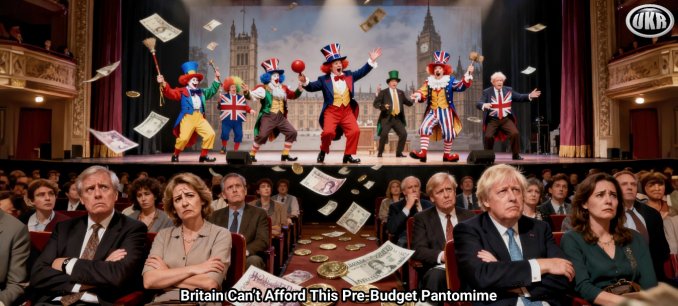
Britain can’t afford this pre-Budget pantomime
DAMIAN PUDNER
There are sensible ways to prepare a Budget, and then there is whatever the Government has put the country through over the past fortnight. To call it confusion would be generous, because ‘omnishambles’ is far closer to the truth. With its slapstick reversals, sudden plot twists and those familiar choruses of ‘Oh no we won’t!’ swiftly followed by ‘Oh yes we will!’, the Treasury has behaved as though panto season had arrived early.
For markets that expect consistency in fiscal signalling, the past two weeks have been unprecedented and destabilising. Britain has known uncertainty before – the turbulence of September 2022 still casts its shadow – yet even then, the pace of reversals was not as frantic as what has unfolded in recent days. Investors have endured a constant stream of U-turns, abandoned kite-flying and mutually incompatible briefings. Movements in ten-year gilt yields have tracked these gyrations closely, an unambiguous reminder that markets place a premium on fiscal conservatism and credibility, both things this government is conspicuously lacking.
The recent chaos peaked during the unusual and widely covered Chancellor’s early-morning broadcast on November 4, when Rachel Reeves strongly hinted that higher income taxes were now necessary to ‘repair the public finances’ – a clear breach of Labour’s manifesto pledge. Polling from Survation and YouGov revealed strong public hostility and a clear electoral cost, prompting a swift Treasury retreat on November 14, abandoning the plans and rushing out a hurried briefing of an entirely new set of tax-raising ideas. This is not how a responsible government prepares a Budget. It is how markets are unsettled, businesses wearied and voters persuaded that the country is being governed through improvisation rather than sound judgment.
What followed was a remarkable assortment of speculative proposals touching almost every corner of economic life. Property, pensions, wealth, savings, motorists, tourism, gambling – little has escaped, even milkshakes have apparently caught the Chancellor’s attention. The UK tax system is already an outsized maze and among the most complex in the developed world. Throwing a last-minute ‘smorgasbord’ of improvised taxes at a £25–30 billion fiscal hole, largely to dodge a straightforward rise in the basic rate, would harden that complexity and make the system even harder to navigate.
Yet this is where the Treasury now seems to be heading. The freeze on personal allowances looks set to continue well beyond 2028, pulling millions further into the tax net through fiscal drag. The Telegraph reports that up to six million more people may be paying higher-rate tax by 2028. HMRC data confirm that this form of stealth taxation has already driven the overall burden to its highest sustained level in modern history.
All of which raises the obvious question. How has a Government that waited fourteen years to take office fallen into such disorder so quickly? There are growing reports of escalating tension between ministers and major trade unions over public-sector reform, pay and productivity. Labour backbenchers have resisted even modest restraint. The outcome is a Treasury constrained by those behind it, blocked from implementing much-needed reforms and unwilling to admit that the budgetary sums collapse without real spending cuts or significant tax increases.
In these circumstances, one might expect the Government to assemble a disciplined, long-term fiscal strategy grounded in realism rather than theatrics. Instead, proposals are floated in the morning, contradicted by lunchtime and quietly disowned by nightfall. The pattern has the feel of an administration making it up as it goes along – with one eye on the news cycle – adjusting course minute by minute instead of setting a clear direction.
This matters because Britain is drifting close to a form of fiscal dominance in which the scale of the state begins to dictate both fiscal and monetary choices. Senior Bank of England figures have already warned that sustained fiscal pressure complicates the return to target inflation. The Office for National Statistics has likewise acknowledged that some recent policy choices, including the sharp rise in the National Living Wage, have contributed to higher consumer prices. When spending commitments rise, borrowing costs increase and taxes climb to historic highs, the margin for error narrows rapidly.
What the country requires is not difficult to articulate, even if it will be challenging to deliver. Britain needs a sustained programme of public-sector productivity reform supported by investment in technology rather than new layers of bureaucracy. It needs a stable, comprehensible tax system that supports enterprise rather than stifling it. It needs planning reform that actually happens rather than being endlessly announced. And it needs a credible strategy to reduce the debt burden without exhausting households and businesses in the process.
Instead, it has a Government still behaving like an opposition, apparently surprised to find that governing involves choices, trade-offs and discipline. Britain did not need a pre-Budget pantomime. And unless the Chancellor restores order next week, she may find that the audience – markets, businesses and her own parliamentary party – has already decided the curtain should fall.
Click here to subscribe to our daily briefing – the best pieces from CapX and across the web.
CapX depends on the generosity of its readers. If you value what we do, please consider making a donation.
This article (Britain can’t afford this pre-Budget pantomime) was created and published by CapX and is republished here under “Fair Use” with attribution to the author Damian Pudner

••••
The Liberty Beacon Project is now expanding at a near exponential rate, and for this we are grateful and excited! But we must also be practical. For 7 years we have not asked for any donations, and have built this project with our own funds as we grew. We are now experiencing ever increasing growing pains due to the large number of websites and projects we represent. So we have just installed donation buttons on our websites and ask that you consider this when you visit them. Nothing is too small. We thank you for all your support and your considerations … (TLB)
••••
Comment Policy: As a privately owned web site, we reserve the right to remove comments that contain spam, advertising, vulgarity, threats of violence, racism, or personal/abusive attacks on other users. This also applies to trolling, the use of more than one alias, or just intentional mischief. Enforcement of this policy is at the discretion of this websites administrators. Repeat offenders may be blocked or permanently banned without prior warning.
••••
Disclaimer: TLB websites contain copyrighted material the use of which has not always been specifically authorized by the copyright owner. We are making such material available to our readers under the provisions of “fair use” in an effort to advance a better understanding of political, health, economic and social issues. The material on this site is distributed without profit to those who have expressed a prior interest in receiving it for research and educational purposes. If you wish to use copyrighted material for purposes other than “fair use” you must request permission from the copyright owner.
••••
Disclaimer: The information and opinions shared are for informational purposes only including, but not limited to, text, graphics, images and other material are not intended as medical advice or instruction. Nothing mentioned is intended to be a substitute for professional medical advice, diagnosis or treatment.
Disclaimer: The views and opinions expressed in this article are those of the author and do not necessarily reflect the official policy or position of The Liberty Beacon Project.


Leave a Reply