

MARY GILLEECE
Fears have been allayed that Professor Becky Francis CBE’s curriculum review will introduce compulsory GCSEs in how to knit slavery out of yoghurt. The reforms suggested are fairly vanilla: a sensible idea to teach financial literacy and an arbitrary suggestion to reduce by 10% the time spent on GCSE exams, for instance. Sadly, these mild changes will do little to stop the ongoing creation of a two-tier education system that rivals the grammar/secondary modern paradigm but without any practical skills being taught. Two education systems are now running in Britain: the traditional school model that Phillipson is tinkering with, and the anarchic world of EBSA (emotionally-based school refusers), CMEs (children missing education) and profit-driven Alternative Provision.
Buckle up for some dispiriting figures: 1.28 million children are persistently absent from school; 170,000 students miss half of school; 74,000 children are CME – entirely missing from education; one in five children in the UK have a mental health condition; 17% of children have a special education needs condition; there are nearly one million NEETS (young people 16–24 not in education, employment or training); 1.05 million under 30s are claiming job seekers allowance and PIP; 1.2 million 16–24-year-olds have never had a job. Where once the uneducated worked in manual jobs, today they are instead adopting spurious mental disabilities and embracing welfare dependency at 16. The problems with education are much greater than Phillipson’s attempts to teach children to recognise AI-generated misinformation.
For the past few decades, the educational orthodoxy has been that all children can be taught academic subjects with the right teaching methods and, for those who struggle, with SEND support. This is laughably not the case now, nor ever has been. What used to happen in more sensible times was that academically inclined students would attend grammar schools and others would learn pared-down academic and vocational skills at secondary moderns, or they would leave school early to work. Until fairly recently, children without the aptitude or inclination to study Shakespeare or quadratic equations at comprehensives were found afternoon placements in local businesses to learn hairdressing or plumbing.
Today, however, academic education is compulsory until 16, with no options for vocational or practical training as an alternative. Unsurprisingly, it is still impossible to educate all children academically. For all of Gove’s bluster that: “Our young people are more literate, numerate and scientifically accomplished than almost all other western nations,” 40% of GSCE entrants fail their English and Maths. This bears repeating: after 12 years of state education, 40% of students fail their Maths and English GCSE.
Instead of recognising this chasm in natural aptitude within cohorts of children by opening up a string of German-style technical secondaries and recreating excellent practical qualifications in cookery, basic plumbing, electricity and woodwork, etc., to allow the non-academic to thrive, successive education ministers have driven hundreds of thousands of children out of school entirely. Rather than receive the ritual humiliation of being unable to do maths in a maths lesson, deconstruct poetry in English or write up calorie counts in food tech, thousands upon thousands of children have decided not to bother at all. I attempt to teach some of them, who have retreated to their bedrooms to play video games or scroll on their phones for 18 hours a day. Their parents cart them off for “additional needs” assessments and they are diagnosed with ADHD or autism rather than being taught how to sew, build walls or paint watercolours.
Educational entrepreneurs have spotted opportunities and dozens of new private special educational needs schools have opened up in London since 2019. Approximately 120,000 students are placed in Alternative Provision facilities – sometimes forest schools, sometimes dismal community centres, sometimes online – with 1,200 new providers, some registered, some unregistered, being established in the past five years. Attracted by guaranteed income from local authorities who are legally obliged to provide education for all students, private equity is increasingly sniffing around the special needs sector. A recent Policy Exchange report noted that: “Many of these [Alternative Provision] settings are subject to limited oversight and yet charge very high fees to the local authorities commissioning their services.” And even if you buy into the whole SEND paradigm (not, of course, for those minority of children who have severe development difficulties), there is no evidence that SEND support improves the educational outcome for the child.
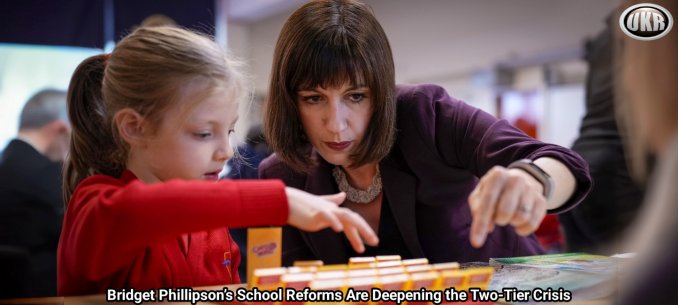
Let’s leave Bridget Phillipson in peace to fiddle at the edges of the education system, encouraging all schools to teach three separate sciences at GCSE, for instance, while other thinkers work out ways of capturing the untapped potential of the hundreds of thousands of students not being educated at all. Who is honest enough to admit that the vast majority of those with SEND who fail their Maths and English GCSEs, or refuse to attend school, are not academic failures but merely in need of a practical education from a young age? If these children are allowed to either work or attend vocational practical courses from a much younger age, Britain’s deathly addiction to mental illness and welfare dependency will begin to end.
Mary Gilleece is an education support worker and her name is a pseudonym.
This article (Bridget Phillipson’s School Reforms Are Deepening the Two-Tier Crisis) was created and published by The Daily Sceptic and is republished here under “Fair Use” with attribution to the author Mary Gilleece


Leave a Reply