

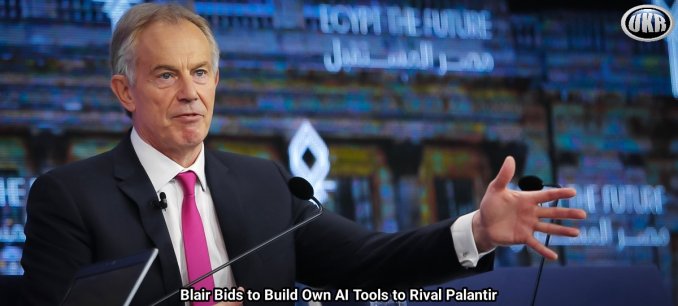
Blair bids to build own AI tools to rival Palantir
TBI insiders warn of “’insane” plan to transform think tank into a tech company
PETER GEOGHEGAN
By Peter Geoghegan, May Bulman and Beatriz Ramalho da Silva
When it comes to AI, Tony Blair is a true believer. He’s said that the technology can transform society for the better, and herald a new industrial revolution that will make us all more productive, more secure and more equal.
But the former British prime minister isn’t just an AI evangelist advising governments on how they should use AI. He’s now getting in on the tech bro act himself.
We can today report that Blair’s eponymous think tank has been spending heavily on developing its own AI tools that it hopes to sell to governments in what insiders describe as a bid to “rival Palantir”.
Democracy for Sale and Lighthouse Reports have spoken to dozens of current and former staff at the Tony Blair Institute for Global Change over the past year as part of our investigations into the influence of Big Tech on government.
Multiple sources confirmed that TBI has set up a new in-house “AI Incubator” in a bid to “get on the AI bandwagon”, while cutting staff in other areas and posting financial losses.
TBI was made aware of all points in this article prior to publication but declined to comment.
The AI Incubator, where top earners reportedly make up to £370,000, is developing tools to help political leaders make decisions, with plans to sell them to governments clients, particularly authoritarian Gulf states, according to insiders.
The move has caused internal concern, with some saying it is “insane” for a non-profit to try to compete with major tech companies. But “Blair sees the Incubator as his legacy,” one former employee said.
Senior leadership at TBI are said to be hoping that the AI Incubator, which was launched last Spring, can transform the non-profit entity into a tech company.
The Incubator is not expected to be offered as a competitor to OpenAI’s ChatGPT or Anthropic’s Claude but instead will build on top of large language models to create products that governments can use, sources say. Proponents of the pivot to making tech say that TBI knows more about how government works than tech giants.
A live job advert for the role of AI Engineer within the Incubator states that the successful candidate would be required to “evangelise best practices in applied AI across the public sector”. It adds that the Incubator is “on a mission to reinvent government leadership and revolutionise public services through cutting-edge AI solutions”.
But insiders have raised concerns that TBI is bidding to become the “new Palantir”, referring to the controversial US tech firm founded by Trump donor Peter Thiel that has won major UK government contracts. “Some senior staff used the Palantir comparison often. They were obsessed that they could rival tech companies,” said one source.
Another former staff member said: “TBI wanted to get on the ‘AI bandwagon’ […] Their previous mode of operation was more that of a consultancy, and they wanted to become more of a provider of the technology.” The source added that “this fundamental shift in direction” was the “main reason” for the organisation’s recent restructure, which saw dozens of staff laid off towards the end of last year.
The changes came as the TBI reported a £3.2m ($4.3m) loss in 2024, according to accounts published in October.
TBI has been heavily reliant on funding from Larry Ellison, the US billionaire founder of database giant Oracle. Ellison, a staunch supporter of US President Donald Trump and whose family is vying for control of Warner Brothers and a major stake in TikTok in the US, has pledged and donated £257 million to TBI so far.
Last year, Democracy for Sale and Lighthouse Reports revealed how Ellison’s funding had produced a culture in TBI dominated by a form of AI boosterism, with staff complaining that they were treated effectively as “tech sales” for Oracle.

Ellison was originally set to fund the AI Incubator, but later decided not to, which has meant funds have been taken from elsewhere in the organisation, according to sources.
Expressing doubts about the AI initiative, a former TBI employee said: “What is stopping an OpenAI or someone else doing this? It’s insane. How are we going to compete? Why don’t we just partner with the tech companies?
“But there was somehow this weird obsession that we should build it, we should own it, and then we will have the IP, and then we can license this out.”
Another said: “The problem is that they want to come up with products, and you might ask, where are these products and what are they? They don’t exist yet. They exist on PowerPoint slides. They show this idea to people […] But they have made very little progress.”
The Incubator has a number of unfinished products, including a ‘delivery dashboard’, meant to leverage AI to advise political leaders on decision-making, and a ‘policy black box’, where governments’ can “dump all their policies and it will crunch and come up with something”, said one former employee.
Tech experts expressed scepticism about TBI’s turn to building tech. “Although AI has a reputation for being a cash cow, the reality is that even the big players like OpenAI are still working out how to monetise it,” said Rachel Coldicutt, director of Careful Industries, which researches how technology interacts with humans.
“Building tools is a lot harder than selling PowerPoints, and without scale it also yields a much lower return on investment,” she added.
Baroness Beeban Kidron, who has been critical of TBI’s proposals on AI and copyright law, said she was concerned about government using AI to develop public policy.
“Political decision-making by black-box technologies is antithetical to trust and democracy. We expect politicians to think through their policies, to own their consequences, and to be transparent about both the arguments they advance and the outcomes they deliver,” Kidron told us.
“It appears that the Tony Blair Institute, funded by big-tech money, is squandering what remains of its reputation as a think tank,” she added.
TBI insiders also noted growing disquiet over the leadership of TBI’s CEO Catherine Rimmer, a former journalist. Despite the job losses and restructuring, critics point to significant new spending on UK-based projects, particularly on tech ambitions.
The AI Incubator is headed up by Benedict Macon-Cooney, a former speechwriter, and Laura Gilbert, who joined TBI after only four months at the Ellison Institute of Technology, another high profile venture funded by the Oracle billionaire.
Gilbert has also worked as the director of Number 10’s own AI Incubator, which has reportedly struggled to attract talent and recently had to wind down a tool it was developing for civil servants. She is among a number of TBI staffers who have previously worked in government or taken Whitehall jobs since Labour came to power.
Blair himself has been a driving force behind Labour’s embrace of AI. In a private meeting after the 2024 general election, he told then technology secretary Peter Kyle that there is “no other solution to productivity, no other route to growth”.
Now it seems Blair’s own private think tank is getting on board, too.
At Democracy for Sale, we’re committed to uncovering Big Tech’s influence on government. If you haven’t yet joined us, now’s the time.
We’re working on major investigations, mounting critical legal challenges and chasing important new leads. But we can’t do it without your support.
Join the fight to protect democracy — become a paying subscriber today from just £5 a month
This article (Blair bids to build own AI tools to rival Palantir) was created and published by Peter Geoghegan and is republished here under “Fair Use”


Leave a Reply