

ALEXANDER MCKIBBEN
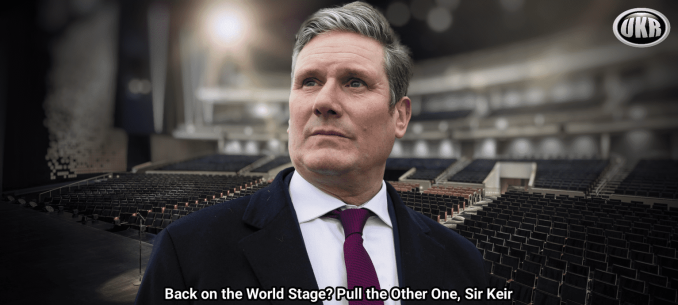
I HAVE a confession to make: I admire Sir Keir Starmer. Yes, that’s correct, I admire Sir Keir Starmer. Who couldn’t appreciate the herculean levels of self-control he exhibited at the recent UK-hosted EU summit, when he proudly announced that Britain was ‘back on the world stage’? Anyone with the very briefest acquaintance with Great Britain would have dissolved into uncontrollable laughter at such an absurd utterance.
Britain, a country riven with discord, a country that cannot police who crosses its borders, a country of work-from-homers, a country happy to see its elderly forced to choose between eat or heat, a country that cannot look after its ill and most needy, a country of food banks, a country of functionally illiterate school-leavers, a country where councils cannot attend to their most basic duties and, let us not forget, a country where the successful must be punished at every turn.
I wonder what faraway theatre Sir Keir had in mind when this vacuous platitude emerged from the cobwebby backwaters of his mind. La Scala perhaps, maybe the Met in New York, the Bolshoi – although given current relations, unlikely, how about our own home-grown Royal Opera House?
Whatever grand and imposing building was uppermost in his imagination, I wonder if he simultaneously visualised what production might ideally lend itself to Britain playing a part in – leading or otherwise. Here are a few thoughts.
Samuel Beckett’s 1953 masterpiece Waiting for Godot has been successfully staged many times, but what a shame Beckett didn’t have the foresight to anticipate how Britain would develop in the following decades. If he had, he might have opted for the more fitting Waiting for Doctor.
In this alternative interpretation, Vladimir and Estragon would engage in a variety of discussions and encounters while, in a modern twist, they would be listening to a holding message from their surgery intoning: ‘Thank you for your call, we are experiencing a higher volume of calls than usual, if you are experiencing a life-threatening emergency replace the receiver and dial 999.’ The play would run for approximately 90 minutes, and faithful to Beckett’s original, the GP would never materialise.
Tennessee Williams’s A Streetcar Named Desire would benefit from a fresh makeover for British audiences. The role of Blanche DuBois could comfortably be played by Angela Rayner or conceivably by Rachel Reeves. Fortunately, the aforementioned streetcar (tram) was of the electric variety and as such would be acceptable for today’s sensitive audiences. This version would end when the lithium-battery-operated tram spontaneously combusts.
One play that our Prime Minister might have seen that resonated with Britain being on the world stage again is Ruinedby Lynn Nottage. Whilst the original deals with the war-torn Congolese republic, it could easily be updated with the title perfectly reflecting today’s Britain. I feel a neat flourish would be if the striking Birmingham binmen could be persuaded to do a choreographed dance routine brandishing placards and loudhailers.
If comedy was what Sir Keir had in mind, might he have been thinking of Neil Simon’s masterpiece The Odd Couple? With Brexit now a distant memory and our renewed love affair with the EU in full bloom, what could be better than Ed Miliband taking the role of Felix Unger and Viktor Orban assuming the part of Oscar Madison. Laughs aplenty would be guaranteed.
Finally, a home-grown number, R C Sherriff’s incomparable Journey’s End. While the WWI theme would no longer be suitable, the title, for me, says it all. Great Britain has been on a long journey, centuries in the making. A journey that has given us remarkable people and remarkable discoveries.
Yet now it really feels as though we have reached the end of that voyage. The expedition hasn’t ended in a bang but in a suffocating shroud of imbecilic and incomprehensible laws, rights and expectations. A land asphyxiated by net zero laws, emasculated by mushrooming diversity, equality and inclusiveness dogma and where basic common sense has been thrown out of the window.
Great Britain back on the world stage? Pull the other one.
This article (Back on the world stage? Pull the other one, Sir Keir) was created and published by Conservative Woman and is republished here under “Fair Use” with attribution to the author Alexander McKibbin
See Related Article Below
The Beta Prime Minister
Leadership matters
DAVID MCGROGAN
The quality of leadership, more than any other single factor, determines the success or failure of an organization.
-F. Fiedler et al, Improving Leadership Effectiveness (1976)
You think you know someone. And then they serve for a year as Prime Minister and you realise you never really knew them at all. Last summer, I thought I had the measure of Sir Keir Starmer when I described him as:
astringent, stern, tough, unmerry, uncomfortable, unconciliatory, and serious
At the time, responding to the Southport riots, he came across as a robotic authoritarian. I compared him to Javert, the police inspector in Les Miserables, who prefers stars, who ‘know [their] place in the sky’, to people, the latter of which showing an irritating tendency to behave as though they have free will.
Ten months or so later, the more apt analogue would be something more along the lines of Adrian Mole, unexpectedly elevated to Head Boy. The authoritarian streak remains, but it has been revealed to derive more from pique than genuine sternness. It is the authoritarianism of a weak man who resents his own weakness and confuses strength with bullying, and authority with punishment. Imbued with a hypertrophied sense of order, he seizes on disobedience to rules as an opportunity to exert what little power he has. But the defining feature of his character is its weakness rather than the bossiness that is incidental to it.
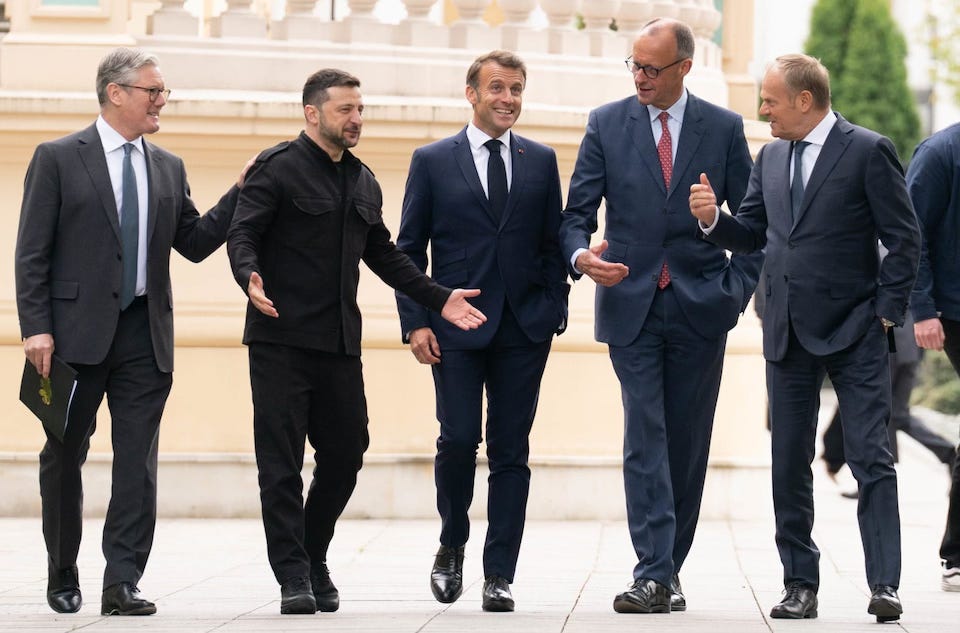
And like all weak men, Starmer is desparate to be liked by those he considers to be the ‘in’ gang. Take a look at the photo at the top of this post. Admittedly, this is just a snap taken by a journalist which caught some world leaders in an unguarded moment in Kiev. But sometimes a single photo can capture more than just a moment – it can reveal important truths about the way in which people comport themselves.
Study the body language carefully. Centre-left, we see Volodymyr Zelensky, the natural comedian. He appears to be poised to deliver a punchline to a joke, like a character from a Hollywood comedy set in old New Yoick: ‘And then she said, “Those aren’t buoys!”’ The others hang on his every word. In the middle, Emmanuel Macron, who can anticipate the gag but is ready to let fly with his best fake laugh. Friedrich Merz stands to his left, listening intently; his English is weaker, and he appears slightly unsure – he can’t quite make up his mind whether Zelensky is making a serious point or not. Donald Tusk, grown old now and curmudgeonly, stands to the right, gesticulating and ready to interject. Like a great uncle at a family gathering who has had a little too much to drink, whatever he has to say, we can be sure, will be delivered at slightly too great a volume and with slightly too wild an expression in the eyes.
Say what you want about these four, they are alpha males. Note how Macron, Merz and Tusk all have their left hands in their pockets and their jackets buttoned. They effortlessly project a combination of smart self control and casual confidence – their bearing suggests seriousness of purpose mixed with indifference. They are powerful, but comfortable with it. It sits easily on their shoulders. Zelensky, of course, is dressed differently, and adopts a more familiar air, but he is a man with nothing to prove: he is not the biggest silverback in the gorilla band, but he is the one who has been out there fighting leopards, and the others give him due respect accordingly.
But…who is this altogether different figure on the far left? He stands awkwardly on the sidelines. His jacket, for some reason, is unbuttoned, and somehow hangs uncomfortably on him. Again one reaches for a school-related metaphor: he looks like a sixth-form maths teacher who has accidentally strayed into a photo op with some major world leaders and who they are desperately trying to ignore. He has nothing of their relaxed air. Whereas they have their hands in their pockets, he clutches a folder or notepad of some sort; they have flunkies, this suggests, whereas he must carry about his own office supplies. His expression is fixed, even slightly rictus; it is the face of a man smiling with the mouth but not the eyes.
Yet the truly excruciating aspect of the scene is that outstretched arm, laying a hand on Zelensky’s back. It is an appallingly cringeworthy gesture. It communicates terrible insecurity – ‘Please,’ that hand seems to be saying, ‘Don’t turn your back on me; I’m here, and I’m important too.’ And at the same time it is grossly sycophantic – as though Starmer can, by simply touching the hem of the Ukrainian premier’s robes, draw succour from Zelensky’s sanctified person, and glean some small amount of glory by the association of touch. Sir Keir Starmer, remember, is a sixty-something man from the south of England; he never makes bodily contact with anybody unless forced. He is forcing himself in this moment, and you can tell.
I saw this photograph a week or so ago, and immediately thought to write a Substack post about it. But it took on a fresh resonance last Monday, with the announcement that Sir Keir has struck a ‘deal’ with the EU that promises a worst-of-all-worlds ‘reset’ between Britain and Brussels after all the unpleasantness of Brexit. The essence of this ‘deal’ would appear to be that the UK will continue to be subject to EU rules on farming and will give up sovereignty over its waters in respect of fishing until 2038, all the while paying into a ‘fishing and coastal growth fund’ for the privilege and being subject to rulings of the Court of Justice of the EU on relevant matters. It will also be subject to EU ‘net zero’ obligations. In return, it got some minor concessions with respect to access to EU food and energy markets and more relaxed border control, as well as a ‘youth experience scheme’. But the basic idea is clear – this is preliminary step towards the reintegration of Britain into the single market and customs union, and hence a complete reversal of what Brexit was about in the first place.
The spectacle of Sir Keir Starmer declaring that Britain is ‘back on the world stage’ while announcing this pathetic ‘deal’ is a very sad and sorry one, of course, because it would more accurately be described as the acceptance of a sort of vassalage – paying tribute for the privilege of being bound by rules over which one has no say. But it raises the importance of the question of character in national leadership. Whether Sir Keir Starmer is weak in respect of the EU, or just weak in respect of resisting the Remoaniac demands of his own MPs, dinner party guests, and senior civil servants, there is no doubt that this deal radiates weakness. Indeed, it seems readily apparent that his personal weakness was instrumental in the deal being done. What are we to make of this?
We have a strange relationship with the issue of character in leaders. There is no doubt that there is a tendency to obsess over the personal flaws in politicians, as evidenced of course by the recent US Presidential election, in which the ‘weirdness’ of one candidate or another seemed to be a matter taking on totemic importance in the race to the White House. But by and large there is a tendency in the culture to ascribe political developments to structures and systems rather than the temperament and abilities of this leader or that.
This is very noticeable when it comes to the study of history in particular. As an undergraduate studying history, I was often (actually, let’s not sugarcoat things – I was always) disappointed to discover that the courses I chose to study emphasised ‘social history’, and eschewed any real analysis of the importance of individual leaders and decision-makers, the study of whose deeds are what really enliven any attempt to engage with what happened in the past. It was made plain to me from day one that, just as was the case in English literature (I did a joint major), it was important not to like the subject you were studying or find it interesting for its own sake. You were supposed to read Romantic poets to understand why conservatism is bad and to read Shakespeare to understand historical materialism and post-colonialism. And you were supposed to study history in order to be able to critique the present. This meant a lot of reference to ‘systems’ and ‘structures’ and not a great deal of discussion about the individual contributions made by major figures.
I did not have a great deal of perspective in those days, of course; being an undergraduate student I just spent a lot of time in bed and did the bare minimum necessary to get by. It did not really occur to me to ask why what I was doing felt so dispiriting. Now, of course, I get it: leftist thought tends to be characterised by an interest in impersonal forces, going back to the time of Marx. And it is therefore entirely natural to expect undergraduate study of history, led by a cast of monolithically left-wing lecturers, to eschew what they derisorily called ‘the Great Man theory of history’. Being interested in, say, what Napoleon did during the course of his career would have been, to those people, incredibly déclassé. What you were supposed to be concerned about instead was the changing circumstances of the rural French peasantry, 1790-1813, as portrayed in the folk songs of the Languedoc. The consequence was a course of study as enthralling as it sounds.
The necessary upshot of the repudiation of the ‘Great Man theory of history’ is that talent and agency are not really considered to be decisive factors in the course of events. Things happen because of social forces. Whatever were the personal qualities and beliefs of Napoleon, Genghis Khan, Hitler, Churchill, FDR, Washington, William the Conqueror, or Caesar Augustus, history would have unfolded in broadly the same way anyway. And it follows from this, of course, that it doesn’t matter very much whether individual leaders or decision-makers are competent or make mistakes, or simply lack fortitude. Those pesky ‘social forces’, ‘structures’ and ‘systems’ will make sure that history sweeps along regardless. Stuff will happen. And individual competence, or lack of it, will not be a decisive factor in the overall process.
Looking at the antics of Sir Keir Starmer, however, I find it very difficult to believe that this theory is true. It is hard to make this point without resorting to cliché, but it is genuinely impossible to imagine Margaret Thatcher making a ‘deal’ like the one cut on Monday – or, indeed, many of the other Prime Ministers before her, regardless of what they may have felt about the substantive issues at stake. That can partly be attributed to ideology and also to sheer patriotism (Robert Tombs made the point, no doubt true, in the aftermath of the deal’s announcement that Sir Keir Starmer simply doesn’t like Britain very much). But it is also a matter of personality. Thatcher didn’t enjoy being bossed around, and was willing to stand up for herself and the country. Starmer simply isn’t like that. Lacking in confidence, intellectually thin and drab, he is not so much made of iron as cardboard and wet lettuce. And he comes across as a pushover. It does not look a great deal more complicated than that: he is a man who can simply be buffeted by events – or made to cough up his lunch money with a nasty Chinese burn. And Ursula von der Leyen clearly gave him a bit of a kicking behind the bike sheds – that was all that it must have taken.
Making these observations in a way simplifies the national problem, but at the same time makes it more intractable. The issue is easily stated: everything would be so much better if we had better leaders. But where does one find good leaders in a pinch? How do we educate them? If they are simply born rather than made, then why did we stop giving birth to them? And what are we doing to discourage those who are born, and who are not making their presence felt? These are very easy questions to ask, but very difficult indeed to answer. Step one may be the admission that we appear to have a problem – and that our national funk is personal as much as it is systemic or structural.
This article (The Beta Prime Minister) was created and published by News From Uncibal and is republished here under “Fair Use”

••••
The Liberty Beacon Project is now expanding at a near exponential rate, and for this we are grateful and excited! But we must also be practical. For 7 years we have not asked for any donations, and have built this project with our own funds as we grew. We are now experiencing ever increasing growing pains due to the large number of websites and projects we represent. So we have just installed donation buttons on our websites and ask that you consider this when you visit them. Nothing is too small. We thank you for all your support and your considerations … (TLB)
••••
Comment Policy: As a privately owned web site, we reserve the right to remove comments that contain spam, advertising, vulgarity, threats of violence, racism, or personal/abusive attacks on other users. This also applies to trolling, the use of more than one alias, or just intentional mischief. Enforcement of this policy is at the discretion of this websites administrators. Repeat offenders may be blocked or permanently banned without prior warning.
••••
Disclaimer: TLB websites contain copyrighted material the use of which has not always been specifically authorized by the copyright owner. We are making such material available to our readers under the provisions of “fair use” in an effort to advance a better understanding of political, health, economic and social issues. The material on this site is distributed without profit to those who have expressed a prior interest in receiving it for research and educational purposes. If you wish to use copyrighted material for purposes other than “fair use” you must request permission from the copyright owner.
••••
Disclaimer: The information and opinions shared are for informational purposes only including, but not limited to, text, graphics, images and other material are not intended as medical advice or instruction. Nothing mentioned is intended to be a substitute for professional medical advice, diagnosis or treatment.
Disclaimer: The views and opinions expressed in this article are those of the author and do not necessarily reflect the official policy or position of The Liberty Beacon Project.


Leave a Reply