

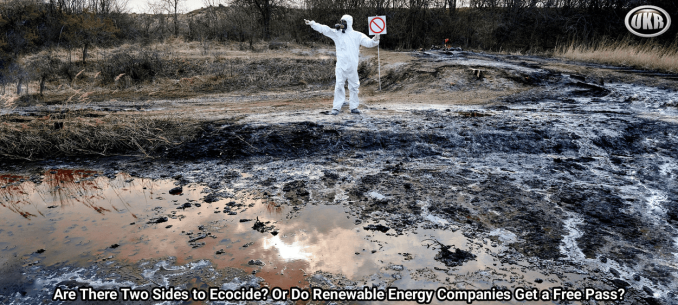
Are There Two Sides to Ecocide?
Or do renewable energy companies get a free pass?
MARK HODGSON
Almost four years ago I wrote an article about ecocide. At the time there was a lot of agitation for this new crime to be introduced. I speculated (wrongly as it turned out) that when the upcoming COP26 failed its own terms (I was right about that) the delegates might press for the introduction of a new crime of ecocide in order to make up for their climate failure. However, the agitation around ecocide has not gone away, and north of the border a draft bill (the Ecocide (Scotland) Bill) has now been introduced by Monica Lennon MSP. The Net Zero, Energy and Transport Committee is the lead committee with regard to this draft legislation, and it is now seeking views on the draft legislation.
Scotland Against Spin has responded, and had kindly given me permission to reproduce its response to the Committee below. Its worry, which I share, is that if the new crime is introduced, a carve-out will be included in order to let renewable energy companies (some of the biggest despoilers of our environment) off the hook. This worry would seem to be justified when reading the words of Edward Mountain MSP when launching the call for views:
We all agree on the need to address the biodiversity crisis and protect and restore fragile ecosystems. That includes making sure there are fitting penalties for serious environmental damage.
Introducing ecocide into Scots criminal law could send a strong message to individuals and organisations about the gravity of serious environmental damage and act as a deterrent, changing corporate behaviour and individual decision-making for the better.
While protecting the environment is vital, it’s also important to ensure that any new measures strike the right balance – avoiding disproportionate costs for public bodies, individuals and businesses, or inhibiting development or infrastructure in places where it is needed and wanted.
And before making new laws, its right to reflect on how well current measures to combat environmental damage work and whether they’re backed up with sufficient resources.
What follows, then, is Scotland Against Spin’s response.
Scotland Against Spin’s Response to the consultation on proposals which would introduce the crime of ecocide into Scots law for the first time
We firmly support in principle the introduction of the Ecocide (Scotland) Bill by Monica Lennon MSP. We agree that causing severe environmental damage should be treated as a serious criminal offence. However, it is vital that the Bill, if enacted, even-handedly protects the environment against damage, whether by bad actors, whether caused recklessly, or whether the damage is the inevitable result of development carried out quite deliberately, whatever the supposed justification for the development.
Ecocide refers to mass damage and destruction of ecosystems – severe harm to nature which is widespread or long-term. What could be more damaging than wind farms? From toxic mining processes to the digging up of peatland which is then filled with massive concrete foundations, deforestation, killing and displacement of wildlife and the Scottish Government’s own rejection of any ban on wind turbine blade graveyards once old turbines are decommissioned, despite the fact many other countries have already banned these giant fibreglass and plastic blades from landfill sites. The people whose lives have been ruined by the impact from noise and blinking aviation safeguarding lights, amongst many other things, will also tell you that wind turbines are a crime against humanity. Increasingly, the same comments can be applied to the tsunami of solar farm and BESS applications that are now blighting Scotland’s environment.
We are concerned that the following view seems to be prevalent in high places in Scotland:
“While protecting the environment is vital, it’s also important to ensure that any new measures strike the right balance – avoiding disproportionate costs for public bodies, individuals and businesses, or inhibiting development or infrastructure in places where it is needed and wanted.”
Page 15 of the consultation document states:
The Scottish Government has also committed to a ‘just transition’ to net zero and a circular economy. An ecocide law would have implications for this. By acting as a deterrent from engaging in potentially environmentally damaging projects, it aligns with the guiding principles on the environment. By encouraging investment in environmentally sustainable projects and renewable energy, and by discouraging investment in projects that pose a greater risk to the environment it could support the move to net zero and a circular economy.
We are greatly concerned by the head-in-the-sand attitude to environmentally-damaging renewable energy developments exemplified by this complacent statement. The idea that an ecocide law could “encourage investment in…renewable energy” demonstrates a complete failure to understand that renewable energy developments probably represent the greatest assault that Scotland’s environment is suffering. An Ecocide Bill that encourages such ecocide (which leaves a toxic legacy for future generations) would be oxymoronic (as well as moronic).
You either criminalise ecocide or you don’t. There can be no exceptions. You don’t save the environment by destroying it.
Turning to the detail of the Bill itself:
Clause 1 – Offence of Ecocide
We approve of the drafting of this clause, including the adoption of the definition of “environmental harm” contained in section 17(2) of the Regulatory Reform (Scotland) Act 2014. We note with approval that these definitions cover many activities of renewable energy companies, which should be criminalised.
Clause 2 – Defence of Necessity
In principle we approve of the drafting of this clause, though we are concerned that clever expensive lawyers employed by (mostly multinational) renewable energy companies might seek to argue that renewable energy is necessary to avert the so-called climate crisis. Such an argument would, of course, be nonsense, given that the most recent figures contained in the EU’s Emissions Database For Global Atmospheric Research (EDGAR) tell us that the UK in 2023 was responsible only for 0.72% of global greenhouse gas emissions, a proportion which has probably already reduced still further, given that global emissions have increased since then as the UK’s emissions continue to fall. If we make the conservative assumption that the UK’s emissions now comprise 0.7% (and falling) of the global total, and recognise that Scotland is probably responsible for only around 10% of the UK’s emissions, and that electricity generation is responsible only for a modest proportion of those emissions, it can readily be seen that renewable energy developments in Scotland reduce global emissions by an infinitesimally small amount. So inconsequential is the impact of renewable energy developments in Scotland to global greenhouse emissions that it can readily be seen that they are making – and can make – absolutely no difference to climate change whatsoever. Thus any defence of “necessity” regarding the need to tackle climate change cannot possibly apply to such ecocidal activities. The logic of that position is beyond dispute, but it won’t stop renewable energy companies seeking to dispute it. We would urge, therefore, that clause 2 is tightened up to make it clear that the defence of necessity cannot apply to claims that renewable energy developments are necessary to tackle climate change.
Clause 3 – Individual culpability where organisation commits offence
We approve of the drafting of this clause. Individual directors of multinational (and other) renewable energy companies understand full well the damage their companies’ activities are causing to the environment, but they don’t care – the financial well-being of their companies (and their personal salaries and bonuses) seem to them to be more important. Individuals who are responsible for the decision to proceed with environmentally-damaging activities should not be able to avoid liability on the basis that it is the company that they direct that is committing the crime of ecocide.
Clause 4 – Vicarious liability
We approve of the drafting of this clause. A company should not be able to evade liability for ecocide by claiming that the acts in question were undertaken by its employees rather than by the company itself.
Clause 5 – Penalty
We approve of the drafting of this clause, but we suggest that provision for the level of any fine should be included within the legislation. Perhaps – akin to much EU legislation – it should be something like 10% of the organisation’s annual turnover, or £10 million, whichever is the greater.
Clause 6 – Regard to be had to financial benefit in determining amount of fine
We believe that this clause is very important, since much ecocide, especially that carried out by renewable energy companies, is motivated solely by financial gain.
Clause 7 – Order for compensation may include costs of remediation or mitigation
We believe that remediation and/or mitigation are vitally important where ecocide has been committed. However, as the wording to the clause heading makes clear, section 249 of the Criminal Procedure (Scotland) Act 1995 (which is incorporated into the Ecocide Bill by reference) provides only that such an order may be made. We believe this should be amended to provide that it shall be made.
Clause 8 – Publicity Order
We believe that such orders are of vital importance if repeat ecocide offenders are to be deterred. Thus we recommend changing the provision from may to shall.
Remaining clauses
As these are mostly of an administrative nature, we have no particular comments to make, save to add that we are concerned that clause 11 (Ancillary Provision) should not give Ministers the power effectively to amend the legislation as provided for in sub-clause (2). We recommend that this sub-clause should be amended to make it clear that Ministers do not have this power. Any substantive amendment should require the sanction of the Scottish Parliament in Holyrood.
Scotland Against Spin
13 July 2025
I await developments with interest. I think Holyrood runs the risk of boxing itself into a corner here. How can it render ecocide a crime, while letting off the hook some of the biggest environmental vandals of all?
This article (Are There Two Sides to Ecocide?) was created and published by Climate Scepticism and is republished here under “Fair Use” with attribution to the author Mark Hodgson

••••
The Liberty Beacon Project is now expanding at a near exponential rate, and for this we are grateful and excited! But we must also be practical. For 7 years we have not asked for any donations, and have built this project with our own funds as we grew. We are now experiencing ever increasing growing pains due to the large number of websites and projects we represent. So we have just installed donation buttons on our websites and ask that you consider this when you visit them. Nothing is too small. We thank you for all your support and your considerations … (TLB)
••••
Comment Policy: As a privately owned web site, we reserve the right to remove comments that contain spam, advertising, vulgarity, threats of violence, racism, or personal/abusive attacks on other users. This also applies to trolling, the use of more than one alias, or just intentional mischief. Enforcement of this policy is at the discretion of this websites administrators. Repeat offenders may be blocked or permanently banned without prior warning.
••••
Disclaimer: TLB websites contain copyrighted material the use of which has not always been specifically authorized by the copyright owner. We are making such material available to our readers under the provisions of “fair use” in an effort to advance a better understanding of political, health, economic and social issues. The material on this site is distributed without profit to those who have expressed a prior interest in receiving it for research and educational purposes. If you wish to use copyrighted material for purposes other than “fair use” you must request permission from the copyright owner.
••••
Disclaimer: The information and opinions shared are for informational purposes only including, but not limited to, text, graphics, images and other material are not intended as medical advice or instruction. Nothing mentioned is intended to be a substitute for professional medical advice, diagnosis or treatment.
Disclaimer: The views and opinions expressed in this article are those of the author and do not necessarily reflect the official policy or position of The Liberty Beacon Project.


Leave a Reply