

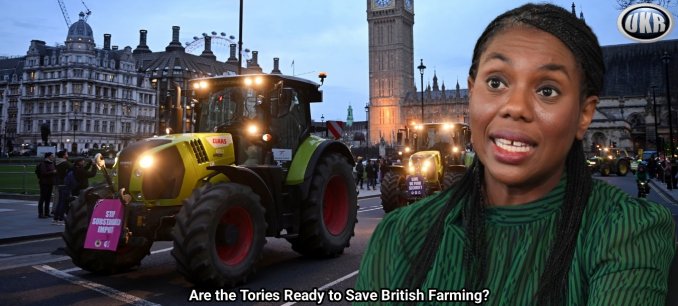
Are the Tories ready to save British farming?
KITTY THOMPSON
Kemi Badenoch is right. Conservatives need to show that they stand with farmers. But if the party wants to show genuine support, it should follow its leader’s pro-growth instincts and treat farms as real businesses.
All agricultural policy must flow from this one truth: food is a private good sold on a private market. Farmers do not need top-down diktats to do their job. Entire livelihoods depend on doing so. When Conservatives lose sight of this basic reality, distortions follow.
And nowhere was this clearer than under the EU’s Common Agricultural Policy. By subsidising farmers based on the amount of land managed, this policy put short-term food production ahead of long-term food security, leading to the systematic removal of nature – otherwise known as resilience – from the farmed landscape.
We cannot blame farm businesses for acting against their own long-term interest. They simply responded to the incentives the government set, as any rational economic actor would. The problem was the incentives, not the farmers.
The CAP remains a cautionary tale for any British politician tempted to ‘help farmers’ by manipulating production through grants or subsidies. In reality, what family farms need – like all businesses – are policy certainty, the ability to plan for the future and for the government to get out of the way.
Under Labour, uncertainty has become the order of the day. The family farm tax, the halting of sustainable farming incentive applications, question marks over the future of countryside stewardship agreements, rapid phasing out of the legacy EU payments and a real-terms cut to the farming budget were all announced in quick succession. Any semblance of stability has been annihilated, and farmers do not know how to act, unsure of whether their response today will have detrimental consequences tomorrow.
British farming has been entangled with taxpayer support for too long, leaving it vulnerable to shifting political priorities. It doesn’t have to be this way.
To avoid the pitfalls of the CAP, the real policy question for Conservatives should be not how to incentivise food production, but how to increase farm incomes. This requires the party to ask brave questions. How can we export more British produce around the world? How can we ensure farmers secure fair contracts with supermarkets? How can we embrace the other functions a farm performs? Diversification is not a dirty word. Nature is an underutilised asset for farmers, they should capitalise on the private money that could flow from their efforts to protect and restore it.
Policy certainty is good for the coming years, but what about the coming generations? The introduction of the family farm tax has thrown into stark relief the importance of long-term planning for farm businesses and the damage done when policy punishes such planning. Yet tax is far from the only long-term threat farmers face.
Nature loss and climate change are not abstract environmental concerns; they are two of the biggest threats to our food security. Farmers across the country are still reeling from drought conditions this summer and preparing for the floods that winter will likely bring. Building resilience into the land is, therefore, not just something that is ‘nice to have’. It is an economic necessity.
That is why Conservatives should champion the policies they introduced in government to reward farms that steward their land for future generations, ensuring it remains productive and profitable for decades to come. Farming is a long-term business, the Conservative Party should support the policies that remember this fact.
But long-term stewardship means little if farmers spend most of their time wading through red tape. One need only watch an episode of ‘Clarkson’s Farm’ to see how invasive the state can be in British agriculture. Streamlining regulation, without compromising the standards that keep British food held in such high regard, would do more to support farmers than any grand new initiative dreamt up in Whitehall.
We made progress in government, by cutting some unnecessary regulation, such as easing the rules for building farm shops. But we should have gone further. Even when offering grants to build environmental infrastructure like slurry stores, we forced farmers to go through the planning process which undermined the whole point of the grant.
This is the easiest area for Conservatives to carve out a clear alternative. But rather than be tempted to produce an interminable list of tape to cut, we must recognise that the problem is not simply the volume of rules, but the mindset behind them.
For too long, we forgot that farmers know their land best, and instead dictated a long list of prescriptive processes, like the old EU ‘three-crop rule’, which dictated crop mixes without considering the nuances of land it applied to. These are the kinds of rules that sap productivity without delivering real environmental gains.
We need a regulatory environment that values outcomes over outputs. That means setting clear goals for healthy soils, abundant wildlife and cleaner water, and then allowing farmers to meet them however they see fit.
With uncertainty for farming rising under Labour, Conservatives face a choice: return to the old habits of meddling and micro-management, or follow Badenoch’s principles and champion a genuinely pro-enterprise approach to British farming – one that recognises that food production is only part of what modern farms can deliver.
Click here to subscribe to our daily briefing – the best pieces from CapX and across the web.
CapX depends on the generosity of its readers. If you value what we do, please consider making a donation.
This article (Are the Tories ready to save British farming?) was created and published by CapX and is republished here under “Fair Use” with attribution to the author Kitty Thompson

••••
The Liberty Beacon Project is now expanding at a near exponential rate, and for this we are grateful and excited! But we must also be practical. For 7 years we have not asked for any donations, and have built this project with our own funds as we grew. We are now experiencing ever increasing growing pains due to the large number of websites and projects we represent. So we have just installed donation buttons on our websites and ask that you consider this when you visit them. Nothing is too small. We thank you for all your support and your considerations … (TLB)
••••
Comment Policy: As a privately owned web site, we reserve the right to remove comments that contain spam, advertising, vulgarity, threats of violence, racism, or personal/abusive attacks on other users. This also applies to trolling, the use of more than one alias, or just intentional mischief. Enforcement of this policy is at the discretion of this websites administrators. Repeat offenders may be blocked or permanently banned without prior warning.
••••
Disclaimer: TLB websites contain copyrighted material the use of which has not always been specifically authorized by the copyright owner. We are making such material available to our readers under the provisions of “fair use” in an effort to advance a better understanding of political, health, economic and social issues. The material on this site is distributed without profit to those who have expressed a prior interest in receiving it for research and educational purposes. If you wish to use copyrighted material for purposes other than “fair use” you must request permission from the copyright owner.
••••
Disclaimer: The information and opinions shared are for informational purposes only including, but not limited to, text, graphics, images and other material are not intended as medical advice or instruction. Nothing mentioned is intended to be a substitute for professional medical advice, diagnosis or treatment.
Disclaimer: The views and opinions expressed in this article are those of the author and do not necessarily reflect the official policy or position of The Liberty Beacon Project.


Leave a Reply