

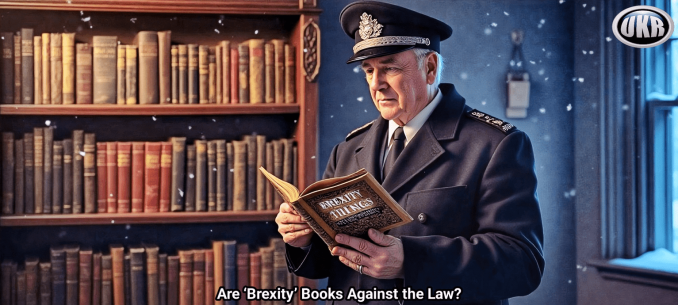
Are ‘Brexity’ books against the law?
Our reading matter is now being taken as evidence of wrongthink.

ANDREW DOYLE
Many of us will recall that bizarre period during the lockdown when we mostly communicated over computer screens, like a reification of E. M. Forster’s dystopian novella ‘The Machine Stops’. It became a running joke that figures in the media were often seen broadcasting from home in front of shelves groaning with weighty tomes in an effort to convey just how learned they were. I myself was guilty of this, although I can assure you that it wasn’t an attempt to imply erudition, but rather that the alternative backdrops – piles of dirty laundry, a lounge scattered with the debris of an indolent lifestyle – were not so televisual.
During this time, a new game emerged whereby viewers would screenshot the bookshelves on display and zoom in to assess the titles. Michael Gove was subject to this curtain-twitching style of analysis, and there was some controversy over the fact that he appeared to own a book by the Holocaust revisionist David Irving and biographies of Mussolini, Stalin and – shock horror – Margaret Thatcher.
The UK police certainly seem to believe in that old aphorism that that ‘You can tell everything you need to know about a person from their bookshelf’. There has been much press coverage this week of the case of Julian Foulkes, a former policeman who was arrested at his home in Gillingham for tweetcrime. It took six officers to handcuff the pensioner and take him to a cell, and bodycam footage from the arrest shows them assessing the contents of his bookshelves. One was seen singling out The War on the West by Douglas Murray and another remarked that there were ‘very Brexity things’.
I have a fair few ‘Brexity’ books on my shelf too. I have just as many ‘anti-Brexity’ books, as it happens. It seems to have escaped the attention of these officers that it is possible to read multiple points of view without necessarily subscribing to any of them. They have also apparently forgotten that ‘Brexity’ views are fairly commonplace, enough so to win the largest democratic mandate the country has ever seen. If it’s a majority view, is it really all that controversial?
I recall during the lockdown I was scheduled for a television interview and, having set up the webcam, I suddenly realised that the two volumes of Ian Kershaw’s excellent biography of Hitler were not only visible, but prominent. The design of the books’ spines is such that the word ‘HITLER’ is displayed in huge letters. Very dramatic and marketable, but not so helpful if you’re about to appear on live television. I must confess that I repositioned my chair to ensure that the books were obscured.
But why? It isn’t as though any sensible person could possibly believe that my interest in the history of tyranny implies an endorsement of it. I could just as easily have a copy of Mein Kampf on the shelf and still retain my wholehearted opposition to its author and everything he stood for. If I owned a copy of the Koran, would that make me a Muslim? If I owned a copy of Jilly Cooper’s Riders, would that make me prone to passionate romps in stables? As a chronic hay fever sufferer, this hardly seems likely.
The assumption that the books we choose to read are a mirror-image of our private thoughts, or that we are so malleable that any opinion we encounter will automatically be assimilated, is very much a core tenet of faith in today’s woke mindset, one that has quite palpably infected the justice system. Those who are currently serving prison time for offensive tweets will be aware that the unevidenced belief that the public act on cue to the language they read has some very authoritarian consequences.
This is why the police consider reading a book by Douglas Murray to be potential evidence in a case for wrongthink. Too often we have seen our law enforcement agencies insisting that it is their job to monitor our opinions. The ‘very Brexity’ Mr Foulkes was arrested because he had tweeted about the rise in antisemitism since the pogrom by Hamas terrorists on 7 October 2023. And that’s all it took for half a dozen officers to storm his property and cart him off to a cell.
This is the chilling reality of living in Britain in 2025. Much as sceptics will insist that there is no free speech crisis, we continually hear of such cases of police and judicial overreach. We know that police are arresting at least 12,000 citizens per year under ‘hate speech’ laws. We know that they have recorded hundreds of thousands of ‘non-crime hate incidents’ against citizens, in spite of demands from successive Home Secretaries that they discontinue this practice. We know that mean tweets are likely to be investigated, whereas many actual crimes are overlooked.
The problems we face with two-tier policing will only get worse while our police forces remain in thrall to an ideology that believes that words are violence and that censorship is necessary for the preservation of a cohesive society. Under Labour, this kind of authoritarianism will doubtless continue. But if we ever end up with a government that actually understands the value of free speech, we might see the systemic changes that are needed to stop the policing from snooping around in our heads.
This article (Are ‘Brexity’ books against the law?) was created and published by Andrew Doyle and is republished here under “Fair Use”
See Related Article Below
The thick blue line
The problem with humourless police officers
BEN SIXSMITH
News of the handcuffing and cautioning of the retired police officer Julian Foulkes over a sarcastic tweet has rightly inspired alarm and outrage towards the dramatic, if by no means unprecedented, state censoriousness that it illustrates.
Fewer people have commented on what it also illustrates: rank stupidity and humourlessness.
In 2023, amid an argument about whether pro-Palestine demonstrations were “hate marches”, Mr Foulkes tweeted, “One step away from storming Heathrow looking for Jewish arrivals…” This was in reference to a mob in Dagestan raiding an airport looking for Jews.
Next, the Free Speech Union report:
Someone complained about Julian’s tweet to the Met and Metropolitan Police Intelligence Command – a specialist unit set up to deal with terrorism and extremism – referred it to Kent Police, citing “concerns around online content”. The following day, six police officers turned up at his home, ransacked the premises, arrested him, detained him for eight hours and gave him a caution.
Nowhere, it seems, either in the Metropolitan Police Intelligence Command — some intelligence command, by the way — or Kent Police did someone ask, “Was he really being serious?” Was this ageing ex-copper really saying that he wanted to launch an anti-Semitic hunt through Heathrow? Or was he being sarcastic?
Rifling through Mr Foulkes’ home, the police uncovered David G. Green’s The Demise of the Free State, a book about the European Union. “That’s a bit odd,” a police officer said. What was “odd” about owning a book on the world’s largest supranational body, which a majority of British voters chose to leave, somehow went unsaid. The police also commented on Mr Foulkes owning “very Brexity things”. Again, 52 per cent of British voters chose to leave the European Union. What was meant to be suspicious and noteworthy about this?
As Chris Bayliss wrote yesterday for The Critic, in multicultural Britain the police are being taught that “social harmony and cohesion are the priorities”. At Pimlico Journal, a former cop observes that the police are being hamstrung when it comes to dealing with serious crimes (“basic police functions, such as staking out a house, [have become] like swimming through treacle”). As we at The Critic have observed time and again, though, “speech crimes” are being treated harshly and humourlessly, with the police perhaps benefiting from the fact that gender-critical commentators and pro-life activists are easier to deal with than hardened thugs.
Policing speech is a minefield however it is done — because policing, say, incitement to commit a crime is so liable to spill over into prosecuting people based on personal opinions. It is worth adding, though, that it is even more of a minefield when a lot of men and women in the police forces are humourless, otherwise literal-minded, self-important, and hypersensitive.
Don’t get me wrong: a lot of people in the police forces are smart, brave and principled. They keep a lot of dangerous men and women off the streets (at least for as long as the courts will actually keep them there). But we also have police officers who grovel before self-appointed Muslim representatives over the scuffing of a Quran and arrest an autistic teenager for saying that an officer looked like a lesbian.
When the police are told to act over things like “non-crime hate incidents”, it demands, even in the best possible world, that they have an understanding of context, irony and various subtle factors related to race, religion and sexual orientation. Even if police officers met these standards, “non-crime hate incidents” would be a bad thing. But when a lot of them — granted, like a lot of people in all professions, including opinion commentary — are unimaginative, mirthless and culturally barren, they become even more problematic.
Again, this does not describe a lot of coppers — many of whom, I’m sure, have absolutely no desire to investigate random tweets. But the dim-witted officers end up doing the damage, and should absolutely not be tasked with implementing expansive censoriousness along fairly arbitrary lines. It’s the authorities that are to blame. As the ex-detective writing for Pimlico Journal observes, the police have been “left deeply unsuited to the challenges of an increasingly balkanised society”. But we can’t appreciate the scale of the dangers of making the police the guardians of “social cohesion” in British discourse without appreciating their limits.
As Mr Foulkes — who is understandably suing the police — commented, seeing officers “investigate” his wife’s underwear drawer was invasive in a manner that has left scars. The police even rummaged through his collection of newspaper cuttings about the premature death of his daughter.
Someone with the vaguest fluency in sarcasm should have made sure that these traumatic events did not occur. But our politicians should make law on the assumption that such an officer might not be there to have a word.
This article (The thick blue line) was created and published by The Critic and is republished here under “Fair Use” with attribution to the author Ben Sixsmith

••••
The Liberty Beacon Project is now expanding at a near exponential rate, and for this we are grateful and excited! But we must also be practical. For 7 years we have not asked for any donations, and have built this project with our own funds as we grew. We are now experiencing ever increasing growing pains due to the large number of websites and projects we represent. So we have just installed donation buttons on our websites and ask that you consider this when you visit them. Nothing is too small. We thank you for all your support and your considerations … (TLB)
••••
Comment Policy: As a privately owned web site, we reserve the right to remove comments that contain spam, advertising, vulgarity, threats of violence, racism, or personal/abusive attacks on other users. This also applies to trolling, the use of more than one alias, or just intentional mischief. Enforcement of this policy is at the discretion of this websites administrators. Repeat offenders may be blocked or permanently banned without prior warning.
••••
Disclaimer: TLB websites contain copyrighted material the use of which has not always been specifically authorized by the copyright owner. We are making such material available to our readers under the provisions of “fair use” in an effort to advance a better understanding of political, health, economic and social issues. The material on this site is distributed without profit to those who have expressed a prior interest in receiving it for research and educational purposes. If you wish to use copyrighted material for purposes other than “fair use” you must request permission from the copyright owner.
••••
Disclaimer: The information and opinions shared are for informational purposes only including, but not limited to, text, graphics, images and other material are not intended as medical advice or instruction. Nothing mentioned is intended to be a substitute for professional medical advice, diagnosis or treatment.
Disclaimer: The views and opinions expressed in this article are those of the author and do not necessarily reflect the official policy or position of The Liberty Beacon Project.


The police now enforce political lawfare, nothing more. Intellect does not require force.