

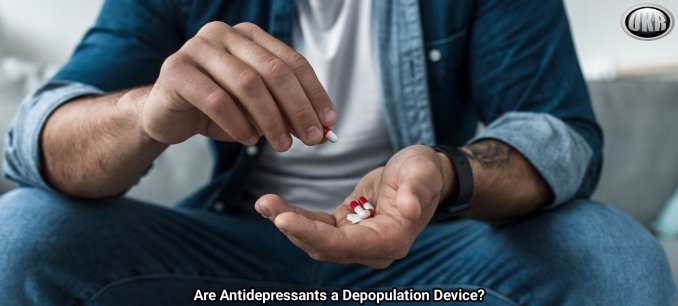
Are antidepressants a depopulation device?
NIALL MCCRAE
Prozac is a feminist drug. That’s how the first of the now ubiquitous class of antidepressants targeting the neurotransmitter serotonin was described by psychiatrist Peter Kramer. Launched by Eli Lilly in 1987, Prozac was an instant success, heralding the era of mass antidepressant therapy. Kramer hosted a popular health programme on National Public Radio, partially funded by Eli Lilly, featuring numerous ‘key opinion leaders’ who promoted SSRIs as a panacea for life’s ills.
Such marketing of Prozac for ‘liberating and empowering’ women (in Kramer’s words) was as feminist as abortion, the contraceptive pill, equality in the workplace and all-female shortlists for parliamentary candidates – all assumed as progress, but each contributing to the declining birth rate and to the psychological, physical and spiritual effects of childlessness (for men as well as women). When JD Rockefeller promoted feminism a hundred years ago, arguably this was not for ordinary women’s benefit but for exploitation. In an academic paper in 2011, feminists Ginger Hoffman and Jennifer Hansen agreed that Prozac had fulfilled some of its promise, particularly for women in professional careers, but by then the detrimental effects were known.
I have been warning of the hazards of antidepressants for two decades. In an interview last tear with David Kurten on TNT Radio, I suggested that these drugs are – whether intentionally or not – making recipients asexual and reducing procreation. This argument is supported by a Daily Mail report (23 May 2024) on how antidepressants cause enduring loss of sex drive.
Patient information leaflets for selective serotonin reuptake inhibitors (SSRI) drugs such as Prozac and Seroxat now warn of sexual adversities including low libido, erectile dysfunction and vaginal dryness. But doctors do not always inform patients of these common side-effects. Millions of people have suffered from such harm. A man with depression who takes an antidepressant that causes lasting impotence is a patient made devastatingly worse by the treatment. Male and female users have experienced genital shrinkage.
The Daily Mail reported that the US Food & Drug Administration (FDA) is being sued by a team of scientists who accuse it of ignoring their petition seeking a warning of permanent sexual damage. The lawsuit filed by Antonei B Csoka, molecular biologist at Howard University, refers to the condition of post-SSRI sexual dysfunction, which can also cause genital numbness, premature ejaculation and emotional blunting. The FDA told Csoka in 2018 that it would review the evidence and get back to him, but it never did.
According to Csoka, ‘without adequate warnings about the risk of potentially permanent damage to sexual function, patients and health care professionals cannot weigh the benefits of the drugs’ use against the potential harms.’ He has been researching sexual dysfunction linked to antidepressants since the early 2000s and was one of the first to posit that the drugs, by interfering with serotonin levels, cause DNA modifications to genes that regulate sexual function. Csoka explained:
Various scientists, including myself, have published studies showing that an SSRI can change epigenetics and human cells. If that’s happening, then those cells or tissues may not immediately revert back to how they were once treatment stops.
The Daily Mail has continued its critique on antidepressants, and particularly their sexual harm, but this has come too late for millions of users who were misled by doctors who must have known the risks. Psychiatrists such as Joanna Moncrieff, sadly, are a minority in recommending safer, natural remedies for depression.
As I argued on TNT Radio, the sexual impact of antidepressants could be a significant contributor to the falling birth rate, particularly in white Westerners. Of course, there are other important cultural trends to take into account: economic constraints, the cost of housing, the need for both partners to work and to be earning enough to afford children, and the breakdown of traditional relationships between the sexes (exacerbated by ideological dogma of toxic masculinity, and promotion of homosexuality).
In the USA, as the Daily Mail reported, fertility has plummeted, and although this is typically attributed to career choice and other cultural and environmental factors, ‘an explosion in antidepressant prescriptions over the past two decades has also been blamed for the country’s baby bust’. In 2020 women in the USA had an average of 1.7 children, according to the United Nations’ World Population Prospects – a dramatic decline since 1970, when the rate was just above replacement level at 2.3. The downward trend has continued since Covid-19.
Evidence indicates that antidepressants are all pain and no gain. In his book Manufacturing Depression, psychologist Gary Greenberg (2010) portrayed this treatment as a myth peddled by an unholy alliance of the commercial interests of the pharmaceutical industry and the professional status of psychiatry. A cure for depression they are not. Expert in clinical evidence Peter Gøtzsche, (Daily Mail, 15 September 2015) observed: –
A successful treatment for depression would allow people to lead more normal lives – go back to work, salvage relationships. But in all the thousands of trials, I’ve never seen evidence that antidepressants do this.
Is mass use of antidepressants leading to depopulation, or is that merely coincidental? Correlation is not causation, but with one in five adults taking antidepressants, and the known sexual harm, it is reasonable to suggest a causal relationship. Whether this is by design is a controversial question. But would we be surprised, following the Covid-19 ‘vaccine’ debacle, that Big Pharma is playing a part in the multimodal neo-Malthusian agenda of a global technocracy?
This article (Are antidepressants a depopulation device?) was created and published by Niall MacCrae and is republished here under “Fair Use”


Leave a Reply