

Six months after the Online Safety Act forced millions to upload their passports, the breaches, the VPN bans, and the state-scale hacks have arrived — exactly as predicted.
THE RATIONALS
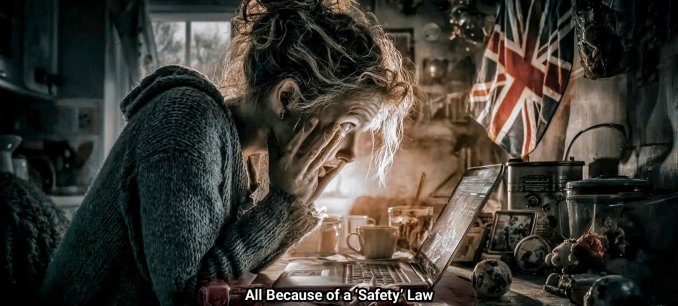
25 July 2025. A young mother uploads her passport to a women’s safety app, nothing more sinister than proving she is over 18 so she can read advice on dating after divorce. By nightfall her photo ID is on 4chan, her address in the open, and she is freezing her credit card and changing the locks. “All because of a ‘safety’ law,” she posts anonymously. This was not a hypothetical. It was the Tea app breach, the first of many.
By the autumn of 2025 the paradox was no longer theoretical. A law sold as a shield for children had quietly begun to amass unprecedented quantities of personal data, biometric, documentary, behavioural, in ever fewer, ever more tempting repositories. What had been marketed as protection was starting to look a great deal like exposure.
That exposure became tangible on 19 December, when Foreign, Commonwealth and Development Office (FCDO) Minister Chris Bryant confirmed a cyber-attack on departmental systems dating back to October. The breach, which exploited a technical vulnerability on a government site, allowed unauthorised access to confidential data, including potentially sensitive visa details.
While officials hastened to assure the public that the risk to individuals was “low” and no highly classified information appeared compromised, the incident reignited debates about the fragility of centralised data systems. Reports suggested involvement by a Chinese state-affiliated hacking group, though Bryant emphasised that attribution remained unclear. The timing, however, was difficult to ignore. The breach came mere months after the full enforcement of the OSA’s age-verification regime, a regime that had already driven millions of Britons into mandatory digital identification systems.
As detailed in our November piece, “They said it was to save kids from porn…”, the OSA’s rollout on 25 July 2025 mandated “highly effective” age verification for platforms hosting potentially harmful content. Platforms such as Reddit, Spotify, and Pornhub swiftly implemented facial scans, government IDs, or biometric checks to comply, fearing fines of up to 10% of global turnover.
What began as a stated effort to shield minors from pornography and self-harm material rapidly became a mass exercise in identity capture, generating vast stores of sensitive personal data. The Act’s logic was simple, verify everyone, everywhere. Its consequence was equally simple, centralise risk.
Recapping the OSA’s Foundations: From ‘Safety’ to Surveillance
The Online Safety Act imposes statutory duties on online services to protect users, particularly children, from harmful content. Its children’s safety provisions came fully into force in July 2025, triggering immediate behavioural and technical shifts. Reddit required ID uploads for NSFW (Not Safe For Work) sections. Spotify gated explicit content behind biometric checks. Pornhub blocked UK access without verification. Ofcom’s guidance left little ambiguity, non-compliance would be treated as a serious offence.
Yet cracks appeared almost instantly. Proton VPN reported a 1,400% surge in UK sign-ups on launch day as users sought to bypass restrictions. Children’s Commissioner Dame Rachel de Souza labelled VPNs a “loophole” in need of closure, prompting Ofcom to warn against promoting circumvention tools. Her August 2025 assessment, that such tools undermined the Act’s protections, signalled the beginning of a political backlash.
By December, that backlash had reached Parliament. On 4 December, the House of Lords debated restricting children’s VPN access, with Baroness Benjamin (Lib Dem) warning that free apps “expose devices to viruses” and monetise user data. Lord Carlile (Ind) urged stricter Ofcom enforcement. The government, through Baroness Lloyd (Lab), pledged monitoring and a June 2026 age-assurance review, but stopped short of bans.
Within days, peers tabled an amendment to the Children’s Wellbeing and Schools Bill proposing a prohibition on VPNs (pp. 19) for under-18s, enforced through age-verification requirements on providers themselves. The logic inversion was striking, a law justified by child safety had begun targeting privacy tools used to escape it.
Early Warnings: When Verification Becomes a Honeypot
More alarmingly, mandatory ID uploads created immediate cybersecurity liabilities. On 25 July, the Tea app, a women’s safety network, suffered a breach exposing 72,000 images and 13,000 government IDs on forums such as 4chan. A subsequent incident leaked 1.1 million private messages, including location data. In October, Discord’s third-party age-verification provider was hacked, potentially exposing 70,000 passports and driving licences worldwide, many belonging to UK users.
These incidents, reported to the Information Commissioner’s Office, revealed a structural flaw. The OSA mandates verification but imposes no clear deletion duties for uploaded identity documents, transforming compliance into long-term data retention. What were meant to be transient checks became permanent repositories, and irresistible targets.
The Quiet Expansion: From Age Checks to National Identity
Compounding this vulnerability was the OSA’s intersection with the Data (Use and Access) Act 2025, which placed the Digital Identity and Attributes Trust Framework on a statutory footing. This framework underpins the GOV.UK Wallet, a mobile application allowing users to store and share government-issued documents for verification purposes.
By December 2025, the framework’s gamma version (0.4) had come into force, with the explicit goal of widespread adoption. Yoti, a major biometric provider, reported a 25% spike in traffic following the OSA’s launch, as millions downloaded reusable digital credentials. The government’s stated target remains 95% adult adoption by 2030, extending digital identity use across NHS access, benefits, voting, banking, and employment checks. What had been sold as a narrow proof-of-age mechanism was fast becoming the foundation of a national digital ID system.
What we called a “soft launch” in November is now statutory fact. The GOV.UK Wallet is not a modest convenience. It is intended to become the default gateway to civic life. Credentials already live or in pilot include digital driving licences, eVisas, right-to-work checks, DBS certificates, and veteran cards. Planned expansions encompass NHS login, benefits eligibility, tax credits, voting ID, banking verification, and right-to-rent checks. In practice, that means one app will soon hold the most intimate details of millions of ordinary lives. Imagine yourself waking up to discover that everything that keeps you safe is now the thing that can destroy you.
For instance, consider a single mother somewhere in the UK. She books her child’s asthma appointment through the Wallet, the same app that already stores her Universal Credit proof and right-to-rent certificate. If that app is ever breached, her child’s medical needs, her benefits, and her home are all exposed in a single stroke.
Or picture a recently divorced father. He uploads his passport to renew his mortgage offer. Months later the same document is linked to his child-benefit claims, his NHS prescriptions, and his voting registration. A single failure of the system he was told would make life easier would strip away the fragile new life he has spent years rebuilding.
What began as a child-safety checkbox on adult websites had, in under six months, become the access key to employment, healthcare, housing, and democratic participation.
New Evidence: The FCDO Hack as State-Scale Confirmation
It was against this backdrop that the FCDO cyber-attack came to light. Confirmed on 19 December, the breach involved hackers exploiting a flaw on a Foreign Office website to access confidential files, including visa data. Bryant described the incident as contained, with no evidence of sensitive compromise. Media reports, however, linked the attack to a Chinese state-affiliated group.
This was not an anomaly. It was escalation.
Visa records, like passports, driving licences, and biometric IDs, are high-value intelligence assets. The FCDO’s breach mirrored, at state scale, the vulnerabilities exposed earlier in private-sector verification systems. In normalising mass identity uploads, the OSA had widened the attack surface not only for criminals, but for hostile states.
Government reassurances followed a familiar pattern. Individual risk was described as low. Systems were said to be secure. Yet the breach coincided with increased UK sanctions on Chinese firms for cyber-activity, and warnings from the Foreign Secretary about hybrid threats blending cyber-attacks with information warfare.
The contradiction was stark, while ministers warned of foreign cyber aggression abroad, domestic policy was expanding the very infrastructure such aggression exploits.
Systemic Risk: Inside the Digital ID Infrastructure
Parliamentary briefings have already flagged cybersecurity concerns surrounding digital identity systems. Those concerns deepened on 18 December, when ITV News reported leaked whistleblower documents from senior civil servants involved in the GOV.UK Wallet’s One Login foundation.
The documents described “extreme” vulnerabilities, administrators accessing systems from malware-prone personal devices, failures to meet mandatory security standards such as Secure by Design and the Cyber Assessment Framework, and red-team tests in March 2025 that granted attackers privileged access without detection.
One insider warned of “the worst data breach in UK government history.” Earlier Government Digital Service testimony had already revealed offshore development, weak governance, and unresolved flaws dating back to the system’s 2022 launch.
Officials insist the concerns are outdated and mitigated through ongoing National Cyber Security Centre testing. Yet internal risk registers reportedly still classify the system as high-risk. The Wallet, sold as convenience, increasingly resembles a state-scale honeypot.
Seven Weeks Later: The November Warning Arrives
Seven weeks after we published “They said it was to save kids from porn…” on 14 November 2025, the future we warned about is no longer theoretical. We had glimpsed its shadow in October, when we dissected Starmer’s “Brit Card” as a Blairite revival — a Trojan horse for Palantir’s data-profiteering empire, complete with offshore development risks and “unlawful surveillance” baked in.
The Foreign Office breach has already placed visa files and diplomatic data in hostile hands under the same regulatory pressures that turned Tea and Discord into leaking ID warehouses. The GOV.UK Wallet — the “soft launch” we wrote about, is now statutory, its reach extending into NHS records, benefits, rent checks, and voting credentials.
The VPN stampede. The parliamentary panic. The private-sector breaches. The state-level hack. None of this is coincidence. It is a sequence.
In November we asked:
“When your NHS record, your rent, and your vote live in a government wallet — will you still call it ‘child safety’?”
Seven weeks later, the answer is no longer abstract.
The Online Safety Act did not fail to protect children. It succeeded, at building the infrastructure for something else entirely.
Welcome to the Britain they warned you about in the name of saving kids from the Britain that no longer exists.
The Rational Forum is entirely reader-supported. If you value what we do, please share the piece, leave a comment, or consider a free or paid subscription. All contributions — whether a subscription or a one-off gift — are gratefully received and keep the lights on.
This article (ALL BECAUSE OF A ‘SAFETY’ LAW) was created and published by The Rationals and is republished here under “Fair Use”
Featured Image: The Rationals

••••
The Liberty Beacon Project is now expanding at a near exponential rate, and for this we are grateful and excited! But we must also be practical. For 7 years we have not asked for any donations, and have built this project with our own funds as we grew. We are now experiencing ever increasing growing pains due to the large number of websites and projects we represent. So we have just installed donation buttons on our websites and ask that you consider this when you visit them. Nothing is too small. We thank you for all your support and your considerations … (TLB)
••••
Comment Policy: As a privately owned web site, we reserve the right to remove comments that contain spam, advertising, vulgarity, threats of violence, racism, or personal/abusive attacks on other users. This also applies to trolling, the use of more than one alias, or just intentional mischief. Enforcement of this policy is at the discretion of this websites administrators. Repeat offenders may be blocked or permanently banned without prior warning.
••••
Disclaimer: TLB websites contain copyrighted material the use of which has not always been specifically authorized by the copyright owner. We are making such material available to our readers under the provisions of “fair use” in an effort to advance a better understanding of political, health, economic and social issues. The material on this site is distributed without profit to those who have expressed a prior interest in receiving it for research and educational purposes. If you wish to use copyrighted material for purposes other than “fair use” you must request permission from the copyright owner.
••••
Disclaimer: The information and opinions shared are for informational purposes only including, but not limited to, text, graphics, images and other material are not intended as medical advice or instruction. Nothing mentioned is intended to be a substitute for professional medical advice, diagnosis or treatment.
Disclaimer: The views and opinions expressed in this article are those of the author and do not necessarily reflect the official policy or position of The Liberty Beacon Project.


Leave a Reply