

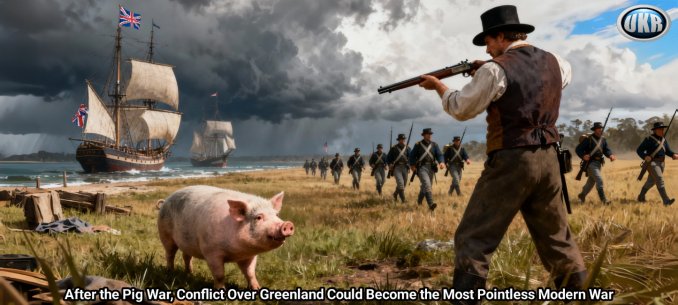
After the Pig War, an eruption of conflict over Greenland could become the most pointless war of the modern era.
FRANK FUREDI
As most of you will know, back in 1859 the British Empire and the United States nearly went to war over the fate of a single pig. The dispute erupted on the San Juan Islands, where American farmer Lyman Cutlar decided to shoot a British-owned pig rooting in his garden. What would normally be seen as an easily resolvable petty incident swiftly mutated into a major international conflict, leading both nations to deploy troops to the islands. Tensions between the two powers escalated, and it appeared that neither side was prepared to back down. In the end, common sense prevailed, and the “war” ended without a shot being fired.
Of course, the conflict on the San Juan Islands was not really about the demise of a pig, but about a boundary dispute between two major global powers. In this respect, the unexpected intra-Western conflict over the future of Greenland resembles the farcical character of the Pig War. If anything, the current dispute over Greenland is even more absurd than the mobilisation of troops over the shooting of a pig.
In the case of the Pig War, both sides actually mobilised lethal military resources. Within two months of the pig’s death, a detachment of 461 American soldiers with 14 cannons squared up to a flotilla of five British Royal Navy warships mounting 70 guns and carrying 2,140 men. Contrast the scale of this mobilisation with the number of military personnel deployed by the European Union and Britain to Greenland.
The EU has flexed its military muscle by sending around 50 personnel: one each from the Netherlands and the UK; two each from Finland and Norway; three from Sweden; and the “big hitters”, France and Germany, sent 15 and 13 respectively. Sadly the absurdity of this supposed gesture of determination has entirely passed by the imagination of the leaders of these different countries. It is as if they cannot help but draw attention to their tin-pot geopolitical statement.
The EU’s attempt to appear serious about defending Greenland has already backfired with President Trump’s announcement that Washington will impose a 10 per cent tariff on goods entering the United States from Denmark, Norway, Sweden, France, Germany, the UK, the Netherlands, and Finland. He has threatened to raise the tariffs to 25 per cent on June 1. Europe’s hapless mobilization of 50 toy-soldiers to Greenland may therefore exact a hefty financial cost.
It is difficult to understand what it is about Greenland that has triggered the eruption of a war of words and a veritable trade war. And unlike the Pig War, where diplomacy prevailed and troops on both sides were stood down, the dispute over Greenland has already created what looks like an irreversible crisis for the Western alliance and NATO.
This is a dispute that could easily get out of hand and unleash a chain of events with grave consequences.
As matters stand, none of the parties to the Greenland dispute is likely to devote serious military resources to defend its position on the island. In recent decades the United States has significantly reduced the number of military personnel stationed at its base in Greenland. For its part, Denmark has done little to defend Greenland. Under pressure, it now promises to increase its military presence, but its military leaders have acknowledged Denmark’s impotence in the face of US intervention.
Major General Søren Andersen, commander of Denmark’s Joint Arctic Command in Greenland, said in an interview with the Axel Springer Global Reporters Network that the stepped-up Danish and allied military activity around Greenland is not a response to an immediate danger, but preparation for future contingencies. In other words, Denmark is preparing to respond to a threat that may occur at some indefinite point in the future. Yet, Lars Løkke Rasmussen, Denmark’s Foreign Minister tells another story. He posted a statement on X that stated:
We agree with the US that we need to do more since the Arctic is no longer a low tension area. That’s exactly why we and NATO partners are stepping up in full transparency with our American allies. [i]
Now that Rasmussen has acknowledged that American concerns about the security of the Arctic are genuine it is difficult for Denmark to counter Washington’s demand for securing Greenland.
In this dispute, Washington holds all the cards. President Trump knows that none of the European governments can stand up to him, and that it is only a matter of time before they back down. Germany was quick off the mark. In response to Trump’s announcement regarding the imposition of tariffs on Germany pulled its 14 soldiers back from Greenland. Since 1945 Europe has relied on the United States for military protection. After decades of playing the role of a dependent child relying on Washington’s largesse, it is not in a position to transform itself into a serious military player.
President Trump also understands that Europe cannot thwart his ambitions for Greenland. But is Washington really playing hardball over the island? In reality, the United States could secure control over Greenland through behind-the-scenes diplomacy. Under existing agreements, it already has the right to station as many troops in Greenland as it wants. With a degree of diplomatic pressure, Washington could gain exclusive control over the island’s mineral resources and informal control of Greenland’s economy.
But Trump is not interested in gaining control through off-camera diplomacy. On the contrary, Washington wants Denmark’s and the EU’s humiliation to occur in front of the cameras. Why? Because an important motive for turning Greenland into a prominent issue is Washington’s aspiration for an easy win. Previous wins in Gaza and Venezuela help reinforce the image of a powerful United States that possesses the means to project its interests throughout the world. Exposing the impotence of European powers serves to underline the message that America cannot be messed with.
It is likely that, one way or another, Washington will get its way in Greenland. But such a development could unleash a chain of events with destructive consequences. For a start, the dispute exposes the extent to which NATO has become a Potemkin alliance. It is unlikely that the so-called Western alliance can be maintained in its present form. The fragmentation of the West that will follow is likely to significantly weaken the international standing of all its members.
We should remember that not all pointless conflicts resemble the Pig War and end through diplomacy. Hopefully, the posturing that led to the dispatch of European military observers to Greenland will not lead to further escalation. Finding a way to give the American president his symbolic triumph should not be that difficult.
Please consider supporting our work financially. Serious research and reflection is time consuming and expensive.
This article (After the Pig War, an eruption of conflict over Greenland could become the most pointless war of the modern era.) was created and published by Frank Furedi and is republished here under “Fair Use”

••••
The Liberty Beacon Project is now expanding at a near exponential rate, and for this we are grateful and excited! But we must also be practical. For 7 years we have not asked for any donations, and have built this project with our own funds as we grew. We are now experiencing ever increasing growing pains due to the large number of websites and projects we represent. So we have just installed donation buttons on our websites and ask that you consider this when you visit them. Nothing is too small. We thank you for all your support and your considerations … (TLB)
••••
Comment Policy: As a privately owned web site, we reserve the right to remove comments that contain spam, advertising, vulgarity, threats of violence, racism, or personal/abusive attacks on other users. This also applies to trolling, the use of more than one alias, or just intentional mischief. Enforcement of this policy is at the discretion of this websites administrators. Repeat offenders may be blocked or permanently banned without prior warning.
••••
Disclaimer: TLB websites contain copyrighted material the use of which has not always been specifically authorized by the copyright owner. We are making such material available to our readers under the provisions of “fair use” in an effort to advance a better understanding of political, health, economic and social issues. The material on this site is distributed without profit to those who have expressed a prior interest in receiving it for research and educational purposes. If you wish to use copyrighted material for purposes other than “fair use” you must request permission from the copyright owner.
••••
Disclaimer: The information and opinions shared are for informational purposes only including, but not limited to, text, graphics, images and other material are not intended as medical advice or instruction. Nothing mentioned is intended to be a substitute for professional medical advice, diagnosis or treatment.
Disclaimer: The views and opinions expressed in this article are those of the author and do not necessarily reflect the official policy or position of The Liberty Beacon Project.


Leave a Reply