

Policing, Politics and Microsoft Copilot

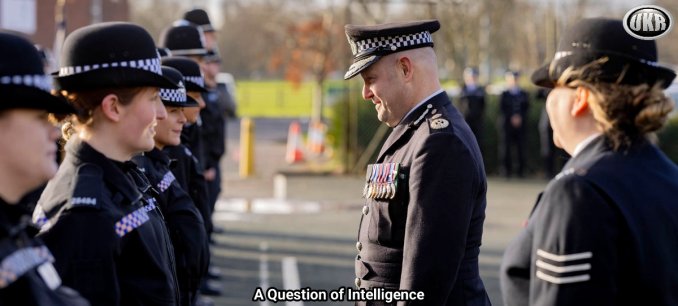
An intelligence officer tries to explain AI to Craig Guildford.
DOMINIC ADLER
Much has been written about the (former) Chief Constable of West Midlands Police and his role in the Maccabi Tel Aviv scandal. I’ve had my say, here, on the affair – along with a critique of Craig Guildford’s tormentor-in-chief, the newly promoted shadow justice secretary Nick Timothy, MP.
One particular aspect of the affair, however, pinged my radar: the use – or rather misuse – of intelligence.
So today, I’m examining the role of intelligence in police decision-making. How does intelligence fit into the murky political terrain chief constables must navigate? By doing so, I hope to demonstrate quite how beyond repair West Midlands Police (and probably other forces) have become. How many senior officers view intelligence – as they did in this case – as a tool to justify a preordained agenda? I touched upon this issue for UnHerd.
For newer readers (welcome, by the way): I worked in police intelligence units at force, regional and national level, in counter-terrorism, public order and serious / organised crime. I even endured the stupendously dull NIM intelligence managers course, but misplaced my certificate. It would’ve looked fab in the downstairs loo, next to my fifty-meter swimming award. Anyway, I’ve a fair bit of insight into how this stuff works.
Or, as we have seen, doesn’t work.
What, then, constitutes ‘Intelligence?’
Forget whatever fancy definitions NIM or geeks or the College of Policing might offer. In practice, police view intelligence any information used to inform decision-making. This could be checks supporting officer attending an emergency call, to a detailed profile of an organised criminal network. Or, indeed, the likelihood of disorder at a politically-contested football match.
Decision-making is a key part of a police officer’s job. But, as we shall see, legislative, cultural and political imperatives often means decision-making becomes a hell-scape of arse-covering, navel-gazing and appeasement. I’ve written about this stuff here.
Anyway, intelligence is delivered via written assessments or ‘products’, the end result of the intelligence cycle. The risk assessment for the Maccabi Tel Aviv game should have been actioned to an intelligence manager via an audited, NIM compliant process. It should have involved detailed research, including the provenance – i.e. the source – of any data (including, if the material is sensitive, any handling conditions). Not an officer throwing a handwritten note, of comments made by an officer from a Dutch police force, in the bin.
During my service I compiled and presented such assessments. For bigger operations and events, it wasn’t unusual to work with representatives of the command group policing the event. All of this will – or should – be documented in systems audit, daily intelligence meeting minutes and policy / decision logs.
What shouldn’t happen, in any circumstances, is relying on a lowly researcher (a support staff admin grade) to ask Microsoft Copilot to find evidence of a potential ruckus. Especially when you already know the locals are planning on tooling up. Any half-decent intelligence manager would have, again, logged such reporting and actioned it for urgent research.
Which begs the question: how did this Mickey Mouse scenario come to pass?
A tale of Ye Olden Days
When I joined the Met, in the early Nineties, the intelligence model would’ve been familiar to a constable working in the Sixties. At local police stations, one police officer would be nominated the local intelligence officer, or ‘collator’. This Pc would usually be long in service and / or on light duties. They would possess an encyclopedic knowledge of local criminals, which they’d diligently enter onto index cards using a typewriter. In lieu of intelligence reports, officers would make entries in the ‘Collator’s Book’, detailing information of interest.
In addition, the collator would study custody records, stop slips and crime reports. From such humble data, they would build an intelligence picture of local criminality. Then, of course, there was information from informants – which all officers (both uniformed and detective) were expected to cultivate. By the late 1990s, this practice ceased, due to concerns around corruption, whereupon human sources were managed by dedicated units.
The only real computer databases available to the average officer in those days were the venerable Police National Computer (PNC) and, occasionally, an intelligence database – known as INFOS – maintained by local Force Intelligence Bureaux (FIB). The mid-Nineties onward, though, saw rapid technological change. CRIMINT, the Met’s criminal intelligence database, was introduced in the mid-Nineties, along with CRIS – the Crime Reporting Information System. This meant crime data and intelligence reports were now available to every officer.
The Future is Now!

One day, son, you’ll get arrested for this!
The Internet appeared, along with floppy discs, trackball mice and dial-up modems. Police forces found themselves inundated with a tsunami of information. The collators were replaced by BIUs, or Borough Intelligence Units. Public sector IT fuckery meant the police were, inevitably, saddled with clunky IT systems, often requiring specific training to access. Then 1997 saw the dawn of the Blairite Legislative Revolution. This meant even more fuel for British policing’s obsession with procedural gold-plating. This resulted in:
- Unwieldy legislative demands developing around disclosure, human rights and information sharing / management (including the aforementioned NIM).
- An obsession with performance management, leading to an insatiable demand for statistics from the centre.
- A proliferation of databases. The average intelligence officer was forced to collect authorisations for different systems, like boy scouts chasing merit badges. The One System To Rule Them All became the holy grail of police intelligence (unless you were an anti-corruption investigator trying to stop leaks, another role I undertook).
The insatiable hunger for statistics demanded analysts to interpret them all – this created a new class of intelligence professional within the police staff (i.e. not sworn officers). Eventually, their influence over operational decision-making became increasingly significant. A them-versus-us culture developed, one where gnarly police officers resented being given directions by geeks with no operational experience but an MSc in statistics.
What, then, were these statistics used for? Well, fighting crime (sort of) but also to ruthlessly game performance around volume crime. Or, if you were above the rank of inspector, play 4D chess to determine where best to deploy your officers. Almost inevitably, though, intelligence became enmeshed with performance.
I vividly remember visiting a BIU in the mid-2000s, an impressive suite of rooms staffed by forty-odd people. The DS nominally in charge shook his head, ‘this isn’t an intelligence unit,’ he said. ‘It’s a performance factory.’ We see this attitude, I would suggest, in the West Midlands affair. Intelligence as an omni-convenient tool, used to justify narratives rather than offer fact-based assessment.
NIM – the aforementioned National Intelligence Model – also created a three-ring circus. Post-Soham and the Birchard Report, decision-making models were designed with an eye on public inquiries. They were clunky, designed to diffuse responsibility and blame for when things went wrong – and in policing, something always goes wrong. New legislation and thinking around ‘Harm’ and ‘Risk’, along with multi-agency working and safeguarding also took its toll. Not to mention equalities legislation, DEI and all the rest of it.
In the space of 15 years, police intelligence – even at local level – went from one police constable with a bad back to thirty-odd staff led by a detective inspector. Not to mention the proliferation of specialist and thematic intelligence units for every type of crime, from fraud to terrorism to murder. It was, on occasion, messier than a bucket of freshly-dug worms. The best intelligence work was often conducted out of necessity – usually fast-time – where minds were focused on basics.
Ops versus Int
As intelligence became a specialism, a divide appeared. Intelligence was largely non-evidential, i.e. much product ended up ‘sensitive material’ for disclosure purposes, never seeing the light of day in open court. This was accelerated by the (not unreasonable) Criminal Procedure and Investigations Act, introduced in 1996.
Intelligence tends to be desk-based (too much, in fact), although there’s an element of field work: surveillance and source-handling being the most obvious examples. The objective is supposed to be simple – develop intelligence to hand over a workable case to an operational team. Running with the ball, they make arrests and take the job to court. Or, in the case of a demonstration or football match, lead the policing operation to ensure public safety and maintain public order.
Ops teams might consist of detectives or firearms teams or riot squads. And, of course, there’s an element of tension baked into their relationship with the intelligence units servicing them. Ops has a tendency to see Int as desk-jockeys who never step into a witness box or pick up a riot shield. Int has a tendency to see Ops as brutish creatures, lacking subtlety and discretion, expecting a suspect handed to them on a plate. Ingrates, who believe Int has access to a crystal ball.
Sometimes, management will put an Ops person in charge of an Int unit (note: it’s not ‘Intel’, that’s a bloody Americanism) to shake stuff up. It’s not unusual for the Ops person see the risks around intelligence management and go native. Just like the Int people transferred to Ops, who suddenly understand the pressures of on-the-ground policing, prosecutions and casework.
Now, you might be wondering, what does that have to do with the WMP / Maccabi scandal? I would suggest the bifurcation between intelligence and operations means staff are too focused on processes than operational outcomes. Nor are they adequately empowered to challenge perceptions or offer material ‘speaking truth to power.’ Take, for example, ‘research Maccabi Tel Aviv and give me some reasons why the fans are horrible and should be banned from the Aston Villa match.’
The reply should be: ‘Sir, what are we trying to achieve? Why are you seeking to prove a negative? Aren’t you interested in other outcomes, or actors, involved?’ It’s called Professional Curiosity, and police are expected to exercise it. Add savage cuts to resources, staff inexperience and poor leadership? Oh, and a relatively-untested technology like AI?
It’s like giving a bunch of howler monkeys a stick of dynamite. Which is a shame, as AI has the potential to be truly transformative for police intelligence, call-handling and investigation.
Then, The Reaping
I often lament the Cameron-May reforms, which pretty much screwed British policing as we knew it. To illustrate how consequential these changes were, here’s an example: in London, the aforementioned BIUs (per borough) were replaced by only three officers per two or even three boroughs. The Met had returned to sub-Nineties collator levels of local intelligence support. But it’s okay, because technology. Technology is a force multiplier right.
Right?
Instead, forces relied on social media monitoring for virtually everything. Human sources? Surveillance? Thematic intelligence? Too risky or expensive. Poring over social media? Cheap as chips. You can see why intelligence units fed on a diet of ‘X’ and Instagram and TikTok might see AI as a panacea, not a loaded gun.
Which brings me to…
Leadership, Community Cohesion and Buck-Passing

‘Hey, Copilot? What’s the annual pension, after tax, for a chief constable?’
There’s a reason the stereotypical chief constable is too often portrayed as a craven, risk-averse nonentity. Wedded to whatever ideas a septum-ringed activist or ‘community leader’ has foisted on the force’s advisory committee. And that stereotype exists because there’s an unhealthy level of truth to it.
This impacts on how leaders perceive their intelligence units. I’ve witnessed senior officers at New Scotland Yard blatantly ignore verifiable intelligence at variance with what an activist ‘advisor’ was telling them. Unsurprisingly, ambitious intelligence managers pick up on the mood music drifting from the command floor. Does this always mean assessments are wrong, or tainted? Not necessarily. There are, or were, chiefs prepared to suffer the slings and arrows of outrageous fortune.
However, for sensitive issues? Especially those concerning race and religion? Chief constables are hopelessly politicised, not least due to the unfortunate Police and Crime Commissioner experiment (another Conservative gem). Of course some issues are soft-soaped – especially community cohesion concerning minority groups. As exists in Labour-run Birmingham, with its strategically critical voting blocs of Muslim communities. Communities likely to upend Labour’s apple cart by electing sectarian MPs. Which is what happened in West Midlands Police – powerful local (Muslim) politicians demanded no Israeli fan set foot on their turf.
I will, however, offer a partial defence of hapless chief constables. After all, they police in the world as it is, not as they’d like it to be. Would a chief constable with the cojones to face down his PCC and powerful local politicians have been supported? By whom? Wouldn’t he have been accused of racism? The post-riot inquiry would have been worse than the brick-bats being thrown at WMP. I’m not defending the likes of Craig Guildford, but we are where we are.
Which is this: having a spine more or less precludes you from achieving high rank.
The outlook is, I’m afraid, bleak. There are lonely islands of competence – even excellence – in British policing. After all, intelligence has traditionally been an area in which our nation excels. Sadly, though, these islands are marooned in a brackish sea of vacillation, bureaucracy and mediocrity.
I doubt the National Police Chiefs Council, College of Policing or Home Office will draw the right conclusions from any investigation into the WMP affair, including the parlous state of police intelligence processes and capability. Why? Because they’re all complicit in two decades of failure.
To which you might ask, ‘that’s all very well, but what’s the answer?’ Big question, but here’s a starter for ten.
Have a great a week and thanks for reading.
Cheers,
Dom
This article (A Question of Intelligence) was created and published by Dominic Adler and is republished here under “Fair Use”

••••
The Liberty Beacon Project is now expanding at a near exponential rate, and for this we are grateful and excited! But we must also be practical. For 7 years we have not asked for any donations, and have built this project with our own funds as we grew. We are now experiencing ever increasing growing pains due to the large number of websites and projects we represent. So we have just installed donation buttons on our websites and ask that you consider this when you visit them. Nothing is too small. We thank you for all your support and your considerations … (TLB)
••••
Comment Policy: As a privately owned web site, we reserve the right to remove comments that contain spam, advertising, vulgarity, threats of violence, racism, or personal/abusive attacks on other users. This also applies to trolling, the use of more than one alias, or just intentional mischief. Enforcement of this policy is at the discretion of this websites administrators. Repeat offenders may be blocked or permanently banned without prior warning.
••••
Disclaimer: TLB websites contain copyrighted material the use of which has not always been specifically authorized by the copyright owner. We are making such material available to our readers under the provisions of “fair use” in an effort to advance a better understanding of political, health, economic and social issues. The material on this site is distributed without profit to those who have expressed a prior interest in receiving it for research and educational purposes. If you wish to use copyrighted material for purposes other than “fair use” you must request permission from the copyright owner.
••••
Disclaimer: The information and opinions shared are for informational purposes only including, but not limited to, text, graphics, images and other material are not intended as medical advice or instruction. Nothing mentioned is intended to be a substitute for professional medical advice, diagnosis or treatment.
Disclaimer: The views and opinions expressed in this article are those of the author and do not necessarily reflect the official policy or position of The Liberty Beacon Project.


Leave a Reply