


ESCAPE KEY
Today, if you have money, you can buy what you like. Assuming you use a credit card your balance is checked and the money withdrawn.
By 2029, the terminal checks a second balance — carbon, social, compliance — before the transaction clears. Fail the check, payment denied. It’s a permission system.
We covered the EU implementation in How Europe is Building a Carbon Currency — Digital Product Passports, Digital ID Wallets, and the Digital Euro. But Europe is just one implementation. The architecture is global.

Find me on Telegram: https://t.me/escapekey
Bitcoin 33ZTTSBND1Pv3YCFUk2NpkCEQmNFopxj5C
Ethereum 0x1fe599E8b580bab6DDD9Fa502CcE3330d033c63c
 A Conditional Existence By Esc

The architecture has five layers:
1. Configuration: They set the goals.
First comes the purpose. The UN’s Sustainable Development Goals provide 17 objectives and 169 targets covering poverty, health, climate, equality, and ‘peace’. These aren’t suggestions — they’re the framework that justifies everything downstream. Climate scenarios from the Network for Greening the Financial System tell banks which futures to plan for. Planetary boundaries define what’s ‘safe’. The goals provide the moral cover: we’re doing this for the planet, for future generations, for equity.
But who speaks for the planet? Who decides what counts as ‘sustainable’ or ‘risky’ or ‘harmful’? Technical committees, standards bodies, working groups, and scientists working for unaccountable ‘black box’ global modelling agencies, such as the IIASA. Not voters, nor parliaments. The rules are written before the public even knows there’s a discussion.
2. Evaluation: How progress is measured.
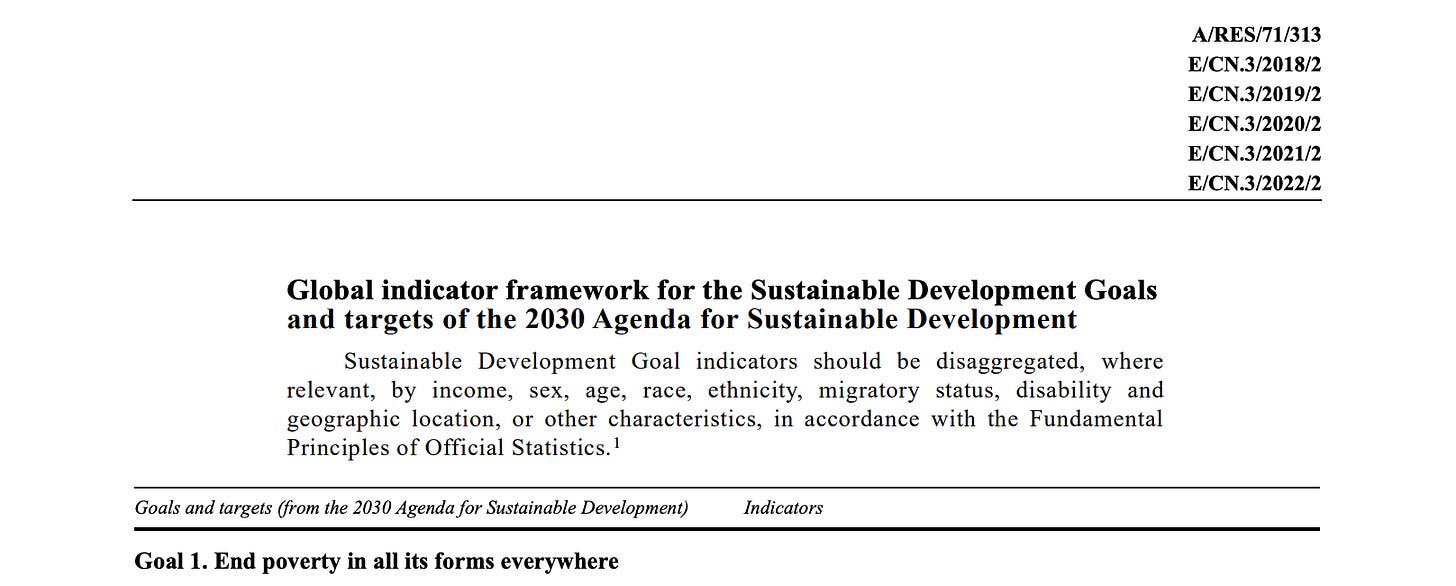
But the SDGs need metrics. The UN’s SDG Indicator Framework1 provides 231 specific indicators to measure progress toward the 169 targets. Maternal mortality rates. CO₂ emissions per GDP. Financial inclusion percentages. ‘Proportion of population subject to physical or sexual harassment’. These indicators define what the system actually tracks — and what it optimises for.
Every indicator becomes a variable the system can monitor. Every variable becomes a condition that can be checked. Every condition becomes a binary gate that can open or close.
3. Compliance: The closed loop.
This is where the trap closes. Four interlocking mechanisms create a system where you cannot operate outside, cannot operate without permission, are watched constantly, and must prove you followed the rules. Together they form a closed loop — controlled from above, with no exit.
If this sounds abstract, it shouldn’t. The financial sector already runs on this model. It’s called KYC — Know Your Customer2. Before you can open a bank account, get a loan, or transfer money internationally, the institution must verify your identity and assess whether you’re permitted to do what you’re asking. KYC is ID plus accreditation, already mandatory, already enforced. What’s being built is KYC for everything.
Digital ID is the entry gate. Without it, you don’t exist to the system. Every product gets a Digital Product Passport. Every person gets a Digital Identity Wallet. No tag, no participation. You cannot engage in economic life without first being identified and registered. The system decides who gets an ID — and can revoke it if you don’t do as you’re told.
Accreditation is the permission layer. Even with an ID, you can only do what you’re credentialed for. Want institutional investment? You need ESG ratings. Want government contracts? You need sustainability certification. Want to operate in regulated industries? You need approved credentials. These aren’t government agencies — they’re private companies applying standards set by technical committees you’ve never heard of. No credential, no participation. And credentials can be suspended or withdrawn.
Once we have identities and credentials, we need to know what the actors get up to. Real-time data is mandatory surveillance. Transaction records, location data, carbon tracking, social media analysis, smart meters, supply chain sensors — all feeding systems that know what you’re doing, where, and with whom. You cannot opt out. The monitoring is continuous. Every action generates data that feeds back into the system.
Audits verify you followed the rules. Did you stay within your carbon budget? Did your suppliers meet their targets? Did your behavior match your accreditation? Audits determine whether you remain in good standing — whether your credentials stay valid, whether your access continues. Fail an audit, lose your standing.
Here’s what makes it a closed loop: there is no outside.
No ID means you cannot transact at all — you don’t exist to the system. No credentials means you cannot engage in specific activities — no permission, no participation. But if you want to be included, you must be visible. You must have an ID. You must have credentials. And with those come surveillance and audits — automatically, by design.
You’re either outside the system entirely — unable to buy, sell, work, or travel — or you’re inside and subject to all of it. The loop is closed. There is no third option.
All of this feeds the execution layer.
4. Execution: Where the system acts.
This is where measurement becomes enforcement — and where the trick reveals itself.
The ethics frame. Everything is presented as an ‘ethical imperative’. Sustainability. Equity. Future generations. Planetary health. If you comply, you’re responsible, ethical, a good, cosmopolitan ‘global citizen’. If you don’t comply, you’re irresponsible, unethical, a threat to the collective, who likely needs to be censored and deplatformed for being ‘irresponsible’ and ‘a threat to our democracy’. The framing makes resistance feel like selfishness. Who could oppose saving the planet? Who could oppose protecting the vulnerable? Who wants granny to die?
This is control through ethics. The system doesn’t need to justify coercion — it makes non-compliance morally indefensible. You’re not being controlled. You’re being given the ‘opportunity to be good’ — to feel righteous. But just to make sure, the ‘sustainability’ framed ‘ethics’ output by the global models for sakes of ‘planetary stewardship’ are backed by enforcement.
Nations first. The mechanism already works at sovereign level. Development funding — from the World Bank, IMF, bilateral aid — is tied to Results-Based Management3 (RBM). Countries receive tranches of funding conditional on hitting Key Performance Indicators derived from SDG targets. Miss your indicators, lose your funding. This isn’t theoretical; it’s how sovereign nations have interacted with international finance since the 1970s, and it begun with PPBS, Robert McNamara, and the Department of Defense in 1961. ‘Unethical’ nations get cut off; those with ‘Good Governance’ receive their ‘equity’, determined by unelected clearinghouse panel.
Then individuals. CBDCs extend this same principle to you. Central banks are building ‘programmable money’ — digital currency where every transaction can have conditions attached. The Bank for International Settlements has prototyped this in projects called Rosalind, Mandala, and Agorá. Seven central banks and 41 private institutions are currently building a ‘programmable core financial platform’.
When you transact, the system checks your ID, verifies your accreditation, reviews your real-time data, confirms your audit standing — then approves or denies in milliseconds. No human needed. The same logic that cuts development funding to non-compliant nations can now deny your grocery purchase, your fuel transaction, your travel booking. Unethical individuals get cut off, as does enterprise refusing to display ‘Ethical Leadership’4.
This is soft exclusion at scale. You don’t get arrested — you just can’t buy, sell, travel, work, or feed your kids until you’re compliant. Until you’re ‘ethical’ again.
Then physical enforcement. Europol’s December 2025 report describes ‘volumetric jurisdiction’ — autonomous drones and robots controlling three-dimensional space. The report explicitly discusses the transition from ‘transparent battlefield’ to ‘transparent society’. The same month, the Pentagon announced AI deployment to 3 million military personnel. The Department of Energy launched the ‘Genesis Mission’ — AI agents directing robotic laboratories. NATO’s AI strategy describes ‘blurred borders with the civilian sector’. Flock Safety’s AI surveillance network is already deployed across thousands of US police departments, flagging vehicles and individuals based on pattern-matching.
5. Anticipation: Where it’s going.
Remember Minority Report? The Tom Cruise film where people are arrested for crimes they haven’t yet committed, based on future prediction?
That’s not science fiction anymore. It’s called ‘anticipatory governance’ — and it’s official policy.
The OECD defines it explicitly: governments using ‘anticipatory intelligence and strategic foresight’ to act before problems emerge5. The UN’s crisis prediction systems use AI to forecast conflicts before they happen6. The DOJ announced in 2025 that its Health Care Fraud Data Fusion Centre represents ‘a fundamental shift from reactive investigation to predictive enforcement’7.
The system doesn’t wait for you to break a rule. It models your likelihood of breaking a rule — and intervenes before you do. Your real-time data feeds prediction models; your very own, personal Digital Twin8. Your pattern of behavior generates a risk score. If the score crosses a threshold, the system can act: flag your account, restrict your transactions, alert enforcement, adjust your access — all before any violation occurs.
The payment gate becomes predictive. The physical enforcement layer becomes pre-emptive. You’re not punished for what you did, but for what the model predicts you might do.
This Already Happened Somewhere
India built a version of this system. It’s called Aadhaar — biometric ID linked to welfare, banking, and services. When authentication fails, the system returns ‘no match’ and benefits are denied. Fingerprints wear down from manual labor. Iris scans fail after cataract surgery. The system doesn’t care why.
Santhoshi Kumari was 11 when her family’s ration card was cancelled for not linking to Aadhaar. She died in 2017 from starvation. Arjun Hembram was 11 when his family stopped receiving rations because ‘Aadhaar seeding’ wasn’t complete. He died in 2023 from severe malnourishment. Documentation submitted to India’s Supreme Court reports 40 million cancelled ration cards.
The database is never wrong. The child was simply not in the system, and retiring the ration cards was the ‘ethical’ decision.
Why It Keeps Growing
Each piece makes sense in isolation. Carbon accounting? Reasonable. Digital ID? Convenient. Programmable payments? Efficient.
No one signed a memo titled ‘Global Control Grid’. Each institution pursues its mandate. The architecture emerges from compatible pieces connecting — defended by people who genuinely believe they’re doing good.
That’s what makes it durable. There’s no villain to blame. Just standards and interfaces that happen to interlock.
There’s no off switch. Search the documents for sunset clauses — automatic expiration dates forcing democratic review. They’re not there. The BIS unified ledger has no termination mechanism. FATF anti-money-laundering rules have been strengthened repeatedly since 1990, never rolled back.
Once deployed, continuation is the default. And while democratic governance runs on deliberation, these systems run at transaction speed, outpacing your response by a huge margin. By the time your appeal is heard, months will likely have gone by… well, if your appeal is heard at all.
You’re entitled to human review of automated decisions — ‘even after the contract has executed’. That phrase, ‘even after’, is where your rights technically disappear.
The Question
The institutions building this ask: How do we manage risk? How do we meet our targets?
These essays ask: What happens to those who fail the conditions?
The same architecture that evaluates carbon can evaluate anything: health compliance, political reliability, ideological alignment. The categories are parameters. What’s being built isn’t a climate system — it’s general-purpose eligibility infrastructure with climate as the current use case.
Call it what it is: conditional existence. Your participation in economic life depends on meeting criteria you didn’t set, verified by systems you can’t see, at a speed you can’t contest.
The justification for all of this is ‘Spaceship Earth’ — the idea, dating to the 1960s, that our planet is a closed system with finite resources, and human activity must therefore be managed; a concept that later developed into becoming ‘the circular economy’. If you accept that flawed frame, everything follows logically: measurement, scores, conditions, enforcement.
The objective is the full automation of Spaceship Earth. Every activity including human measured, scored, and managed at planetary scale — yet, with no human in the loop. Well, apart from a few at the top. And that objective is what initiatives such as the Genesis Mission seek to address.
But the implementation is a closed loop of a different kind. Not planetary — administrative. Digital infrastructure that tracks everything, scores everyone, and controls access to economic life.
All sold under the guise of you becoming a good, ‘ethical planetary steward’.
This article (A Conditional Existence) was created and published by Escape Key and is republished here under “Fair Use”


Leave a Reply