

SALLUST
Sadiq Khan’s £30 million bribe to avert Tube strikes in January 2024 was likely to lead to later problems says the Times:
Khan stepped in during the last big dispute between the RMT and TfL, in January last year, by injecting £30 million of taxpayers’ cash into TfL’s budget to break the deadlock. Although it averted industrial action, some close to the negotiations believed it would encourage union brinkmanship.
At Mayor’s Question Time, where he was challenged by Conservative Transport Spokesman Keith Prince, Khan (devoting six minutes of the three-hour session to the strikes) justified both the previous bailout and not repeating the gesture this time, accepting no responsibility for failing to attach conditions:
When asked what was different this time, Khan said the economic picture had normalised and “skilled negotiators from TfL [were] talking to the RMT until the strikes began and I’m confident those talks will resume”, implying there were no plans to make a financial intervention. “These strikes are bad for London,” he said.
As London now confronts recovering from the chaos caused by the latest bout of Tube strikes (until the next ones), it’s emerged that among the litany of demands being made by the RMT union is two-for-one Legoland tickets, according to the Mail:
Striking London Underground drivers want two-for-one Legoland tickets as part of their list of demands which already includes more pay and a four-day working week.
Members of the Rail, Maritime and Transport (RMT) plunged the capital into further travel chaos today as they walked out of their £72,000-a-year jobs for a third day.
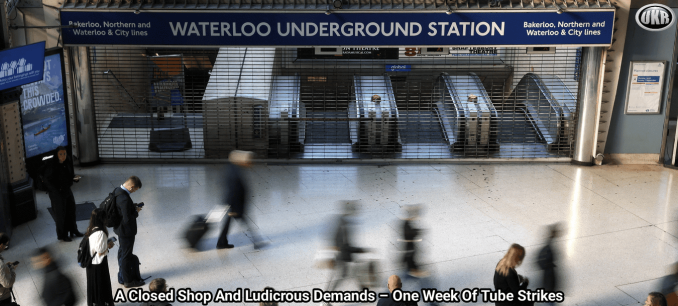
While some Tube staff stand on the picket line, workers in London are packing onto buses, boats, bikes and trains amid gridlocked traffic and cycle lane closures.
This is on top of the revelations in the Telegraph about what Tube drivers don’t want you to know about their pay:
They have a rare type of pension that is so generous they can retire on an income worth almost three quarters of their salary. This comes on top of salaries worth close to two times more than the national average.
TfL workers have defined benefit pensions, which guarantee an income in retirement until death.
These schemes are so expensive for employers to maintain that they have largely disappeared from the private sector, where most workers have inferior defined contribution pensions. These fluctuate in value and can risk running out of money.
A 21 year-old train operator, who works until the age of 65 on the current base salary of £58,000, would build a pension worth £42,500 per year even without any pay rises, according to calculations from AJ Bell. This would represent almost three quarters of their salary.
Tom Selby, from AJ Bell, said: “Defined benefit pension schemes are exceptionally valuable for those who receive them and have proved cripplingly expensive for employers to maintain, which is why they have pretty much died out in the private sector.”
Such revelations raise the interesting possibility that the unions might have gone too far.
It’s also emerged that the Transport for London (TfL) has been obliged since 2008 to advertise any train driver vacancies internally first. The result has been a self-perpetuating closed shop, according to the Telegraph:
In practice, the £71,000 annual salary paid to drivers means that almost all vacant posts have been filled from the Underground’s existing workforce for the past 17 years, other than a small number recruited for the less popular Night Tube, which started running in 2016.
That means that the ranks of 4,000 drivers are wholly unionised, in defiance of legislation that outlawed so-called closed shop requirements for employees to join a union in the 1990s.
Critics of the agreement say it perpetuates a union stranglehold over the Tube, handing the Rail and Maritime Union (RMT) and Aslef, which represent drivers, the ability to shut down the entire network while denying management the ability to recruit staff who might be less inclined to strike.
Elliot Keck, of the Taxpayers Alliance, the paper notes, observes that:
Right now it’s a closed shop, essentially. You have to work for TfL for a certain amount of time, work your way up through the ranks, and then you can become a Tube driver.
Mr Keck said that the salary paid to drivers is not the market rate and that, given the perks of the job, external candidates would be willing to work for significantly less, saving money for TfL and diluting the power of the unions.
He said: “You have average pay of £70,000, a four-day week at 35 hours, unlimited free travel on the transport network for life for you and your family, and 40 days of annual leave.
“I can guarantee that if you threw the job open at 80% of the current salary, you would be oversubscribed and have more than enough people applying to end the cycle of strikes.”
However, Keck added that unless “the profit motive” is brought to bear on TfL, which answers to Sir Sadiq Khan, the Mayor of London, and has received more than £5 billion in emergency funding from the Government, it has no incentive to address the driver recruitment issue.
The Guardian, unsurprisingly, quoted the Government and TfL’s opposition to the strikes but was keen to give space to those justifying the action:
An RMT spokesperson said: “We are not going on strike to disrupt small businesses or the public. This strike is going ahead because of the intransigent approach of TfL management and their refusal to even consider a small reduction in the working week in order to help reduce fatigue and the ill-health effects of long-term shift work on our members.
Support for the union came from the 4 Day Week Foundation. Joe Ryle, its Campaign Director, said: “It’s a bold and necessary stand, and these workers deserve widespread support. The five-day week is a century-old model that no longer reflects how we live and work today.”
The RMT’s regret belongs to a long-standing tradition of union humbug.
According to the Independent, the RMT claims Tube drivers are not able to afford to buy a house in London:
A £72,000 salary earned by some striking Tube workers is not enough to buy a house in London, a rail union boss has claimed.
Eddie Dempsey, General Secretary of the Rail, Maritime and Transport (RMT) union, was quizzed over the pay of London Underground workers amid a week-long strike, which has caused severe disruption in the capital.
When asked on Times Radio on Wednesday if he thought £72,000 meant a worker was not well paid, Mr Dempsey replied: “Well, you can’t afford to buy a house in London, even on £72,000.”
In another piece, the Guardian says the RMT is now looking to Sir Sadiq Khan to resolve the crisis, as usual accompanied by threats:
No talks have taken place to resolve the dispute, with the RMT now demanding a summit with the London mayor, Sadiq Khan, in its quest for a shorter working week.
The RMT General Secretary, Eddie Dempsey, speaking at TUC Congress, called on Khan to meet the union. He said: “Stop going on social media, invite us to the meeting, let’s have a discussion, because I want to know what is going on in London.”
He warned further strikes could follow. Speaking earlier to the BBC, he said: “We’ve got towards the end of a week of strike action, we’re open to negotiations, but there are no invitations to sit down with TfL. We’ll have to see what the next move is.”
That can only mean the union hopes Khan will stump up more readies.
This sounds suspiciously like a march ultimately to a Promised Land where union members don’t go to work at all and just get paid. That would entail automating the Tube trains so that those without such unions, like sole traders and small businesses, can get to work. But, as we shall see, automation is a long way off.
Of course, the fascinating thing about the phenomenon of aggressive and aggrieved unions is that they act exactly like the capitalist system they profess to detest. The commodity this time though is labour, with the overriding principle being to do as little as possible for as much as possible.
It’s clear there have been and always will be legitimate grievances about exploitation as employers seek to extract as much labour for as little financial outlay as possible. It was Karl Marx in Das Kapital who explained how capitalists seek to increase profits either by reducing the cost of production or increasing prices, or both.
Although smaller-size chocolate bars and cans of baked beans with fewer beans are facile examples, they illustrate the short-term stupidity of that business model because there is nowhere to go with that type of strategy except expecting customers eventually to pay for empty packaging.
When it comes to unions like RMT (who represent 40% of London’s tube drivers, the other 60% being Aslef members), it’s union leaders, keen to come up with justifications for their existence, huge salaries and members’ subscriptions, who seek reasons to come out on strike again. The result for the unions that are most successful at this form of extortion is increasingly ambitious and divisive demands which, if met, would undoubtedly be followed by further demands to reduce working hours more.
Anecdotal evidence from sources your correspondent cannot divulge suggests that Transport for London is obliged to manage excessive levels of sickness among train drivers on a daily basis, causing routine cancellations.
The Telegraph said the result of the current strikes has been to place pressure on London mayor, Sir Sadiq Khan, to reconsider driverless trains:
A major walkout this week on the London Underground is poised to cost the economy £270 million based on the loss of 700,000 working days, according to the Centre for Economics and Business Research – not including the impact on retail and tourist spending.
The backing for automated trains rekindles plans announced in 2012 by Boris Johnson, the former mayor, and dropped by Sir Sadiq last year under pressure from trade unions.
Richard Holden, the Shadow Transport Secretary, said Sir Sadiq had been “spineless” in the face of “Labour’s bully-boy union paymasters”.
He said: “The London Mayor took driverless trains off the table despite the network being designed decades ago for their rollout.
Richard Tice, Reform’s Deputy Leader, said driverless trains are now “on the agenda, without question” following what he called “this ludicrous action by the RMT”.
Mr Tice said the Mayor had “bottled it in the face of union demands” but that by striking for a four-day week with a maximum of 32 hours, Tube workers had eroded any sympathy people might have for their position by provoking “fury and rage” among the travelling public.
It seems, the Telegraph continued, that not only are driverless trains in service elsewhere, like Singapore and Barcelona, but it seems part of the London Tube network is part-prepared for them:
Nine Tube lines and parts of the Thameslink and the Elizabeth line across London are equipped for so-called grade two automation, with the signalling system effectively controlling trains and a driver required only to open and close doors.
In addition, the Docklands Light Railway already is automated.
Richard Tice, Reform’s Deputy Leader, said Reform would also seek to address wider problems around the ability of unions to halt transport networks with the RMT’s station staff still able to lock down stations even if all trains were driverless.
He said: “It’s all on the table. We’ve got a country that’s going bust, productivity is collapsing and the hard-Left socialists think the answer is to work less for more money. It’s the most economically illiterate thing you could think of.”
Apparently unaware of the rest of the world:
Aslef said driverless trains “are the stuff of science fiction” and would not work on Britain’s ageing infrastructure.
Returning to the Telegraph’s piece on the closed shop and Elliot Keck again:
Automation is the long-term solution, but it would cause chaos at the moment because the second you moved in that direction the unions would simply strike until you backed down.
As the week rolls to a close, with hundreds of millions of pounds lost by London businesses, leaving commuters, workers and tourists inconvenienced, it seems that those who govern us are left floundering by their total inability and lack of will to do anything serious about the problem. This time it was London’s turn to be propelled back to a world that ought to have disappeared long ago and there is little prospect of anything changing.
Until the next time then.
This article (A Closed Shop And Ludicrous Demands – One Week Of Tube Strikes) was created and published by The Daily Sceptic and is republished here under “Fair Use” with attribution to the author Sallust

••••
The Liberty Beacon Project is now expanding at a near exponential rate, and for this we are grateful and excited! But we must also be practical. For 7 years we have not asked for any donations, and have built this project with our own funds as we grew. We are now experiencing ever increasing growing pains due to the large number of websites and projects we represent. So we have just installed donation buttons on our websites and ask that you consider this when you visit them. Nothing is too small. We thank you for all your support and your considerations … (TLB)
••••
Comment Policy: As a privately owned web site, we reserve the right to remove comments that contain spam, advertising, vulgarity, threats of violence, racism, or personal/abusive attacks on other users. This also applies to trolling, the use of more than one alias, or just intentional mischief. Enforcement of this policy is at the discretion of this websites administrators. Repeat offenders may be blocked or permanently banned without prior warning.
••••
Disclaimer: TLB websites contain copyrighted material the use of which has not always been specifically authorized by the copyright owner. We are making such material available to our readers under the provisions of “fair use” in an effort to advance a better understanding of political, health, economic and social issues. The material on this site is distributed without profit to those who have expressed a prior interest in receiving it for research and educational purposes. If you wish to use copyrighted material for purposes other than “fair use” you must request permission from the copyright owner.
••••
Disclaimer: The information and opinions shared are for informational purposes only including, but not limited to, text, graphics, images and other material are not intended as medical advice or instruction. Nothing mentioned is intended to be a substitute for professional medical advice, diagnosis or treatment.
Disclaimer: The views and opinions expressed in this article are those of the author and do not necessarily reflect the official policy or position of The Liberty Beacon Project.


Leave a Reply