

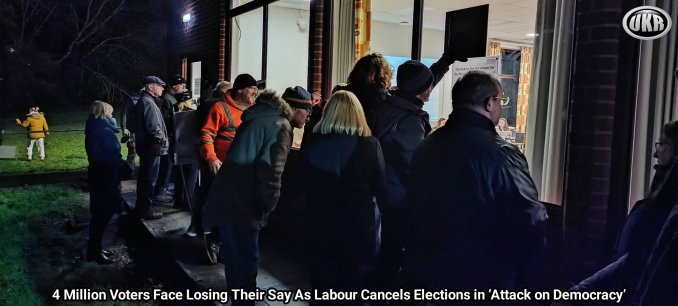
Four million voters face losing their say as Labour accused of cancelling elections in ‘attack on democracy’
CP
Around four million people are set to be denied a vote in this May’s local elections after the Labour Government moved to cancel dozens of council polls, triggering accusations of a “disgraceful attack on democracy”.
At least 27 council elections are expected to be postponed, allowing hundreds of councillors to remain in office without facing voters. Some will now serve for as long as seven years without re-election.
The Conservatives and Reform UK have accused Sir Keir Starmer of “running scared” of the electorate, as opinion polls point to a sharp fall in Labour support. Reform UK confirmed it will on Thursday launch a judicial review in a bid to force the elections to go ahead.
The decision has sparked a furious backlash from opposition parties, constitutional experts and voters, with the Conservatives and Reform UK accusing Sir Keir Starmer of “running scared” as Labour’s poll ratings slump. Reform UK has confirmed it will launch a judicial review in an attempt to force the elections to go ahead.
Ministers are relying on section 87 of the Local Government Act 2000, an obscure power that allows the Communities Secretary to change the year in which elections are held. Critics say the clause was designed for extreme emergencies and not for routine political convenience.
The Government says councils need the option to delay polls because of wide ranging local government reorganisation, including the abolition of some district councils and the creation of mayoralties. However, the Electoral Commission has questioned whether such changes amount to “exceptional circumstances” and warned that there is a clear conflict of interest in allowing sitting politicians to decide when voters can remove them.
So far, more than 20 councils have confirmed they will delay elections, around three quarters of them Labour run. A further seven Labour councils are expected to follow before the deadline, bringing the total number of affected authorities to at least 27 and leaving around 3.7 million people without a vote in May.

.
James Cleverly, the shadow local government secretary, said: “It cannot be right that some elected representatives will now be serving seven year terms. Residents have a right to choose who represents them, and the Government must respect that right.
“Labour are denying democracy and running scared of voters’ verdict on their appalling leadership. Having promised elections would go ahead, they have U turned again. Democracy must prevail and voters must be able to make their voices heard.”
Nigel Farage said his party would pursue legal action, accusing Communities Secretary Steve Reed of an “abuse of power”. He said: “We will use every means possible, starting with our judicial review.”
Sir Ed Davey, the Liberal Democrat leader, called for the law to be changed so ministers cannot “delay elections at the stroke of a pen” and said MPs should be given a vote on any future postponements.
The controversy has already spilled onto the streets. In Redditch, a council in Worcestershire that was due to hold elections this May, residents gathered outside a community centre to protest after the Labour run council voted to postpone the poll until 2027.
Around 50 people chanted “let us vote” while holding placards against the windows as councillors met inside. Tensions rose when Labour councillor Ian Woodall responded to heckling by calling a member of the public a “Nazi”. Police were called but no offences were identified.
Mr Woodall later apologised, saying: “My reaction was an error of judgment and fell short of the standards expected of me as a councillor. I am sorry to the individual concerned and to everyone present.”
The council ultimately voted six to four to delay the elections, arguing that holding a vote for a council expected to be abolished would waste money.
Emma Marshall, a former Conservative councillor who was planning to stand, said the issue went beyond party politics. “I am campaigning for the people to have the right to not vote for me, but people should have the chance to have their say. These councillors are hiding,” she said.
“When you start using finances as an excuse it becomes an everyday occurrence. How do we ensure we don’t suddenly find cancelled elections all over the place including the general election? It’s a slippery slope.”

.
Other protesters said they were being denied the chance to hold councillors to account over housing, planning, council tax and the state of local high streets. One said: “This will be the first election I won’t be voting in, because I can’t.”
Labour’s Sharon Harvey, the leader of Redditch council, defended the decision, saying the election would cost £192,000 and that postponement would allow the authority to focus on reorganisation. “The final decision will be made by the Government,” she said.
A local resident said: “They keep blaming finances, but that’s exactly why we should be having elections. This Labour lot can’t handle money. They’ve already put council tax up and services have started slipping since they took control, and now they’re using cost as an excuse to cancel the vote. It’s obvious we need a change on the council, and that’s why local elections matter more than ever.
“And that Labour council leader doesn’t know what she’s talking about… or she’s just trying to use the cost as an excuse. I know full well that Redditch Borough Council was due to take part in an elections trial where the costs would have been covered by the Government. The council has already spent a significant amount preparing for that trial, and if the elections are cancelled there’s a real risk that money won’t be reimbursed.”
Nationally, concerns around the cancellations have been echoed by election watchdogs and academics. Vijay Rangarajan, chief executive of the Electoral Commission, said last month: “Scheduled elections should as a rule go ahead as planned and only be postponed in exceptional circumstances.”
Speaking in the Telegraph, Sir Vernon Bogdanor, professor of government at King’s College London, warned that giving councils and ministers the power to cancel elections was fundamentally flawed, while Professor Colin Copus said removing voters’ rights because elections are inconvenient is “simply incompatible with any notion of democracy”.
A Liberal Democrat peer has tabled an amendment to new legislation that would require full parliamentary approval before any future election delays.
Before the 2000 Act, elections could only be postponed through primary legislation, even during wartime. Critics warn that repeated delays risk normalising the suspension of local democracy.
As protests grow and legal challenges loom, ministers now face mounting pressure to explain why millions of voters should lose their say at the ballot box.


Following Operation Talla, the Starmer government is already no longer legitimate anyway.